2026 Mazda CX-30
Small on space, big on style, and still one of the most entertaining subcompact crossovers.
As a subcompact crossover, the 2026 Mazda CX-30 continues to distinguish itself by emphasizing upscale design, engaging driving dynamics, and interior refinement rather than maximizing passenger and cargo space. Introduced to the United States for the 2020 model year, the CX-30 shares its underlying architecture with the Mazda3 and occupies the space below the CX-5 in Mazda's crossover lineup. Now in its seventh model year, this first-generation CX-30 receives several meaningful updates for 2026, including revised suspension dampers designed to improve ride comfort, a new brake-based limited-slip differential function for improved traction, expanded technology availability, and two new Aire Edition models featuring distinctive exterior and interior styling. The CX-30 is offered exclusively as a four-door, five-passenger crossover with two rows of seating and standard all-wheel drive. Its primary competitors include the Chevrolet Trailblazer, Honda HR-V, Hyundai Kona, Kia Seltos, Nissan Kicks, Subaru Crosstrek, Toyota Corolla Cross, and Volkswagen Taos.
The 2026 CX-30 lineup consists of eight trim levels: 2.5 S, 2.5 S Select Sport, 2.5 S Preferred, 2.5 S Aire Edition, 2.5 S Carbon Edition, 2.5 S Premium, 2.5 Turbo Aire Edition, and 2.5 Turbo Premium Plus. Two versions of Mazda's 2.5-liter Skyactiv-G four-cylinder gasoline engine are available. The standard naturally aspirated engine develops 186 horsepower and 186 pound-feet of torque, while the optional turbocharged engine produces 227 horsepower and 310 pound-feet on regular 87-octane gasoline or 250 horsepower and 320 pound-feet on premium 93-octane fuel. Both engines pair with a conventional six-speed automatic transmission featuring manual-shift and Sport modes. Mazda's predictive i-Activ all-wheel-drive system is standard across the lineup.
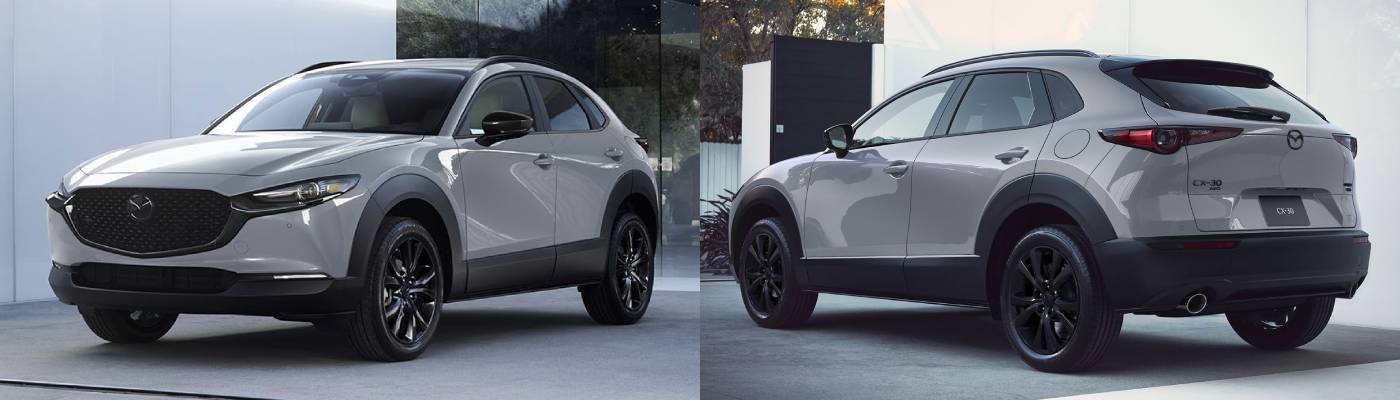
Pricing for the 2026 Mazda CX-30 begins at $26,375 for the base 2.5 S, followed by $28,060 for the Select Sport, $29,690 for the Preferred, $30,250 for the Aire Edition, $31,430 for the Carbon Edition, and $33,640 for the Premium. Turbocharged models start at $34,410 for the Aire Edition and rise to $37,900 for the Premium Plus. These prices exclude Mazda's $1,595 destination charge, taxes, and additional fees. Standard equipment includes an 8.8-inch infotainment display, smartphone integration, an eight-speaker audio system, LED headlights, adaptive cruise control, automatic emergency braking, blind-spot monitoring, and lane-departure warning with lane-keeping assistance. Higher trims add wireless Apple CarPlay and Android Auto, a 10.25-inch display, a power moonroof, leather seating, a Bose 12-speaker audio system, a heated steering wheel, a 360-degree camera, and additional driver-assistance technology. The new Aire Editions introduce white leatherette upholstery, contrasting gray interior materials, black exterior trim, and distinctive black wheels, while the Carbon Edition features Polymetal Gray paint and red leather upholstery.
ACCERATION & PERFORMANCE
The Mazda CX-30 has always been one of the more entertaining vehicles in the subcompact crossover class, and much of its appeal comes from its relatively substantial four-cylinder engines. While competitors increasingly rely on small-displacement turbocharged engines or continuously variable transmissions, Mazda continues to offer a pair of 2.5-liter engines matched to a traditional six-speed automatic.
The standard naturally aspirated 2.5-liter four-cylinder produces 186 horsepower at 6,000 rpm and 186 pound-feet of torque at 4,000 rpm. Those figures are competitive for the segment, providing more horsepower than the standard engines in the Honda HR-V, Hyundai Kona, Nissan Kicks, and Toyota Corolla Cross. The base engine responds smoothly to accelerator inputs and develops power progressively as engine speed increases. Around town, the engine feels willing without being particularly forceful, and it has sufficient low- and midrange output to make merging into traffic relatively effortless. However, the engine needs to rev considerably higher when maximum acceleration is required, which brings a noticeable increase in engine noise.
The optional turbocharged 2.5-liter engine dramatically changes the CX-30's personality. Producing up to 250 horsepower and 320 pound-feet of torque, it transforms the small crossover into something approaching an entry-level performance SUV. More important than the horsepower figure is the substantial torque available at relatively low engine speeds. Rather than requiring the driver to chase higher rpm, the turbo delivers a strong surge of acceleration with relatively modest accelerator input. The result is especially satisfying during highway merging and passing maneuvers, where the engine can provide meaningful acceleration without repeatedly shifting into lower gears.
Both engines use Mazda's six-speed automatic transmission, which generally prioritizes smoothness and predictable operation over rapid-fire shifting. Compared with the continuously variable transmissions and dual-clutch automatics found in some competitors, the Mazda automatic provides more natural acceleration and avoids the prolonged engine drone that can accompany CVTs and the abrupt gearchanges of a DCT. Gear changes are deliberate and generally unobtrusive, and the transmission makes good use of the engines' available torque.
Overall, the naturally aspirated engine is perfectly suitable for everyday commuting, but the turbocharged CX-30 delivers a substantially more satisfying performance experience.
FUEL ECONOMY
Fuel economy is one of the Mazda CX-30's less impressive characteristics, although the tradeoff is somewhat understandable given its standard all-wheel drive, relatively large four-cylinder engines, and conventional automatic transmission. Mazda's focus on smooth power delivery and driving enjoyment does not produce the highest efficiency figures in the segment. Buyers prioritizing maximum fuel economy will find more economical alternatives, particularly among front-wheel-drive competitors and hybrid crossovers.
For 2026, the naturally aspirated 2.5-liter engine carries EPA estimates of 24 mpg city, 31 mpg highway, and 27 mpg combined. The turbocharged 2.5-liter is rated at 22 mpg city, 30 mpg highway, and 25 mpg combined. Both engines use a 12.7-gallon fuel tank, and both can operate on regular 87-octane gasoline, although Mazda recommends 93-octane premium fuel to obtain the turbo engine's maximum performance.
Real-world fuel economy generally follows the EPA estimates, although individual results depend heavily on driving style, temperature, traffic, and terrain. Owners of naturally aspirated models can reasonably expect fuel economy in the mid-to-upper 20-mpg range during mixed driving, with approximately 33-35 mpg possible during steady highway travel. The turbo's numbers are generally 2-5 mpg less across the board.
One shortcoming is the slightly undersized 12.7-gallon fuel tank. When combines with slightly below average fuel economy, you end up with a usable highway range of just 330 miles. That's generally OK for a week's worth of commuting, but it does mean you will be spending a bit more time at the gas station.
ALL-WHEEL DRIVE & DRIVE MODES
Every 2026 Mazda CX-30 includes Mazda's i-Activ all-wheel-drive system, which continuously monitors driving conditions and adjusts torque distribution between the front and rear wheels to improve traction and stability. Unlike a traditional truck-based four-wheel-drive system, i-Activ AWD operates automatically and is primarily intended to improve confidence on wet, snowy, or slippery pavement. Mazda also equips the CX-30 with G-Vectoring Control Plus, which makes subtle engine-torque and braking adjustments to help stabilize the vehicle during steering transitions. For 2026, Mazda adds a brake-based limited-slip differential function that uses selective braking to manage wheelspin rather than a mechanical locking differential. The six-speed automatic includes a selectable Sport mode, and every CX-30 also features Off-Road Traction Assist, which can help free a wheel that has lost traction in mud, sand, or snow. With 8.0 inches of ground clearance, the CX-30 is reasonably capable on gravel roads, shallow snow, and maintained trails. However, there is no dedicated off-road trim with additional ground clearance, skid plates, low-range gearing, locking differentials, or specialized all-terrain tires.
RIDE QUALITY
The Mazda CX-30's ride quality reflects the company's longstanding preference for balancing comfort with driver engagement. Rather than isolating occupants completely from the pavement, the suspension maintains a degree of firmness that allows the driver to sense what the vehicle is doing. The result is a crossover that feels controlled and substantial on smooth roads, although it can become less comfortable over deteriorated pavement.
The CX-30 uses MacPherson struts in front and a torsion-beam rear suspension rather than the more sophisticated independent rear suspension found in some competitors. But you wouldn't know it. The arrangement is relatively simple and Mazda's careful chassis tuning has historically produced a comfortable and composed ride under most conditions. Small road imperfections are generally handled without excessive body movement, while larger bumps can produce more noticeable impacts, particularly when the rear wheels encounter uneven pavement.
The torsion-beam suspension becomes more apparent on roads with successive bumps or uneven surfaces. Because the rear wheels are not independently suspended, sharp impacts affecting one side of the vehicle can introduce additional movement across the rear of the cabin. This is most noticeable when traveling over expansion joints, broken pavement, or poorly maintained urban streets. For 2026, Mazda has revised the suspension dampers specifically to improve ride comfort. This is a welcome development because it addresses one of the vehicle's longstanding compromises without requiring a complete suspension redesign.
Wheel and tire choices also affect the driving experience. The base 2.5 S rides on 16-inch alloy wheels with relatively tall tire sidewalls, providing additional cushioning over rough pavement. Higher trims use larger 18-inch wheels with lower-profile tires, which generally provide sharper responses but have less sidewall available to absorb abrupt impacts. As a result, the base model may offer a slightly more forgiving ride, while the larger-wheel models can communicate more road texture to the cabin.
HANDLING & ROADHOLDING
Handling remains one of the strongest reasons to consider the Mazda CX-30. Where many subcompact crossovers emphasize ease of operation and transportation efficiency, the Mazda demonstrates a noticeable effort to make ordinary driving more involving. Its steering, body control, and chassis responses create a sense of connection that is increasingly uncommon in this segment.
The electrically assisted steering is well weighted, precise, and relatively natural in its response. Although it does not provide the detailed road feedback of an older hydraulic steering system, it avoids the excessively light, disconnected sensation found in some competitors. The steering responds predictably to small inputs, making the vehicle easy to place accurately through corners. On winding roads, the CX-30 feels more like a slightly elevated Mazda3 hatchback than a conventional small SUV.
Body lean is present but carefully controlled. The suspension allows enough movement to avoid feeling excessively stiff, yet the vehicle settles into corners without the pronounced pitching and rolling that can characterize taller crossovers. Mazda's G-Vectoring Control Plus contributes to this composed behavior by subtly adjusting engine torque and braking during steering inputs. The intervention is generally imperceptible to the driver, but it helps produce smooth, natural transitions between acceleration, braking, and cornering.
The standard all-wheel-drive system also contributes to the CX-30's secure handling characteristics. While it cannot overcome the limits of tire grip, it can distribute power to improve traction when accelerating out of corners or driving on slippery surfaces. This is particularly valuable with the turbocharged engine, whose substantial torque might otherwise overwhelm the front tires under aggressive acceleration.
Braking performance is similarly competent. The four-wheel-disc braking system delivers controlled stopping power, and the pedal generally provides a reassuring sense of progression rather than an overly sensitive initial response.
INTERIOR NOISE LEVELS
Interior noise suppression is another area where the CX-30 demonstrates Mazda's effort to create a more upscale driving experience. At normal cruising speeds, the cabin feels substantial and well insulated for a vehicle in this price range. Wind noise is generally restrained, and the doors, dashboard, and interior trim contribute to an impression of solidity that is not always present in entry-level crossovers.
Highway driving is particularly pleasant because the CX-30's cabin does not feel as acoustically exposed as its relatively affordable price might suggest. Road noise remains noticeable, especially over coarse pavement, but the overall sound character is reasonably subdued. The absence of excessive wind whistle and rattles contributes to the vehicle's more refined personality.
INTERIOR DESIGN & MATERIALS
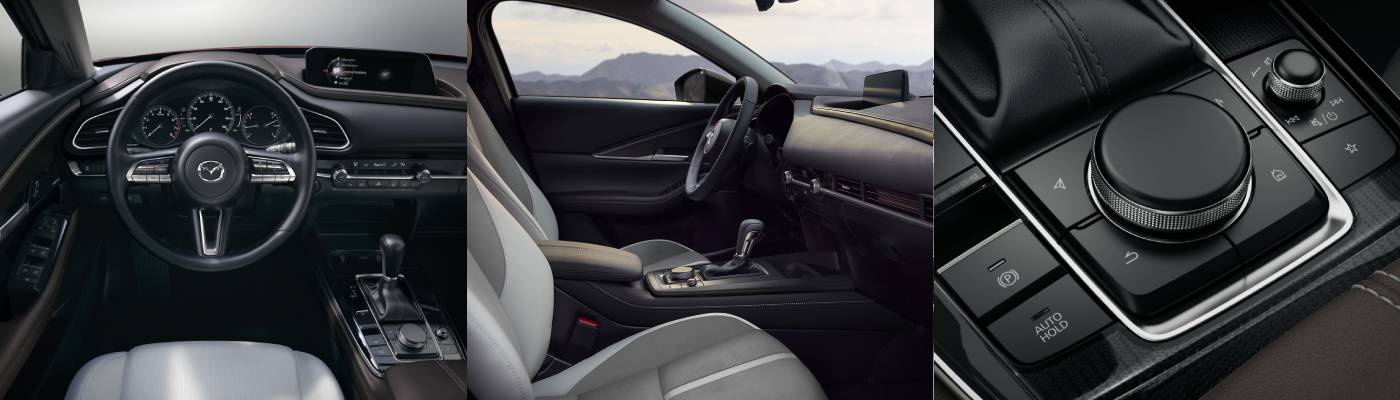
The interior is arguably the CX-30's most distinctive feature. While many competitors use dramatic digital displays, colorful accents, and busy dashboard designs to create visual interest, Mazda takes a more restrained approach. The cabin emphasizes flowing surfaces, carefully coordinated materials, and a relatively simple arrangement of controls. The result is a space that feels more expensive than the vehicle's price would suggest.
The dashboard features a broad, horizontally oriented design with soft-touch materials and carefully integrated trim. Rather than placing every function within an oversized touchscreen, Mazda separates the infotainment display from the primary driving controls. The instrument panel, center console, and door panels appear thoughtfully coordinated, creating a cabin that feels cohesive instead of assembled from unrelated design elements.
Material quality is particularly impressive in the upper trims. Soft padding extends across prominent areas of the dashboard and doors, while leatherette and genuine leather upholstery elevate the cabin's appearance. The switchgear feels substantial, and the use of conventional buttons and rotary controls reinforces the impression that Mazda has prioritized tactile quality.
For 2026, the Aire Editions offer a different interpretation of Mazda's premium design philosophy. Instead of emphasizing dark colors and sporty accents, these models use white leatherette upholstery and contrasting gray inserts to create a lighter, more contemporary atmosphere. The turbocharged Aire Edition incorporates gray suede-like inserts, while black exterior trim and wheels provide a deliberate contrast. The lighter interior colors help make the compact cabin feel more open, although they may require additional cleaning attention compared with darker upholstery.
Despite its impressive appearance, the CX-30's interior has some limitations. The dashboard and center console wrap closely around the front occupants, producing a cockpit-like sensation that some drivers will enjoy but others may find confining. The dark headliner and relatively small windows can also make certain versions feel less spacious than their exterior dimensions suggest.
INTERIOR FUNCTIONALITY & CONTROLS
Mazda's approach to interior functionality is centered on minimizing distraction rather than maximizing touchscreen interaction. The most obvious example is the infotainment system, which relies primarily on a rotary controller located on the center console. Mazda believes the arrangement allows drivers to operate many functions without extending an arm toward the dashboard, and there is merit to that argument.
Once familiar with the interface, the rotary controller provides a precise way to navigate menus, change audio sources, and access vehicle settings. The accompanying shortcut buttons make it relatively easy to return to common functions. However, the learning curve can be frustrating for drivers accustomed to modern touchscreen systems, particularly when navigating smartphone applications designed around direct touch interaction.
The standard 8.8-inch display is positioned high on the dashboard, where it is relatively easy to view without taking attention far from the road. Its graphics are clear, but the interface lacks some of the visual sophistication and flexibility offered by newer systems from Hyundai and Kia. The larger 10.25-inch display, now available beginning with the Preferred trim, improves visibility and introduces touchscreen functionality for Apple CarPlay and Android Auto. However, the system is not a conventional full-time touchscreen, and the display's recessed position can make it difficult to reach.
Thankfully, the CX-30 retains separate physical climate controls. Temperature adjustments, fan settings, and other commonly used functions are controlled through conventional buttons and knobs rather than buried within digital menus. This arrangement is especially convenient during winter driving, when touchscreen operation can become awkward while wearing gloves.
The steering wheel controls are similarly straightforward, allowing drivers to adjust audio settings, manage cruise control, and access vehicle information without navigating complicated menus. The conventional transmission selector is easy to operate, and the overall arrangement of the center console feels familiar.
Visibility is somewhat less impressive. The CX-30's sloping roofline, thick rear pillars, and relatively small rear windows create larger blind spots than those found in some competitors. The standard blind-spot monitoring system helps compensate, while upper trims offer additional camera technology that makes parking and maneuvering considerably easier. Frontward visibility is generally better, although the cabin's relatively high beltline and the sculpted hood can take some adjustment.
TECHNOLOGY & SAFETY FEATURES
The 2026 CX-30 offers a substantial collection of technology features, although availability depends on trim level. The standard model includes an 8.8-inch infotainment display, an eight-speaker audio system, Apple CarPlay and Android Auto integration, Bluetooth connectivity, two USB-C ports, and a partially digital instrument cluster with a 7-inch LCD information display.
Select Sport models introduce several useful conveniences, including wireless Apple CarPlay and Android Auto, Alexa Built-in functionality, an eight-way power driver's seat with memory settings, and heated front seats. Moving to the Preferred adds the larger 10.25-inch infotainment display, wireless phone charging, front and rear parking sensors, and a power moonroof.
The Carbon Edition's Bose 12-speaker audio system is a particularly worthwhile upgrade for buyers who enjoy music. Compared with the standard eight-speaker system, the premium audio installation offers greater output and a more substantial listening experience. The Premium adds a windshield-projected Active Driving Display, a 360-degree camera system, an adaptive front-lighting system, and a power liftgate. These features help narrow the gap between the Mazda and entry-level luxury crossovers. 
Mazda also offers connected services through the MyMazda smartphone application. Owners can access certain remote vehicle functions and vehicle-status information, depending on service availability and enrollment. The 2026 CX-30 includes a one-year complimentary Mazda Connected Services period, along with a limited Wi-Fi hotspot trial. Continued use of some functions requires a paid subscription after the trial expires.
Safety equipment is another strong point. Every CX-30 includes Mazda's i-Activsense suite of driver-assistance features. Standard equipment includes forward collision warning with automatic emergency braking, adaptive cruise control with stop-and-go capability, lane-departure warning, lane-keeping assistance, blind-spot monitoring, rear cross-traffic alert, automatic high-beam control, and driver attention monitoring.
The standard adaptive cruise control system is particularly useful on highways and during congested commuting. It can automatically adjust vehicle speed to maintain a selected following distance and bring the vehicle to a stop when necessary. Edmunds found the adaptive cruise control's acceleration and braking behavior natural during testing, with relatively few inappropriate interventions from the driver-assistance systems.
More advanced features become available on higher trims. The Preferred adds rear automatic emergency braking and rear cross-traffic braking, while the Premium introduces a 360-degree camera system that is especially helpful given the vehicle's restricted rearward visibility. The Turbo Premium Plus offers Cruising and Traffic Support, which combines adaptive cruise control with steering assistance under appropriate conditions. The feature helps reduce driver workload in traffic but is not a hands-free or autonomous driving system, and the driver must remain attentive.
PASSENGER SEATING
The Mazda CX-30 is designed for five passengers, with two front bucket seats and a three-person rear bench. There is no third-row seating option, and the seating configuration remains consistent across all trims. Although the vehicle technically accommodates five occupants, its dimensions and interior design make it better suited to four people, particularly when traveling longer distances.
Front-seat comfort is a notable strength. Mazda has developed supportive seats that maintain a relatively natural driving posture, and the cabin provides sufficient adjustment for a wide range of drivers. Front legroom measures 41.7 inches, while headroom is 38.1 inches in models without a moonroof and approximately 37.8 inches in moonroof-equipped configurations. The seats provide good upper-body support, and the cushions are sufficiently substantial for extended highway travel.
The driving position is relatively low and carlike compared with many crossovers, although the CX-30 still provides a higher seating position than a conventional compact sedan. The steering wheel offers generous adjustment, and the pedals are positioned naturally. The dashboard and center console create a driver-focused environment, with most controls within convenient reach.
Rear-seat accommodations are decidedly less generous. Although Mazda lists 36.3 inches of rear legroom and 38.3 inches of rear headroom, the actual seating environment feels tighter than those measurements might suggest. The front seatbacks, relatively low roofline, and narrow side windows contribute to a somewhat confined atmosphere. Two average-size adults can travel in the rear seat for shorter trips, but taller passengers may find knee and foot room restrictive, especially when seated behind taller front occupants. The seat cushion is reasonably supportive, and the backrest provides a comfortable angle, but longer journeys can expose the limitations of the available legroom.
Entry and exit present another compromise. Although the CX-30 sits higher than a conventional hatchback, its roofline is relatively low for a crossover. Taller occupants may need to duck when entering the front seats, and rear passengers must pay additional attention to the shape of the door openings. This is particularly noticeable when compared with more upright competitors such as the Honda HR-V, Hyundai Kona, and Kia Seltos.
For buyers who regularly carry adult passengers, the CX-30's limited rear-seat space is one of its most significant shortcomings. Those who primarily travel alone or with one front passenger, however, are unlikely to find the compact rear accommodations especially troublesome.
CARGO CAPACITY & INTERIOR STORAGE
Cargo capacity is another area where the Mazda CX-30 prioritizes appearance and driving dynamics over maximum utility. Its sloping roofline and relatively short rear overhang give it attractive proportions, but they also restrict the size and shape of the available cargo area.
Behind the second row, the CX-30 provides 20.2 cubic feet of cargo space. Folding the rear seatbacks increases maximum cargo capacity to 45.2 cubic feet. These figures apply across the lineup, including turbocharged models. The rear bench uses a 60/40 split-folding design, allowing passengers to carry longer items while retaining at least one rear seating position.
With the rear seats upright, the cargo area is adequate for several grocery bags, a pair of medium-size suitcases, or everyday personal belongings. The hatch opening is reasonably wide, making it relatively easy to load smaller luggage and shopping bags. However, the cargo floor is not particularly long, and the vehicle's tapered rear body limits the amount of bulky equipment that can fit inside.
Interior storage is functional but not especially generous. The center console includes a covered storage compartment that can accommodate smaller personal items, while a tray ahead of the transmission selector provides space for a phone or other frequently used belongings. Additional storage is available in the glove compartment and door pockets.
BOTTOM LINE
The 2026 Mazda CX-30 remains one of the most distinctive choices in the crowded subcompact crossover segment. Its strengths are immediately apparent in the areas Mazda has traditionally emphasized: attractive design, premium interior materials, responsive steering, balanced handling, and an engaging driving experience. The standard 2.5-liter engine delivers competitive performance, while the available turbocharged engine makes the CX-30 unusually quick for its class. Standard all-wheel drive adds meaningful value, particularly for buyers who regularly encounter wet or snowy roads, and the extensive collection of standard driver-assistance features contributes to an impressive overall package. Mazda's 2026 updates address several smaller shortcomings, including revised suspension damping, improved traction management, additional technology availability, and the stylish new Aire Editions. Nevertheless, the CX-30 is not without significant compromises. Its rear seats are cramped, cargo capacity trails several major competitors, and fuel economy is merely average. As a result, the CX-30 is most appealing to drivers who prioritize the experience behind the wheel over maximum interior space.
For most buyers, the 2.5 S Preferred represents the most attractive combination of equipment and value. It adds the larger 10.25-inch display, wireless phone charging, moonroof, parking sensors, and additional safety technology while retaining the economical pricing of the naturally aspirated lineup. Buyers interested in minimizing cost should also seriously consider the $28,060 Select Sport, which gains heated front seats, power driver's seat adjustment, wireless smartphone connectivity, and several additional comfort features for relatively little extra money. Drivers willing to spend considerably more for performance should consider the $34,410 Turbo Aire Edition, which combines the desirable turbocharged engine with distinctive styling and a well-equipped interior. Regardless of trim, the CX-30 delivers something increasingly uncommon among affordable crossovers: a sense that its engineers wanted the driving experience to be rewarding, not merely convenient.