2026 Genesis GV60
A luxury EV that trades conventional thinking for personality.
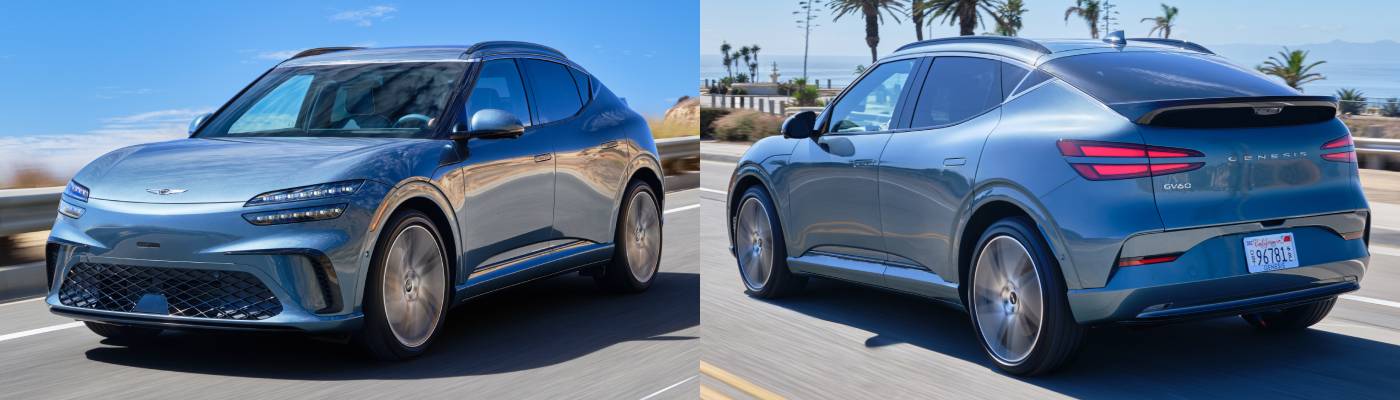
The 2026 Genesis GV60 is a compact luxury crossover. Introduced to the United States for the 2023 model year, the GV60 was Genesis' first vehicle developed exclusively as an electric model rather than adapted from an existing gasoline-powered platform. It shares its E-GMP architecture with the Hyundai Ioniq 5 and Kia EV6, but distinguishes itself with a more upscale interior, unique styling, and additional luxury features. For 2026, the GV60 receives its first significant refresh, bringing revised front and rear styling, new Micro Lens Array LED headlights, updated wheel designs, a redesigned dashboard with a 27-inch OLED display, and an enlarged 84-kWh battery that improves driving range across the lineup. Genesis has also switched to the North American Charging Standard (NACS) port which provides access to compatible Tesla Superchargers. The GV60 is offered exclusively as a five-passenger, four-door wagon with a rear liftgate and a distinctive fastback-inspired roofline. Key competitors include the Audi Q4 e-tron, Cadillac Optiq, Lexus RZ, Tesla Model Y, and Volvo EX40.
The 2026 GV60 is available in four configurations: RWD, AWD, Advanced AWD, and Performance AWD. The entry-level rear-wheel-drive model uses a single rear-mounted electric motor producing 225 horsepower and 258 pound-feet of torque. The AWD and Advanced AWD versions add a front motor, increasing combined output to 314 horsepower and 446 pound-feet of torque. The Performance AWD model employs two higher-output electric motors producing a combined 429 horsepower and 516 pound-feet of torque, while a steering-wheel-mounted Boost button temporarily increases horsepower to 483 for up to 10 seconds. Every GV60 uses a single-speed reduction-gear transmission and all models share the same 84-kWh lithium-ion battery, replacing the previous 77.4-kWh pack. EPA-estimated driving range is 306 miles for the RWD, 282 miles for the AWD, 267 miles for the Advanced AWD, and 252 miles for the Performance AWD. Genesis rates the GV60 to tow up to 2,000 pounds when equipped with a trailer that has its own brakes. Its high-voltage electrical architecture also supports exceptionally rapid DC charging, with a manufacturer-claimed 10-to-80-percent charging time of approximately 18 minutes under ideal conditions.
Pricing for the 2026 GV60 begins at $52,525 for the RWD, followed by $56,025 for the AWD, $59,405 for the Advanced AWD, and $71,875 for the Performance AWD, excluding the $1,495 destination charge. Even the base model comes generously equipped with heated power-adjustable front seats, a panoramic glass roof with power sunshade, dual-zone automatic climate control, wireless smartphone integration, navigation, a wireless charging pad, a power liftgate, and numerous driver-assistance features. The Advanced adds leather upholstery, ventilated front seats, a heated steering wheel, additional parking assistance, a surround-view camera system, and expanded interior amenities. The Performance takes the GV60 further upscale with Nappa leather, a 17-speaker Bang & Olufsen sound system, electronically controlled suspension, an electronic limited-slip differential, a head-up display, and more sophisticated driver-assistance equipment. Standard safety technology includes automatic emergency braking, blind-spot collision avoidance, lane-keeping assistance, adaptive cruise control, and rear cross-traffic collision avoidance. Particularly distinctive features include the illuminated Crystal Sphere gear selector, biometric fingerprint authentication, available vehicle-to-load power capability, and the Performance model's temporary horsepower Boost function.
ACCELERATION & PERFORMANCE
Electric vehicles have made instant acceleration almost commonplace, but the Genesis GV60 demonstrates that impressive performance does not necessarily require enormous horsepower. Its three available motor configurations deliver distinctly different driving experiences, ranging from the relaxed efficiency of the rear-wheel-drive model to the enthusiastic acceleration of the Performance AWD. Regardless of output, each uses a single-speed reduction gear rather than a conventional automatic transmission, resulting in exceptionally smooth power delivery without the interruptions associated with gear changes. Electric motors also deliver substantial torque almost immediately, giving the GV60 strong throttle response during everyday driving and eliminating the hesitation sometimes experienced with turbocharged gasoline engines.
The entry-level RWD model produces 225 horsepower and 258 pound-feet of torque from a single motor driving the rear wheels. Although these figures are relatively modest by contemporary EV standards, the RWD has sufficient power for confidently merging onto highways, passing slower vehicles, and navigating urban traffic. Expect a 0-to-60-mph time of approximately 6.5 seconds, making it reasonably quick rather than genuinely sporty. Acceleration is strongest at lower speeds, where the electric motor's immediate torque provides an especially responsive feel. Highway passing requires more accelerator input than in the dual-motor versions, but power delivery remains linear and predictable. The relative simplicity of the rear-drive configuration also contributes to reduced weight and better efficiency, making this model particularly appealing to drivers who prioritize comfort and driving range over outright performance.
The two 314-horsepower AWD models represent a substantial improvement in performance. Their combined 446 pound-feet of torque is delivered through independently controlled front and rear motors, providing substantially stronger initial acceleration and more immediate passing power. The 0-to-60-mph time drops to 5.1 seconds for the Advanced AWD, an impressive result for a small luxury crossover. At highway speeds, the additional power makes overtaking considerably easier, and the GV60 responds promptly when the driver requests a burst of acceleration. The dual-motor system also provides superior traction when accelerating from a stop, particularly on wet pavement.
The Performance AWD transforms the GV60 into a genuinely quick electric crossover. Its two high-output motors generate a combined 429 horsepower and 516 pound-feet of torque in normal operation. Pressing the Boost button on the steering wheel temporarily increases output to 483 horsepower for up to 10 seconds. The result is an immediate surge of acceleration that makes highway merging almost effortless and creates the sort of rapid forward thrust that remains one of the most entertaining characteristics of high-performance EVs. With a 0-to-60-mph time of around 3.6 seconds, the Performance AWD can be considered genuinely quick.
EFFICIENCY, CHARGING & RANGE
Because the GV60 is exclusively electric, conventional fuel economy measurements require some explanation. There is no gasoline tank, and none of the models consumes gasoline. Instead, all four versions use an 84-kWh lithium-ion battery, with efficiency expressed in miles per gallon equivalent, or MPGe. The EPA uses 33.7 kWh of electricity as the energy equivalent of one gallon of gasoline, allowing electric and gasoline vehicles to be compared on a common scale. Another useful measurement is kilowatt-hours consumed per 100 miles, where a lower number indicates better efficiency.
The most efficient GV60 is the rear-wheel-drive model, which earns EPA ratings of 119 MPGe city, 101 MPGe highway, and 110 MPGe combined. It consumes approximately 31 kWh per 100 miles and delivers an EPA-estimated combined driving range of 306 miles. The EPA also lists an estimated highway-only range of 278 miles. Its combination of single-motor propulsion, 19-inch wheels, and relatively modest output helps maximize the distance available from the battery. For drivers who regularly travel longer distances and do not require all-wheel drive, the RWD is the most practical choice in the lineup.
The standard AWD is rated at 107 MPGe city, 93 highway, and 100 combined, with electricity consumption of approximately 34 kWh per 100 miles. Its combined driving range is 282 miles, while its estimated highway-only range is 261 miles. The Advanced AWD uses the same motors but rides on larger 20-inch wheels with wider tires, resulting in slightly lower efficiency. Its EPA ratings are 102 MPGe city, 89 highway, and 96 combined, with consumption of approximately 35 kWh per 100 miles. Driving range falls to 267 miles combined and 247 miles on the EPA highway estimate. The 15-mile difference between the AWD and Advanced AWD demonstrates how wheel and tire specifications can influence electric-vehicle efficiency even when battery capacity and motor output remain identical.
Predictably, the Performance AWD is the least efficient model. Its EPA ratings are 97 MPGe city, 83 highway, and 90 combined, with electricity consumption of approximately 37 kWh per 100 miles. Combined driving range is 252 miles, while the EPA's estimated highway-only range is 230 miles. The Performance's higher-output motors, wider 21-inch tires, and additional weight contribute to its greater electricity consumption. While a 252-mile range may be adequate for commuting and most daily activities, it is less reassuring for frequent long-distance travel, particularly in regions where charging stations remain widely separated.
Real-world driving range can vary considerably from EPA estimates, especially in electric vehicles. Highway speeds, outside temperature, headwinds, elevation changes, climate-control use, and driving style all affect consumption. The GV60's efficiency is generally more favorable in moderate-speed urban driving, where regenerative braking recovers energy during deceleration. At sustained interstate speeds, aerodynamic resistance increases and range can fall significantly.
Charging performance is one of the GV60's greatest advantages. Its advanced high-voltage architecture supports rapid charging on compatible high-powered DC stations, with Genesis claiming a 10-to-80-percent recharge in approximately 18 minutes when using a suitable 800-volt, 350-kW-class charger under ideal conditions. This is exceptionally competitive for a luxury electric crossover. At home, its 10.9-kW onboard AC charger can replenish the battery from 10 to 100 percent in approximately seven hours using a properly configured 240-volt, 48-amp Level 2 charging setup. Ordinary 120-volt household charging is much slower and is best reserved for occasional use or emergencies.
The adoption of a native NACS charging port for 2026 also makes public charging more convenient by providing access to compatible Tesla Superchargers. However, owners should understand that not every Supercharger can deliver the GV60's maximum charging performance. Many older Superchargers operate at lower voltages than the Genesis' architecture prefers, which can reduce charging speed. A compatible CCS adapter is also necessary when using conventional CCS fast chargers.
ALL-WHEEL DRIVE & DRIVE MODES
The Genesis GV60's available all-wheel-drive system employs separate electric motors at the front and rear axles rather than a traditional mechanical connection between the wheels. This allows the vehicle to adjust power distribution quickly and precisely according to traction conditions, accelerator demand, and the selected driving mode. Available driving modes include Eco, Comfort, Sport, My Drive, and Snow, allowing the driver to tailor throttle response, steering characteristics, and traction management. Eco emphasizes efficiency and more restrained accelerator response, while Sport sharpens power delivery for more enthusiastic driving. Snow mode is designed to provide smoother acceleration and improved control on slippery surfaces, making AWD models particularly appealing in northern climates. The Performance also features an electronically controlled limited-slip rear differential that improves traction and power distribution during cornering, along with its temporary Boost function. That said, the GV60 is not intended for serious off-road driving. Its approximately 6.3 inches of ground clearance, street-oriented tires, and absence of low-range gearing or specialized off-road protection make it better suited to snow-covered roads and occasional maintained gravel surfaces than demanding trails.
RIDE QUALITY
The GV60 strikes an appealing balance between luxury-car comfort and the body control expected of a modern electric crossover. Its suspension consists of front MacPherson struts and an independent multilink rear arrangement, with tuning that emphasizes passenger comfort without allowing excessive body movement. The battery is mounted low in the structure, helping reduce the vehicle's center of gravity and minimizing some of the pitching and rocking sensations associated with taller crossovers. While the GV60 is relatively heavy for its exterior dimensions, Genesis has generally done an effective job of keeping that weight from compromising everyday ride quality.
On smooth pavement, the GV60 feels composed and substantial, with a settled character that is appropriate for a luxury vehicle and belies its diminutive dimentions. Small road imperfections are absorbed without much disturbance to the cabin, and the suspension generally maintains good control over larger undulations. The GV60 deftly combines responsive handling with a comfortable suspension that manages most bumps effectively.
Ride quality varies somewhat according to trim level and wheel size. The RWD and standard AWD ride on 19-inch wheels with 235/55-series tires, providing relatively generous sidewalls that help absorb sharp pavement imperfections. These configurations are likely to provide the most consistently forgiving ride on deteriorated city streets. The Advanced AWD moves to 20-inch wheels with wider, lower-profile 255/45-series tires. Although these improve the vehicle's visual presence and can sharpen responses, their reduced sidewall height leaves slightly less cushioning between the wheel and the pavement.
The Performance AWD uses even larger 21-inch wheels and 255/40-series tires, but compensates with an electronically controlled suspension featuring Road Preview technology. A forward-facing camera monitors the road surface, allowing the suspension to adjust damping in anticipation of certain bumps and irregular pavement. This technology is particularly useful because the Performance's larger wheels would otherwise make it more susceptible to sharp impacts. The system can also provide firmer damping when more aggressive driving demands improved body control. Despite the sophisticated suspension, the Performance does not completely eliminate the effects of rough pavement. Sharp-edged potholes, expansion joints, and consecutive small bumps can still transmit noticeable movement into the passenger compartment.
HANDLING & ROADHOLDING
Although comfort is a major part of the GV60's character, its handling is more capable than its rounded appearance might suggest. The combination of a relatively long 114.2-inch wheelbase, a low-mounted battery, and well-controlled suspension movement creates a stable platform through corners. Steering response is relatively quick, with a 12.57:1 overall ratio and approximately 2.3 turns from lock to lock. The wheel responds promptly to driver inputs, making the GV60 feel reasonably agile despite its considerable weight. In ordinary driving, it changes direction confidently and requires little steering correction to maintain its intended path.
The steering is accurate and appropriately weighted, although it does not communicate road-surface information with the same clarity as the best performance-oriented luxury vehicles. Sport mode adds a more purposeful character, but the vehicle never becomes particularly demanding or engaging at moderate speeds. The low center of gravity helps restrain body lean, and the rear-biased nature of the standard dual-motor system contributes to the sensation of a balanced chassis.
The GV60 is at its best on gently winding roads, where its immediate acceleration and accurate steering make it enjoyable without requiring aggressive driving. Push harder, however, and the limits become more apparent. While having a large and heavy battery provides impressive steady-state cornering, quick changes of direction can induce unwanted reactions from the suspension as it tries to cope with transitioning all that weight.
Braking performance is adequate for ordinary driving, although the GV60 does not distinguish itself with particularly short stopping distances. The Performance benefits from larger 14.2-inch front and rear brake rotors and four-piston front calipers, compared with smaller brakes on the standard models. Much of the limitation can be attributed to the vehicle's substantial weight and the traction characteristics of its all-season tires rather than a lack of brake hardware.
The regenerative braking system adds another dimension to the driving experience. Steering-wheel-mounted paddles allow drivers to adjust the level of energy recovery during deceleration, ranging from relatively mild regenerative braking to stronger settings that reduce the need to use the brake pedal. The available i-Pedal function allows one-pedal-style driving in many situations, particularly in stop-and-go traffic. The transition between regenerative and conventional friction braking is generally well managed. The ability to customize regenerative braking is a welcome feature, allowing drivers who enjoy traditional coasting behavior and those who prefer one-pedal operation to find a setting that suits their preferences.
INTERIOR NOISE LEVELS
One of the GV60's more appealing luxury characteristics is its quiet passenger compartment. With no gasoline engine producing mechanical noise, the primary sources of sound are wind turbulence, tire contact with the pavement, and occasional suspension movement. Genesis addresses these issues through extensive sound insulation and acoustic laminated glass. All models include an acoustic windshield and front side windows, while the Advanced AWD and Performance AWD add acoustic rear side glass. The Performance also includes an active road-noise cancellation system designed to reduce certain unwanted sounds inside the cabin.
At low speeds, the GV60 feels exceptionally peaceful, with only a faint electric-motor sound accompanying acceleration. On smooth roads, passengers can converse at normal volume without much interference from the outside environment. Road noise does become more noticeable on coarse pavement, particularly in models fitted with the larger 20- and 21-inch wheels. At highway speeds, the GV60 remains competitive with other luxury EVs but does not establish an overwhelming advantage.
INTERIOR DESIGN & MATERIALS
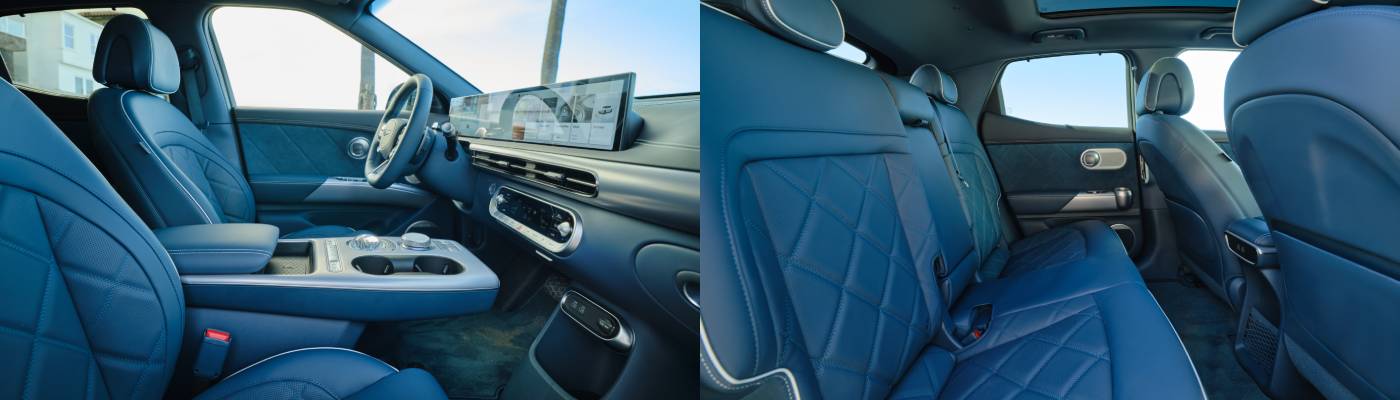
The GV60's interior is arguably its most distinctive feature, successfully combining modern luxury with a playful personality that sets it apart from many competitors. Where some electric vehicles rely on stark minimalism and enormous touchscreens, Genesis takes a more expressive approach. Flowing dashboard surfaces, contrasting materials, metallic accents, and available colorful upholstery create an environment that feels intentionally designed rather than simply assembled around a display. The architecture is modern and uncluttered, yet it retains enough visual detail to make the cabin interesting.
The centerpiece of the revised interior is a sweeping 27-inch OLED display that integrates the digital instrument cluster and infotainment system within a single continuous panel. It gives the dashboard a high-tech appearance while reducing the visual separation between vehicle information and entertainment functions. The display is crisp and modern, with graphics that complement the cabin's overall design. Below it, the dashboard flows smoothly into the center console, where Genesis incorporates one of the most unusual gear selectors in the automotive industry. The Crystal Sphere gear selector serves as both a functional control and a conversation piece. When the vehicle is switched off, an illuminated glass-like sphere occupies the center console. Starting the GV60 causes the sphere to rotate, revealing a rotary gear selector that the driver uses to select Drive, Reverse, or Neutral. The mechanism is undeniably theatrical, but it also gives the vehicle a distinctive identity.
Material quality is generally impressive, with attractive stitching, carefully fitted panels, and pleasant surfaces throughout the areas occupants frequently touch. Not every surface is equally luxurious, however. Some lower dashboard and door-panel plastics feel less expensive than the surrounding leather and metal accents, a noticeable inconsistency in a vehicle whose upper trims can exceed $70,000. Still, the overall environment is appealing, and the combination of thoughtful details and unconventional design gives the GV60 a personality that more conservative luxury crossovers sometimes lack.
INTERIOR FUNCTIONALITY & CONTROLS
Despite its futuristic appearance, the GV60 is refreshingly straightforward to operate. Genesis has resisted the temptation to place every vehicle function inside the infotainment touchscreen, retaining dedicated controls for several frequently used features. Climate adjustments, seat heating and ventilation, and other common settings can be accessed without navigating multiple touchscreen menus. This approach makes the vehicle considerably easier to operate while driving, particularly when compared with competitors that require drivers to use a central display for nearly every adjustment.
The 27-inch infotainment display is the most significant functional change for 2026. It integrates vehicle settings, navigation, media, and digital instrumentation within an attractive interface. Wireless Apple CarPlay and Android Auto are now standard, allowing drivers to connect compatible smartphones without using a cable. The screen also supports customizable information layouts and expanded over-the-air software update capability. The Crystal Sphere selector is surprisingly easy to use once its operation becomes familiar. Its rotary design requires less physical space than a traditional gear lever, helping create an open and contemporary center console. The unusual rotating mechanism also clearly communicates when the vehicle has been switched on or off. Genesis retains a conventional start button rather than relying entirely on automatic vehicle activation, which may appeal to drivers who prefer a more familiar operating sequence.
The steering-wheel controls provide access to audio, driver-assistance systems, and vehicle information without requiring frequent interaction with the center screen. Regenerative braking paddles are particularly useful because they allow the driver to alter deceleration characteristics without taking their hands off the wheel. Drive modes can also be selected using steering-wheel controls, making changes convenient while traveling.
Not everything about the controls is ideal. The number of available vehicle settings and driver-assistance functions can initially feel overwhelming, and some advanced features require navigating touchscreen menus. The glossy surfaces and touch-sensitive areas also demand more attention than conventional mechanical switches. The GV60's sloping roofline, thick rear pillars, and relatively small rear glass compromise outward visibility, making its available camera systems especially valuable. Overall, however, the GV60 achieves a more satisfying balance between digital sophistication and everyday usability than many touchscreen-heavy competitors.
TECHNOLOGY & SAFETY FEATURES
Technology is an important part of the GV60's appeal, and Genesis provides an extensive collection of features across the lineup. The standard 27-inch OLED display combines digital instrumentation and infotainment, while navigation, wireless Apple CarPlay and Android Auto, wireless phone charging, Wi-Fi hotspot capability, and connected services are included. The system supports voice recognition and over-the-air software updates, helping the vehicle maintain current functionality without requiring every update to be performed at a dealership. Fingerprint authentication offers an unusual additional convenience, allowing the vehicle to recognize an authorized user for certain vehicle functions and personalized settings.
Audio equipment varies considerably according to trim. Standard models use an eight-speaker system that should satisfy most listeners, while the Performance includes a much more sophisticated 17-speaker Bang & Olufsen audio system with a 14-channel amplifier and a maximum output of 1,400 watts. This upgraded system is one of the Performance's more appealing luxury features, particularly for buyers who value high-quality sound. The Premium model also adds a head-up display and digital rearview mirror, improving access to information and helping compensate for the vehicle's limited rearward visibility.
The GV60 also offers vehicle-to-load capability, allowing electricity stored in the main battery to power compatible external devices. The Advanced AWD and Performance AWD include an interior V2L power outlet, while an available external adapter can provide power through the charging port. Maximum output is approximately 1.9 kW, making the system useful for running certain household appliances, electronic devices, camping equipment, or other small electrical loads.
Safety technology is equally comprehensive. Standard equipment includes Forward Collision-Avoidance Assist, automatic emergency braking, blind-spot collision avoidance, rear cross-traffic collision avoidance, lane-keeping assistance, Lane Following Assist 2, driver-attention monitoring, adaptive cruise control, and Highway Driving Assist. These systems can assist with maintaining speed, distance, and lane position during highway travel, although they require the driver to remain attentive and responsible for vehicle control. The 2026 model adds or improves several monitoring and assistance functions, including enhanced lane following and steering-wheel hands-on detection.
PASSENGER SEATING & COMFORT
The GV60 accommodates five passengers in two rows, with individual front bucket seats and a three-position rear bench. No third-row seating configuration is offered. Although the GV60's overall length of 178.9 inches makes it relatively compact, its dedicated electric platform and 114.2-inch wheelbase help create an interior that feels larger than its exterior dimensions might suggest. The absence of a traditional transmission tunnel also contributes to improved interior packaging, particularly for passengers seated in the rear.
Front-seat accommodations are generous, with approximately 42.3 inches of legroom, 39 inches of headroom, and 57.5 inches of shoulder room. These dimensions provide adequate space for most adults, and the extensive seat adjustments make it relatively easy to establish a comfortable driving position. Visibility through the windshield is generally good, while the high seating position provides a useful view of surrounding traffic without making the vehicle feel excessively tall.
Rear passengers receive approximately 37.6 inches of legroom, 38.1 inches of headroom, and 55.9 inches of shoulder room. Those figures are respectable for the segment and allow two adults to travel comfortably, even when the front seats are adjusted for taller occupants. The long wheelbase helps create useful knee room, while the nearly flat floor improves foot space for the center passenger. The rear seat is also suitable for children and provides accessible attachment points for child safety seats. Despite the favorable measurements, the GV60's sloping roofline creates some compromises. Taller rear passengers may find headroom relatively tight, particularly when sitting fully upright. The rear bench is also better suited to two adults than three because shoulder room becomes restrictive when every seating position is occupied.
Getting into and out of the front seats is generally easy thanks to the crossover's moderate ride height and relatively large front door openings. Rear access is somewhat more compromised by the descending roofline and the shape of the rear door openings, requiring taller passengers to duck slightly when entering. Once seated, however, passengers benefit from a reasonably spacious environment, rear climate outlets, and convenient charging connections.
CARGO CAPICITY & INTERIOR STORAGE
Cargo space is one area where the GV60's emphasis on styling creates a meaningful compromise. Behind the second row, the vehicle provides 24 cubic feet of luggage volume. Folding the rear seats expands capacity to 54.7 cubic feet, allowing the GV60 to accommodate larger packages, sporting equipment, or luggage for longer trips. The rear seatbacks feature a split-folding arrangement, permitting passengers and longer cargo to be carried simultaneously. Overall, the GV60's cargo figures are respectable for a compact crossover but fall short of several larger or more practical electric crossovers.
Access to the cargo compartment is convenient thanks to a standard hands-free power liftgate. The opening is relatively wide, and the cargo floor provides a generally practical loading surface. Smaller items can be stored beneath the cargo floor, depending on the arrangement of the charging equipment and accessories.
The GV60 also provides a small front storage compartment beneath the hood, commonly called a frunk. At approximately 0.71 cubic feet, this space is considerably smaller than the front trunks offered by some competitors. It is best suited to storing a small emergency kit, cleaning supplies, or selected charging accessories rather than luggage. While its presence adds convenience, it does little to improve the GV60's overall cargo-carrying capability.
Interior storage is reasonably well considered. A floating center console provides useful space for personal belongings, while the glove compartment features an unusual drawer-style design that makes smaller items easier to reach. There are also door pockets, cupholders, a center armrest storage compartment, and additional spaces for smartphones and other everyday items. The open area beneath the center console is particularly useful for purses, small bags, or items that would otherwise occupy the passenger seat.
Connectivity is generous. Every GV60 includes four USB-C ports, with two located in the front for charging and data connectivity and two additional charge-only ports for rear passengers. Conventional 12-volt power outlets are provided in the front passenger compartment and cargo area. Advanced AWD and Performance AWD models also include the more powerful interior vehicle-to-load outlet, providing an AC power source for compatible equipment. Combined with wireless smartphone charging, these connections make the GV60 well equipped for families and passengers carrying multiple electronic devices.
BOTTOM LINE
The 2026 Genesis GV60 succeeds by offering something increasingly uncommon in the electric-vehicle market: a distinct personality backed by genuine luxury and impressive technology. Providing a comfortable ride, quiet cabin, responsive steering, and effortless acceleration reinforce that impression, while the enlarged battery and exceptionally rapid DC charging improve the vehicle's everyday usefulness. Even the least expensive RWD model delivers respectable performance and more than 300 miles of EPA-estimated range, while the dual-motor versions provide the traction and acceleration most buyers associate with modern electric SUVs. The Performance is particularly entertaining in a straight line, although its handling and braking capabilities do not entirely match its remarkable acceleration. The most significant weaknesses are relatively limited cargo space, compromised rearward visibility, reduced rear-seat headroom for taller passengers, and the high price of the Performance model.
For most buyers, the Advanced AWD represents the best combination of luxury, performance, and value. Starting at $59,405 before destination, it provides the same 314 horsepower and 446 pound-feet of torque as the standard AWD while adding genuine leather upholstery, ventilated front seats, a heated steering wheel, upgraded cabin materials, and useful camera and parking-assistance technology. Its 267-mile EPA driving range remains adequate for most daily needs, and its 5.1-second 0-to-60-mph capability provides acceleration that is more than sufficient for an upscale family crossover. Compared with the Tesla Model Y, the GV60 offers a more expressive interior and a more traditional luxury-car atmosphere, although the Tesla generally provides greater practicality and stronger value. Against competitors such as the Audi Q4 e-tron and Lexus RZ, the Genesis makes a compelling case with its quick charging, distinctive design, and generous equipment. It may not be the largest, least expensive, or most efficient electric crossover in its class, but the GV60 combines enough appealing qualities to stand out as an attractive alternative for drivers who want their luxury EV to feel special rather than merely functional.