2026 Hyundai Palisade
Bigger and bolder with a new hybrid powertrain, but is that enough?
# 2026 Hyundai Palisade and Palisade Hybrid Review
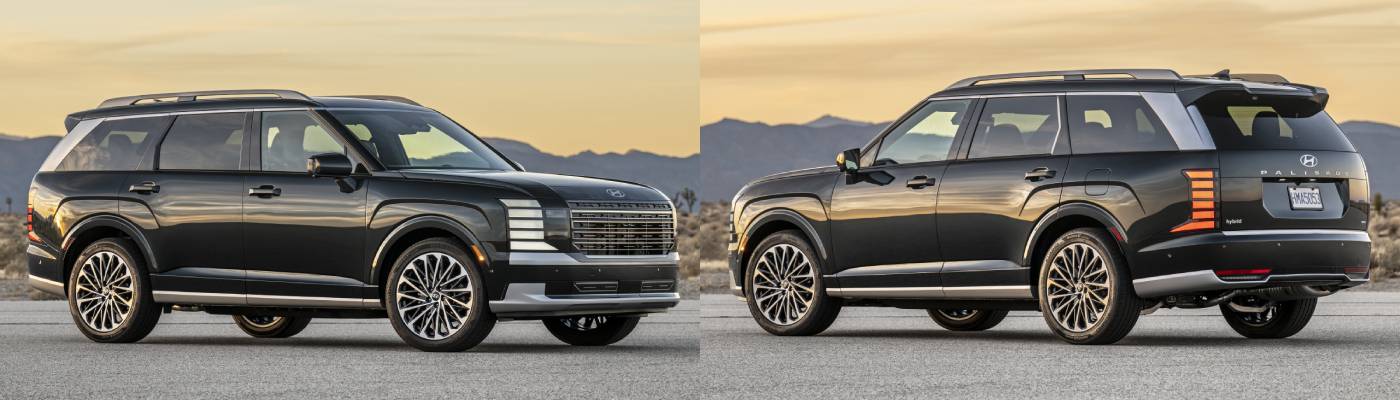
The 2026 Hyundai Palisade is a three-row midsize crossover that enters its second generation with a complete redesign, a larger body, a fresh interior, and the introduction of a hybrid powertrain. Originally introduced to the U.S. market for the 2020 model year, the Palisade quickly established itself as one of the more compelling family haulers, combining generous passenger space, upscale appointments, and competitive pricing. For 2026, Hyundai has taken that formula further, giving the Palisade a bolder, more upright exterior design, a wheelbase stretched to 116.9 inches, and an overall length of approximately 199 inches. The new model features vertical LED lighting, a broad grille, and a more substantial profile. Also new for 2026 is a hybrid powertrain. The Palisade is available exclusively as a four-door wagon with three rows of seats and room for either seven or eight passengers, depending on whether the second row features captain's chairs or a three-person bench. It competes in one of the industry's most competitive segments, with principal rivals including the Chevrolet Traverse, Ford Explorer, Honda Pilot, Kia Telluride, Mazda CX-90, Subaru Ascent, Toyota Grand Highlander, and Volkswagen Atlas.
The standard gasoline engine is a naturally aspirated 3.5-liter V6 producing 287 horsepower and 260 pound-feet of torque, paired with an eight-speed automatic transmission. Front-wheel drive is standard, while Hyundai's HTRAC all-wheel-drive system is optional on most trims. Gasoline-powered versions are offered in SE, SEL, SEL Convenience, SEL Premium, Limited, XRT PRO, and Calligraphy configurations, with the off-road-oriented XRT PRO featuring standard all-wheel drive. The new Palisade Hybrid combines a turbocharged 2.5-liter four-cylinder engine with two electric motors integrated into a six-speed automatic transmission. The gasoline engine produces 258 horsepower and 260 pound-feet of torque independently, while the complete hybrid system delivers 329 horsepower and 339 pound-feet of torque. Hybrid models are available in SEL, SEL Premium, Limited, and Calligraphy trims, with front-wheel drive standard and all-wheel drive optional. The hybrid uses a 1.65-kWh lithium-ion battery that recharges through regenerative braking and operation of the gasoline engine. Because it is a conventional hybrid rather than a plug-in hybrid, it has no externally rechargeable battery or EPA-rated all-electric driving range, although it can travel short distances under electric power alone. Properly equipped V6 models can tow up to 5,000 pounds, while hybrids are rated for 4,000 pounds.
Pricing for the 2026 Palisade starts at $39,435 for the gasoline-powered SE, while the top-of-the-line gasoline Calligraphy begins at $54,560. The Hybrid opens at $44,160 for the SEL and climbs to $56,780 for the Calligraphy, with all prices excluding destination charges, taxes, and options. Even the entry-level Palisade comes generously equipped, with dual 12.3-inch displays, wireless Apple CarPlay and Android Auto, automatic climate control, and an extensive suite of active safety features. Higher trims add leather upholstery, heated and ventilated seating, a Bose 14-speaker premium audio system, a surround-view camera, a head-up display, and an integrated front-and-rear dashcam system. Available luxury features include power-adjustable second-row relaxation seats, power-folding and reclining third-row seats, heated third-row seating, and an Ergo Motion driver's seat designed to reduce fatigue. The new XRT PRO is the most distinctive addition to the lineup, bringing all-terrain tires, an electronic rear limited-slip differential, additional ground clearance, recovery hooks, and specialized terrain modes. Hyundai also offers Highway Driving Assist, adaptive cruise control, automatic emergency braking, blind-spot monitoring, and numerous parking assistance features. The result is a family SUV that offers a remarkable amount of technology and comfort equipment for its price, with the Hybrid adding a substantial improvement in fuel economy and performance. 
PERFORMANCE & ACCELERATION
The 2026 Palisade's two powertrains deliver noticeably different driving experiences, and surprisingly, the hybrid is the stronger performer in nearly every measurable category. The standard 3.5-liter V6 is a conventional, naturally aspirated engine that emphasizes smoothness rather than outright acceleration. Its 287 horsepower is competitive on paper, but the 260 pound-feet of torque arrives relatively high in the rev range, at 5,000 rpm. This means the V6 sounds like it is working harder than turbocharged competitors to deliver strong acceleration, particularly when carrying a full complement of passengers or climbing steep grades. Around town, the engine is smooth, quiet, and adequately responsive under light throttle. However, drivers seeking a quick burst of acceleration often need to press the accelerator farther than expected to coax the engine into its stronger operating range. The eight-speed automatic transmission generally delivers smooth, unobtrusive shifts during ordinary driving. It works well when the driver maintains a steady pace, and its conventional torque-converter design avoids the unusual engine behavior sometimes associated with continuously variable transmissions.
The new hybrid powertrain changes the Palisade's personality considerably. Its turbocharged 2.5-liter four-cylinder engine produces 258 horsepower and 260 pound-feet of torque, while an electric drive motor supplements its output with immediate torque assistance. A second electric motor functions primarily as a starter-generator, helping manage engine operation and battery charging. Together, the system produces 329 horsepower and 339 pound-feet of torque, representing increases of 42 horsepower and 79 pound-feet over the V6. That additional torque makes its presence felt immediately. The hybrid pulls away from traffic lights with less effort, responds more quickly to modest accelerator inputs, and delivers stronger acceleration without requiring the gasoline engine to operate at high rpm.
The hybrid uses a conventional six-speed automatic transmission rather than a continuously variable transmission. This provides more familiar acceleration characteristics, with distinct gear changes and a natural relationship between engine speed and vehicle speed. Under normal conditions, the transitions between electric and gasoline operation are often difficult to detect. However, the hybrid is not completely without quirks. Drivers may note occasional low-speed hesitation and less-than-perfectly-smooth gear changes, particularly during transitions between electric and gasoline power. The turbocharged four-cylinder also sounds somewhat coarser than the V6 when accelerating hard. Nevertheless, the hybrid's additional power, stronger passing performance, and generally pleasant everyday operation make it the more satisfying powertrain for most buyers.
FUEL ECONOMY
Fuel economy is another area where the two Palisade powertrains differ substantially. The gasoline-powered 3.5-liter V6 operates on regular unleaded gasoline and carries a 19-gallon fuel tank. According to the EPA, front-wheel-drive Palisade models return 19 mpg city, 25 mpg highway, and 21 mpg combined. Adding HTRAC all-wheel drive reduces those figures to 18 mpg city, 24 mpg highway, and 20 mpg combined. The XRT PRO, with its all-terrain tires, increased ride height, and standard AWD, is rated at 16 mpg city, 22 mpg highway, and 19 mpg combined.
The hybrid represents a significant improvement. It also uses regular unleaded gasoline, but carries a slightly smaller 18.2-gallon tank. The most efficient front-wheel-drive SEL and SEL Premium Blue configurations earn EPA ratings of 33 mpg city, 35 mpg highway, and 34 mpg combined. The front-wheel-drive Limited and Calligraphy models return 31 mpg city, 32 mpg highway, and 31 mpg combined. Adding all-wheel drive results in an EPA rating of 29 mpg city, 30 mpg highway, and 29 mpg combined across the hybrid range.
Real-world driving suggests the hybrid generally delivers on its efficiency promise, although the exact benefit depends on how and where it is driven. Expect roughly 25 to 29 mpg is a reasonable mixed-driving expectation for an AWD hybrid and perhaps 21 to 25 MPG in the non-hybrid, although highway speed, temperature, traffic, and driving style can produce substantial variation.
ALL-WHEEL DRIVE & OFF-ROAD CAPABILITY
Both Palisade powertrains offer Hyundai's HTRAC all-wheel-drive system, which uses an electronically controlled coupling to distribute engine torque between the front and rear axles as traction conditions change. The system is designed primarily to improve stability and traction on wet pavement, snow-covered roads, and loose surfaces rather than to provide extreme off-road capability. Drivers can select Eco, Sport, and My Drive settings to alter powertrain responses, while AWD-equipped models also provide Snow, Mud, and Sand terrain modes. A dedicated Tow mode adjusts transmission behavior to reduce unnecessary gear changes when pulling a trailer, and downhill braking control helps maintain a controlled speed on steep descents. The XRT PRO takes capability considerably further with a model-exclusive electronic rear limited-slip differential that can redistribute torque between the rear wheels, a 1-inch lift in ground clearance to 8.4 inches, and 18-inch wheels fitted with 255/60R18 all-terrain tires. It also features improved approach, departure, and breakover angles of 20.5, 22.4, and 18.3 degrees, respectively, functional front and rear recovery hooks, a factory-integrated tow hitch, and displays showing pitch, roll, elevation, and compass information. Unlike the previous appearance-focused XRT, the XRT PRO includes genuine traction-enhancing hardware, making it better suited to muddy campsites, unpaved trails, and deep snow. However, it remains a unibody crossover without a two-speed transfer case or low-range gearing, so it is not intended to compete with specialized off-road vehicles.
RIDE QUALITY
Ride comfort has long been one of the Palisade's strongest attributes, and the redesigned 2026 model continues that tradition. Hyundai has developed a suspension that prioritizes isolation from imperfect pavement, highway stability, and passenger comfort rather than athletic handling. All models use an independent MacPherson strut front suspension and a multilink rear suspension, allowing each wheel to react independently to road irregularities. The combination of a longer wheelbase, substantial sound insulation, and comfort-oriented suspension tuning gives the Palisade a composed, substantial feel that is particularly well suited to long-distance travel.
Over ordinary pavement imperfections, the Palisade absorbs bumps without sending excessive vibration into the passenger compartment. Expansion joints, shallow potholes, and patched asphalt are generally handled with a reassuring sense of solidity. Larger bumps can produce some secondary body movement, but the suspension usually settles quickly rather than continuing to bounce. The overall sensation is closer to a luxury crossover than a traditional truck-based SUV, with the vehicle maintaining its composure even when the pavement becomes rough. Consumer Reports considers both the gasoline and hybrid versions among the better-riding vehicles in the three-row midsize SUV class, although its testing found the conventional V6 model slightly more comfortable over broken pavement. 
Wheel and tire choices have a noticeable influence on ride quality. Lower trims typically ride on 18-inch wheels with relatively tall tire sidewalls, providing additional cushioning between the road surface and suspension. Limited models move to 20-inch wheels, while Calligraphy versions feature 21-inch wheels with lower-profile tires. Although the larger wheels enhance the Palisade's upscale appearance, they also allow more small impacts to reach the cabin. The XRT PRO introduces a different suspension and tire combination. Its additional inch of ground clearance and taller-sidewall all-terrain tires make it better suited to rough roads, gravel, and uneven surfaces. Those tires provide additional compliance over sharp impacts, although their more aggressive tread and different construction can produce slightly less precise responses on smooth pavement. The result is a vehicle that feels particularly comfortable on poorly maintained secondary roads, even if it sacrifices some of the conventional models' on-road refinement.
HANDLING & ROADHOLDING
The 2026 Palisade is not intended to be an especially engaging vehicle to drive, but it demonstrates predictable handling and reassuring stability. Hyundai has tuned the steering and suspension to make a large, relatively heavy crossover feel manageable in everyday situations. Steering effort is light at parking-lot speeds, making it easy to maneuver despite the Palisade's substantial dimensions. As speed increases, steering resistance builds artificially and becomes soupy at highway speeds. This results in constant corrections at speed.
Body lean is present during cornering, but it is well controlled for a vehicle of this size. The Palisade remains composed through sweeping highway curves and does not exhibit excessive pitching or rolling during ordinary driving. The hybrid can feel marginally more disciplined. However, neither model encourages aggressive cornering. Drivers who prioritize handling precision will find the Mazda CX-90 more entertaining, while those seeking comfortable and predictable transportation should find the Palisade entirely satisfying.
Braking performance is adequate, although not especially impressive. Hybrid models have a noticeable "dead" space where the brakes transition from regenerative to friction and this can result in a slight panic when coming to an abrupt stop.
INTERIOR NOISE LEVELS
Cabin quietness is one of the 2026 Palisade's most impressive characteristics. Hyundai has devoted considerable attention to reducing road, wind, and mechanical noise, resulting in an interior that can rival considerably more expensive luxury crossovers. Additional sound-deadening materials, acoustic insulation around the engine compartment, laminated windshield glass, and acoustic front side windows help prevent unwanted sounds from entering the cabin. Limited and Calligraphy models add acoustic treatment to the second-row side glass, further improving isolation for rear passengers.
At highway speeds, wind noise around the mirrors and windshield pillars is well controlled, while tire noise remains subdued on most pavement surfaces. The conventional V6 contributes to the refined atmosphere with smooth operation and a relatively pleasant engine note. During gentle acceleration, its sound remains in the background, becoming more noticeable only when the accelerator is pressed deeply. The hybrid can be quieter during low-speed operation when the gasoline engine is shut off, but its turbocharged four-cylinder produces a somewhat coarser sound under hard acceleration.

INTERIOR DESIGN & MATERIALS
The 2026 Palisade introduces an entirely redesigned interior that represents one of the vehicle's strongest selling points. Hyundai has moved away from the more conventional dashboard design of the first-generation model, replacing it with a broad, horizontal layout that emphasizes spaciousness and sophistication. A sweeping display assembly stretches across the instrument panel, incorporating the digital instrument display and infotainment touchscreen. The dashboard features softly rounded surfaces, contrasting materials, and carefully integrated trim pieces that create a more contemporary appearance without sacrificing functionality.
Material quality is particularly impressive in the upper trim levels. Soft-touch surfaces cover much of the dashboard and upper door panels, while available leather upholstery, decorative stitching, and carefully selected finishes contribute to a premium atmosphere. The Limited features leather seating surfaces and additional luxury appointments, while Calligraphy models introduce premium Nappa leather, suede-like headliner materials, and more elaborate interior detailing. The latter creates an environment that would not seem out of place in a vehicle carrying a luxury-brand badge. The new center console is particularly attractive and functional. With the transmission selector relocated to the steering column, Hyundai has freed up space for cupholders, wireless smartphone charging, and additional storage. A broad center armrest separates the front seats, while an open storage area beneath the console provides room for a purse, small bag, or other personal items. This design helps maintain the cabin's open, spacious feeling while creating useful storage compartments.
Ambient lighting is available in multiple colors, illuminating selected interior surfaces without overwhelming the cabin. Higher trims also provide a dual-pane sunroof, allowing additional natural light into the passenger compartment. The combination of light-colored upholstery, large windows, and a relatively upright roofline makes the Palisade feel especially airy. Buyers seeking a darker or more rugged interior can choose the XRT PRO, which introduces distinctive upholstery, darker decorative accents, and a more utilitarian appearance.
There are some limitations. Lower trims use more conventional materials, and although they remain attractive, they lack the richness of the Limited and Calligraphy interiors. Some door armrests and other frequently touched surfaces are firmer than expected, and certain decorative finishes may not prove particularly resistant to fingerprints or scratches. Nevertheless, Hyundai has created one of the most appealing interiors available in a mainstream three-row crossover. The Palisade's combination of styling, comfort, and material quality is a compelling reason to consider it over several similarly priced competitors.
INTERIOR FUNCTIONALITY
Hyundai deserves considerable credit for keeping the Palisade's interior relatively easy to operate despite the enormous number of electronic features. Unlike vehicles that place nearly every function inside a touchscreen, the Palisade retains physical controls for many frequently used features. Separate climate controls, conveniently located buttons, and traditional rotary controls make it easier to adjust temperature, audio volume, and other settings without navigating complicated menus.
The 12.3-inch infotainment touchscreen features a clear graphical interface, logical menus, and responsive operation. Wireless Apple CarPlay and Android Auto are standard, allowing drivers to integrate their smartphones without connecting a cable. The system also provides navigation, audio settings, vehicle information, and access to various comfort and safety features. Although some secondary settings require exploring touchscreen menus, Hyundai has generally organized the interface in a way that avoids unnecessary complexity.
The steering-column-mounted electronic transmission selector is another thoughtful addition, although it may initially require some familiarization. Moving the selector away from the center console creates useful storage space and allows the driver to access the transmission controls without reaching toward the dashboard. The arrangement becomes intuitive with practice, but drivers accustomed to traditional console-mounted shifters may need time to develop the necessary muscle memory.
Visibility is generally excellent, aided by the tall seating position, large windshield, upright body, and generously sized windows. The relatively flat hood helps drivers judge the vehicle's front corners, although the Palisade's considerable width still requires attention in narrow parking spaces. Available front and rear parking sensors, a surround-view camera, and a digital rearview mirror make maneuvering easier. The surround-view system is especially helpful when parking in crowded garages or navigating tight spaces.
Hyundai also provides several features specifically intended to improve family usability. Passenger Talk allows the driver to communicate with rear-seat occupants through the audio system, while Rear Seat Quiet Mode reduces audio output in the rear seating area. The rear climate controls are conveniently positioned, and passengers have access to cupholders, charging ports, and storage spaces throughout the cabin.
One notable weakness involves the available power-operated second-row seats. Although the ability to move and adjust these seats electronically sounds convenient, the mechanisms can operate slowly.
TECHNOLOGY & SAFETY
The 2026 Palisade includes an impressive collection of technology features, many of which would previously have been reserved for luxury vehicles. The infotainment system includes a 12.3-inch touchscreen, wireless smartphone integration, navigation, and over-the-air software updating. A digital instrument cluster is available throughout the lineup, with a 12.3-inch display fitted to most configurations. Hyundai's Bluelink+ connected services provide remote access to vehicle functions through a smartphone, while available Digital Key 2 Premium allows compatible phones and smartwatches to function as vehicle keys. Wireless smartphone charging, Wi-Fi hotspot capability, and integrated Alexa voice assistance add further convenience.
Among the most interesting new features is the available integrated front-and-rear dashcam system. Offered on Calligraphy models, it can record driving events and monitor the vehicle while parked. Integrating the cameras into the vehicle eliminates the need for an aftermarket windshield-mounted camera and provides a cleaner installation. Hyundai also offers a somewhat dubious UV-C sterilization compartment on selected upper trims. Located in the center console, it uses ultraviolet light to possibly reduce certain germs on exposed surfaces of suitable objects.
The Palisade Hybrid introduces additional functionality through its electrified powertrain. An available Stay Mode allows occupants to operate selected electrical and climate-control functions while parked, with the hybrid system managing battery charge as necessary. The hybrid also offers energy-flow information that allows drivers to monitor how power is being produced, stored, and delivered. These features give the vehicle some of the conveniences associated with electric vehicles without requiring external charging.
Safety equipment is extensive. Standard driver-assistance technology includes forward collision warning with automatic emergency braking, pedestrian and cyclist detection, lane-keeping assistance, blind-spot monitoring, rear cross-traffic collision avoidance, driver-attention monitoring, and adaptive cruise control. Highway Driving Assist combines adaptive cruise control with lane-centering assistance to reduce the workload during extended highway travel. More advanced versions of the system, along with blind-spot camera displays, a surround-view monitor, and remote parking assistance, are available on higher trims.
PASSENGER SEATING & COMFORT
Passenger accommodation remains one of the Palisade's defining strengths. The vehicle offers seating for either seven or eight occupants, depending on the second-row configuration. Eight-passenger models feature a three-person bench seat, while seven-passenger versions substitute two individual captain's chairs. The second-row bench is especially useful for larger families, while the captain's chairs create a more luxurious atmosphere and provide easier access between the second and third rows.
Front-seat occupants enjoy generous space and an elevated driving position. Hyundai lists 44.2 inches of front legroom and up to 41.5 inches of front headroom, depending on equipment. The seats are broad, supportive, and comfortable over extended distances, with available power adjustments that allow drivers of different sizes to find suitable positions. Heated seats are widely available, while upper trims introduce ventilation, memory settings, and additional adjustment capabilities.
The Calligraphy takes front-seat comfort considerably further. Its Ergo Motion driver's seat incorporates adjustable support intended to reduce fatigue during long drives. Available relaxation seating allows the front seats to recline farther and extend leg supports while the vehicle is parked. These features give the Palisade an unusually luxurious character for a mainstream family SUV, making long trips more enjoyable for front-seat occupants.
Second-row accommodations are equally impressive. Hyundai specifies up to 43 inches of legroom, providing ample space for adults to stretch out even when the front seats are positioned comfortably. The captain's chairs offer generous cushioning and individual adjustments, while available heating and ventilation help maintain comfort in different weather conditions. Calligraphy models add power-operated relaxation seats with extended reclining capabilities and enhanced head restraints. Rear-seat passengers also benefit from separate climate controls, window sunshades, cupholders, and charging connections. The eight-passenger bench offers greater flexibility for families that need to carry three passengers in the second row. Its center seating position is less comfortable than the outboard seats, but it provides a useful alternative when a full passenger load is necessary. The bench can also be more practical for families with multiple child seats, depending on the specific seats and installation arrangement.
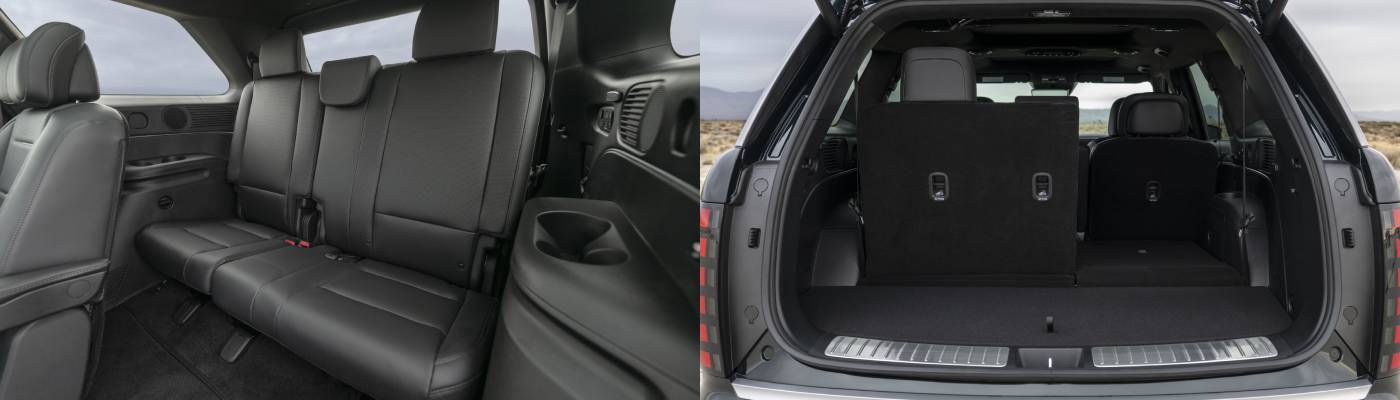
Third-row accommodations are competitive but not exceptional. Hyundai lists 32.1 inches of third-row legroom and approximately 37.7 to 37.8 inches of headroom. Those figures are adequate for children and smaller adults, but the third row is less suitable for extended travel by taller passengers. The relatively low seat cushion creates a knees-up seating position, and limited space beneath the second-row seats restricts foot placement. Adults can ride back there for shorter trips, particularly if second-row passengers move their seats forward, but the third row does not deliver the same comfort as the first two rows.
Accessing the third row can be accomplished by moving the second-row seats forward or walking between the captain's chairs. The latter is often the easier method for smaller passengers, although the passage is not especially wide. Vehicles equipped with power-operated second-row seats provide an electronically controlled entry mechanism, but its slow operation can make repeated entry and exit inconvenient. The software changes associated with Hyundai's seat recall also require different control inputs on affected vehicles.
Although the Palisade offers more interior space than its predecessor, competitors such as the Chevrolet Traverse and Toyota Grand Highlander can provide more accommodating third-row arrangements for adults. The Palisade's greatest passenger-comfort advantage lies in its exceptionally comfortable first and second rows, along with the availability of luxury seating features rarely offered at this price.
CARGO CAPACITY & INTERIOR STORAGE
The redesigned Palisade provides a meaningful improvement in cargo space over its predecessor. With all three seating rows upright, it offers 19.1 cubic feet of storage behind the third row. Although that figure may seem modest compared with a two-row SUV, the space is relatively deep and usefully shaped. It can accommodate several grocery bags, smaller suitcases, backpacks, or other everyday items without requiring passengers to sacrifice seating positions.
Folding the third-row seats increases cargo capacity to 46.3 cubic feet behind the second row. This provides enough room for luggage for an extended family trip, sporting equipment, a stroller, or several larger boxes. With both the second and third rows folded, maximum capacity expands to 86.7 cubic feet behind the front seats. These measurements are the same for gasoline and hybrid models. The Palisade's cargo area is wide and relatively square, making it easier to accommodate bulky objects than in vehicles with sharply sloping rear windows. The third-row seats feature a 60/40 split-folding arrangement, allowing owners to carry longer items while retaining some rear passenger seating. Higher trims add power-operated folding and sliding mechanisms that allow the rear seats to be repositioned using controls near the cargo opening. A hands-free power liftgate is another convenient feature when loading groceries or luggage.
Despite its useful capacity, the Palisade is not the outright cargo leader in the segment. The Toyota Grand Highlander and Chevrolet Traverse offer particularly generous maximum cargo volumes, making them potentially better choices for buyers who frequently transport large items. Still, the Palisade provides more than enough flexibility for most families, and its comparatively upright rear bodywork helps maximize usable space.
Interior storage is another strong point. The redesigned center console provides a large storage compartment, multiple cupholders, and an open lower storage area suitable for a small bag or purse. Additional compartments are located in the doors, dashboard, and rear seating areas, while a concealed storage compartment beneath the cargo floor provides room for smaller belongings.
Overall, the Palisade combines competitive cargo dimensions with thoughtful storage solutions. The ability to carry eight passengers, fold the rear seats for bulky cargo, and provide charging access throughout the cabin makes it well suited to the varied demands of everyday family life.
BOTTOM LINE
The completely redesigned 2026 Hyundai Palisade remains one of the most compelling choices in the three-row midsize crossover segment, offering an impressive combination of passenger comfort, interior quality, technology, and value. Its spacious cabin, upscale materials, remarkably quiet ride, and extensive list of available features make it feel more expensive than its pricing suggests. The XRT PRO adds legitimate traction-enhancing hardware for buyers who occasionally venture beyond paved roads, while the Calligraphy delivers luxury appointments that rival more expensive premium-brand vehicles. The addition of the hybrid powertrain is arguably the most important improvement, providing significantly stronger acceleration and substantially better fuel economy without sacrificing passenger or cargo space. There are drawbacks, however. The conventional V6 is relatively slow, some power-operated seating functions are unnecessarily cumbersome, and third-row comfort remains merely adequate for adults. Large wheels can compromise ride comfort, the steering provides limited feedback, and the hybrid's operation is not always as polished as the V6's. The 2026 Palisade also faces increasingly strong competition, particularly from the Toyota Grand Highlander Hybrid, which offers excellent efficiency and more generous cargo capacity, and the Mazda CX-90, which provides a more engaging driving experience. Nevertheless, the Palisade distinguishes itself through its unusually broad collection of premium features, comfortable interior, and competitive pricing.
For most buyers, the Palisade Hybrid SEL Premium represents the strongest combination of features, performance, efficiency, and affordability. Starting at $47,520 before destination charges, it adds desirable equipment including heated and ventilated front and second-row seats, a heated steering wheel, a surround-view monitor, blind-spot camera displays, ambient lighting, wireless smartphone charging, and Hyundai Digital Key functionality. It retains the more comfortable 18-inch wheels and, in its front-wheel-drive configuration, achieves the lineup's best EPA fuel-economy rating of 34 mpg combined. Buyers who regularly encounter snow or slippery roads can add HTRAC all-wheel drive for approximately $2,000, although combined fuel economy drops to 29 mpg.