2026 Mazda CX-90
Premium ambitions, turbocharged inline-six muscle, and a sporty soul set the CX-90 apart from the crowd.
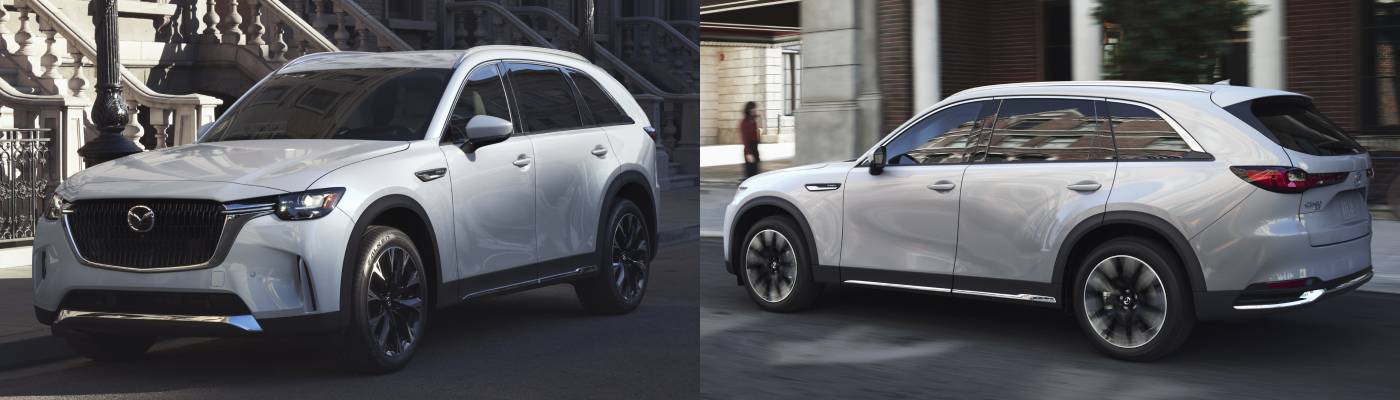
The 2026 Mazda CX-90 is a midsize, three-row crossover that blends premium styling, sophisticated engineering and engaging driving dynamics in a family-oriented package. Introduced for the 2024 model year as the replacement for the aging CX-9, the CX-90 represents Mazda's most ambitious effort to move its products upscale without abandoning mainstream pricing. Built on a rear-wheel-drive-based architecture, the CX-90 distinguishes itself from more conventional family crossovers with an available turbocharged inline-six engine, standard all-wheel drive and a carefully crafted interior. For 2026, changes are relatively modest. Amazon Alexa voice control becomes standard, equipment packages have been revised, the 3.3 Turbo S Premium Sport joins the lineup, and Polymetal Gray Metallic becomes an available exterior color. The CX-90 is offered exclusively as a four-door wagon, with three rows of seating accommodating either seven or eight passengers, depending on configuration. There are mild-hybrid and a true hybrid powertrains. Principal competitors include the Chevrolet Traverse, Ford Explorer, Honda Pilot, Hyundai Palisade, Kia Telluride, Subaru Ascent, Toyota Grand Highlander and Volkswagen Atlas.
The 2026 CX-90 lineup includes nine trims across three powertrain configurations. The standard 3.3 Turbo is offered in Select, Preferred, Premium Sport and Premium Plus trims, each powered by a turbocharged 3.3-liter inline-six engine producing 280 horsepower and 332 pound-feet of torque. The 3.3 Turbo S is available in Premium Sport and Premium Plus trims, with output increasing to 340 horsepower and 369 pound-feet of torque on premium gasoline, or 319 horsepower on regular fuel. Both six-cylinder engines incorporate Mazda's 48-volt M Hybrid Boost mild-hybrid technology. The CX-90 Plug-in Hybrid, or PHEV, is available in Preferred, Premium Sport and Premium Plus trims. It combines a naturally aspirated 2.5-liter four-cylinder engine with an electric motor and a 17.8-kWh lithium-ion battery, producing a combined 323 horsepower and 369 pound-feet of torque on premium gasoline, or 319 horsepower on regular. The PHEV provides an EPA-rated 26 miles of all-electric driving range. Every CX-90 uses an eight-speed automatic transmission and comes standard with i-Activ all-wheel drive. Maximum towing capacity is 3,500 pounds for the base Turbo Select, Turbo Preferred and all PHEV models, while properly equipped Turbo Premium Sport, Turbo Premium Plus and Turbo S models can tow up to 5,000 pounds.
Pricing for the 2026 CX-90 begins at $39,300 for the 3.3 Turbo Select, followed by the Preferred at $43,450, Premium Sport at $47,480 and Premium Plus at $50,270. The higher-output Turbo S Premium Sport starts at $54,140, while the Turbo S Premium Plus tops the gasoline lineup at $57,570. Plug-in hybrid pricing begins at $50,695 for the PHEV Preferred, increases to $55,500 for the Premium Sport and reaches $58,700 for the Premium Plus. These prices exclude Mazda's $1,645 destination charge and optional equipment. Standard equipment includes three-zone automatic climate control, a power liftgate, LED lighting, keyless entry, smartphone integration and a comprehensive assortment of active safety technologies. Higher trims add features such as Nappa leather upholstery, heated and ventilated front seats, heated second-row seats, a panoramic moonroof, a Bose 12-speaker audio system, a head-up display, 360-degree cameras and enhanced driver-assistance systems. The range-topping models also offer Mazda's Driver Personalization System, which automatically adjusts the driving position to suit an individual driver. New and revised Premium Sport models feature dark exterior accents, black wheels and unique trim details.
ACCELERATION & PERFORMANCE
The Mazda CX-90 takes a somewhat unconventional approach to powertrain design, especially in a segment dominated by transverse-mounted four-cylinder and V6 engines. Its longitudinally mounted 3.3-liter turbocharged inline-six is an unusual feature for a mainstream crossover, and one that gives the CX-90 a distinctly different personality. Inline-six engines are inherently well-balanced, and Mazda uses the configuration to deliver strong low-speed torque, a relatively linear power curve and a more sophisticated driving experience than might be expected from a family crossover. Both versions of the inline six employ a 48-volt mild-hybrid system that assists the gasoline engine during acceleration, supports regenerative charging and allows smoother operation of the automatic engine stop-start system. Unlike a conventional full hybrid, however, neither six-cylinder model can travel meaningful distances solely on electricity.
The standard 3.3 Turbo develops 280 horsepower and 332 pound-feet of torque, with maximum torque arriving at just 2,000 rpm. Those numbers might not sound especially impressive compared with some turbocharged competitors, but the generous low-end torque gives the CX-90 satisfying acceleration without constantly requiring high engine speeds. The engine responds confidently when pulling away from a stoplight, entering an interstate or accelerating to pass slower traffic. The higher-output Turbo S offers another level of performance. With 340 horsepower and 369 pound-feet of torque on premium gasoline, the engine delivers notably stronger acceleration at higher speeds and greater reserves of passing power. The additional horsepower is most apparent when accelerating aggressively onto the highway or overtaking at interstate speeds, where the engine pulls with increasing enthusiasm as the tachometer climbs. Both deliver the same basic character and strong low-rpm response, while the Turbo S rewards drivers who regularly demand maximum performance. Buyers should also remember that achieving the full 340 horsepower requires premium gasoline.
Both inline-six engines are paired with an eight-speed automatic transmission that uses a multiplate wet-clutch arrangement in place of a conventional torque converter. The design contributes to the powertrain's direct mechanical feel and efficiency, but it also introduces one of the CX-90's more noticeable shortcomings. Most of the time, shifts are generally well-timed and appropriately quick, and the transmission does a reasonable job of keeping the engine within its broad torque band. At lower speeds, however, particularly in stop-and-go traffic or when accelerating gently from a rolling stop, the transmission can exhibit hesitation, abrupt engagement or an occasional shudder.
The CX-90 plug-in hybrid substitutes a naturally aspirated 2.5-liter four-cylinder engine and a substantial electric motor for the turbocharged inline-six. The gasoline engine produces up to 189 horsepower and 192 pound-feet of torque, while the electric motor contributes 173 horsepower and 199 pound-feet. Combined system output reaches 323 horsepower and 369 pound-feet of torque on premium gasoline. These are impressive figures for a plug-in hybrid, and the instantaneous torque provided by the electric motor gives the PHEV particularly strong initial acceleration. With both power sources operating, acceleration is vigorous, and highway passing power compares favorably with the Turbo S. Driving exclusively on electricity provides a different experience. The electric motor's 173 horsepower is sufficient for normal city driving, suburban commuting and maintaining highway speeds, but the roughly 5,200-pound PHEV is not especially quick when relying on electric propulsion alone.
FUEL ECONOMY
Regardless of powertrain, fuel economy is one of the CX-90's strongest attributes, especially considering its size, standard all-wheel drive and six-cylinder powertrains. All conventional gasoline versions benefit from Mazda's 48-volt mild-hybrid system, which recovers energy during deceleration and assists the engine during certain operating conditions. The system is designed primarily to improve efficiency and throttle response rather than maximize electric propulsion, and its operation is largely transparent during normal driving.
The standard 3.3 Turbo is EPA-rated at 23 mpg city, 28 mpg highway and 25 mpg combined. These figures apply to every trim with the 280-horsepower engine, and regular 87-octane gasoline is recommended. Fuel capacity is 18.5 gallons, providing a calculated highway range of approximately 518 miles when multiplying the EPA highway rating by tank capacity. The EPA combined rating suggests approximately 463 miles per tank in mixed driving.
Surprisingly, the more powerful Turbo S carries the same EPA ratings of 23 mpg city, 28 mpg highway and 25 mpg combined. This is a meaningful advantage over some competitors whose more powerful engines impose significant fuel-economy penalties. Turbo S models also have a larger 19.6-gallon fuel tank, increasing their calculated highway range to approximately 549 miles and providing roughly 490 miles of combined-driving range. Premium gasoline is recommended for maximum performance. Although the Turbo S can operate on regular fuel, drivers should expect lower peak horsepower.
Real-world testing suggests that both engines can deliver impressive results. Owners can reasonably anticipate fuel economy in the low-to-mid-20s during mixed driving and low 30s on extended highway trips, provided speeds and driving habits are moderate.
The CX-90 PHEV introduces a different approach to efficiency. With its 17.8-kWh battery fully charged, the plug-in hybrid can complete shorter trips without consuming gasoline. Mazda advertises approximately 26 miles of electric-only range. The PHEV earns an EPA rating of 56 MPGe combined when using electricity and gasoline. Once the battery's usable electric range has been depleted, it operates as a conventional hybrid and returns an EPA-estimated 24 mpg city, 28 mpg highway and 26 mpg combined on gasoline. Premium fuel is recommended. The PHEV uses an 18.5-gallon gasoline tank, yielding a calculated gasoline-only highway range of about 518 miles under ideal EPA highway conditions.
The distinction between MPGe and conventional mpg is particularly important. The PHEV's 56-MPGe rating measures combined energy consumption, including electricity, and should not be interpreted as 56 miles traveled on a gallon of gasoline. When the battery is depleted, the PHEV offers only a slight improvement in EPA combined fuel economy compared with the inline-six models. Owners who seldom plug in may find that the PHEV's higher purchase price is difficult to justify through fuel savings alone. Conversely, drivers with access to home charging and daily commutes within the vehicle's electric range may consume very little gasoline during routine use.
ALL-WHEEL DRIVE & DRIVING MODES
Every 2026 Mazda CX-90 comes standard with Mazda's rear-biased i-Activ all-wheel-drive system, which continuously monitors driving conditions and adjusts torque distribution to improve traction and handling. Rather than behaving like a front-wheel-drive crossover that sends power rearward only after detecting wheelspin, the CX-90's longitudinal powertrain architecture emphasizes a more traditional rear-drive driving character while allowing the system to distribute torque as conditions demand. All models include Mazda Intelligent Drive Select, or Mi-Drive, with Normal, Sport and Off-Road modes. Sport mode sharpens throttle response and alters transmission behavior, while Off-Road mode works with the traction-control and AWD systems to maintain progress on loose or uneven surfaces. Higher-output gasoline models and the Turbo Premium Sport and Premium Plus also provide a Towing mode. PHEV models include a dedicated EV mode, with a Towing mode added on the PHEV Premium Sport and Premium Plus. Hill-descent control, hill-launch assist and off-road traction assistance are included, while Mazda's Kinematic Posture Control helps manage body movement during cornering. Ground clearance measures approximately 8.0 to 8.1 inches, depending on wheel configuration. Although the CX-90 can handle gravel roads, snow-covered pavement, muddy trails and moderate off-pavement driving, it is not intended to compete with dedicated off-road SUVs. There is no two-speed transfer case, selectable low-range gearing or specialized trail-oriented suspension package.
The PHEV offers a simple to use battery-save mode as well. This is idea to extract the best fuel economy if your commute include some highway driving. With save activated, the vehicle operates in hybrid-only mode, saving the battery charge for later use as an EV only. So, say your commute includes five minutes to the expressway, 20 minutes of expressway driving and then 5 minutes to work. Drivers can activate save mode when enter the highway and deactivate when returning to surface streets. This optimizes your fuel economy strategy and would likely net an overall fuel consumption of about 45-50 mpg on your commute.
RIDE QUALITY
The CX-90's ride quality reflects Mazda's determination to build a three-row crossover that feels more athletic and responsive than the typical family crossover. Rather than tuning the suspension primarily for softness, Mazda favors body control, stability and precise responses. The result is a vehicle that feels substantial and well planted, particularly at highway speeds, but also one that can transmit more road imperfections into the passenger compartment than some buyers might expect from a luxury-oriented verhicle.
The suspension consists of a double-wishbone arrangement in front and a multilink independent design at the rear. This sophisticated hardware provides excellent control over wheel movement and contributes to the CX-90's secure, composed behavior over rolling pavement. Highway undulations are generally absorbed without excessive bouncing, and the vehicle settles quickly after encountering large bumps. On smooth pavement, the CX-90 offers a pleasantly controlled ride that feels closer to a European luxury crossover than a conventional family crossoer.
The suspension's limitations become more apparent on broken pavement. Sharp potholes, pavement seams and abrupt road imperfections can produce noticeable impacts, particularly when equipped with the larger wheels found throughout most of the lineup. The 19-inch wheels and 265/55-series tires fitted to the base Turbo Select provide additional sidewall cushioning, helping absorb smaller irregularities. Most other 2026 trims use 21-inch wheels with lower-profile 275/45-series tires, which provide a more aggressive appearance and responsive handling but reduce the amount of cushioning available from the tire itself.
Ride quality is therefore an important consideration when selecting a trim. The Turbo Select's smaller wheels are potentially beneficial for drivers who regularly encounter rough city streets or deteriorating suburban roads. The Turbo Preferred and higher trims sacrifice some compliance for appearance and responsiveness. All 2026 PHEV models receive 21-inch wheels, leaving buyers with fewer opportunities to choose a softer-riding configuration. The heavier plug-in hybrid also has slightly different weight distribution and suspension requirements because of its battery pack, but its overall ride character remains recognizably similar to the six-cylinder versions.
HANDING & ROADHOLDING
Handling is arguably the CX-90's defining characteristic in class and the area in which it most clearly separates itself from mainstream competitors. Mazda has invested considerable effort in creating a three-row crossover that responds naturally to steering inputs and changes direction without the ponderous feeling often associated with large crossovers. The long wheelbase, rear-biased all-wheel-drive architecture and carefully tuned suspension work together to give the CX-90 an unusually composed and confident personality.
Steering is quite firm, precise, and relatively quick. In doing so it communicates more information than most competitors. The CX-90 turns into corners with enthusiasm, follows a chosen line accurately and provides a reassuring sense of connection between the steering wheel and front tires. The steering effort is deliberately substantial, contributing to the impression of a sporty, well-engineered vehicle. However, that weight can become excessive during parking maneuvers or prolonged urban driving.
Body control is another strength. The CX-90 remains impressively stable through sweeping turns and resists the excessive pitching and wallowing that characterize some softer-sprung competitors. Mazda's Kinematic Posture Control system subtly applies braking force to help manage body movement during cornering, contributing to more predictable handling responses. There is still noticeable body lean when the vehicle is pushed aggressively, particularly considering its substantial height and weight, but the motions are controlled rather than unsettling.
Braking performance is similarly confident. The system provides strong stopping power and generally good pedal feedback. Pedal modulation can be a little sensitive during low-speed stops, however. The PHEV blends regenerative braking with conventional friction braking. Unlike in some competitors, driver's won't notice the transitions.
INTERIOR NOISE LEVELS
The CX-90 delivers a generally quiet and refined passenger compartment, especially during steady-speed highway driving. Mazda has taken considerable care to suppress road and wind noise, and the result is an interior that feels appropriately upscale for the vehicle's premium positioning. Wind noise around the windshield and side mirrors is well controlled, while the substantial body structure and sound insulation help isolate occupants from surrounding traffic.
At moderate speeds, the turbocharged inline-six engines operate quietly and deliver a subdued mechanical character. They also avoid the coarse or strained sounds sometimes associated with four-cylinder engines working to move large vehicles. Under aggressive acceleration, however, the six-cylinder can become surprisingly vocal.
The PHEV offers a different acoustic experience. When running on electricity, the absence of engine noise makes low-speed driving especially quiet, leaving only tire, wind and suspension sounds. Once the four-cylinder engine starts, the refinement advantage diminishes. Its sound is more noticeable under acceleration and less sophisticated than the turbocharged six-cylinder. Transitions between electric and gasoline power can also draw attention to the drivetrain.
INTERIOR DESIGN & MATERIALS
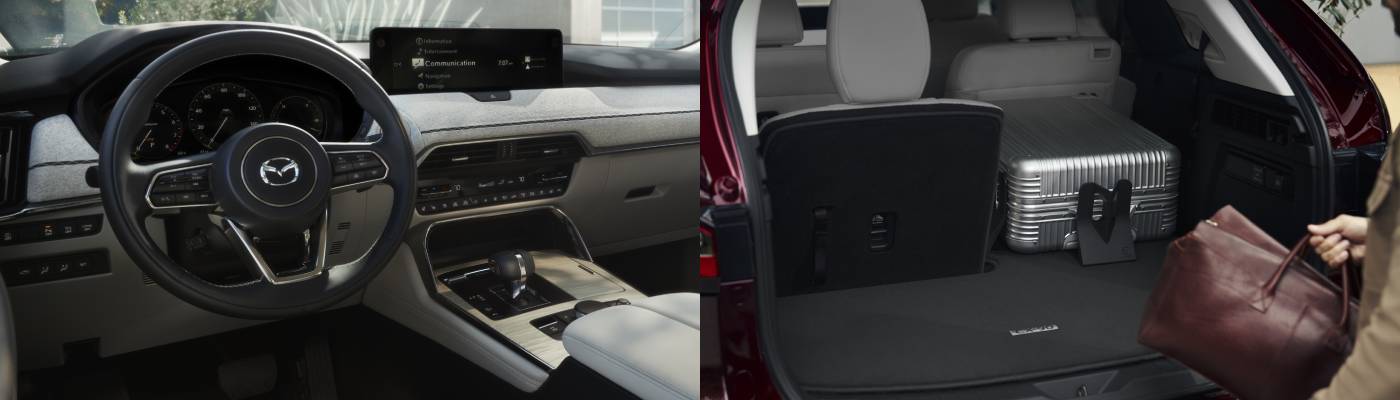
The CX-90's cabin is among the most attractive and thoughtfully designed interiors in the mainstream three-row crossover segment. Mazda has developed a distinctive approach to interior design that emphasizes horizontal lines, carefully selected materials and a restrained presentation. Rather than filling the dashboard with enormous displays and decorative lighting, Mazda uses traditional craftsmanship and balanced proportions to create an environment that looks more expensive than the vehicle's price might suggest.
The dashboard is broad and elegantly shaped, with a low-mounted center display that preserves outward visibility. Available stitched surfaces, textured trim and contrasting materials give the cabin a layered, sophisticated appearance. Unlike some competitors that rely heavily on glossy black plastic and large digital panels, the CX-90 uses traditional materials like wood and metal to establish its premium character.
Even the entry-level Turbo Select provides a reasonably upscale atmosphere, with leatherette upholstery, a leather-wrapped steering wheel and attractive trim details. The Turbo Preferred introduces leather seating surfaces and additional comfort equipment, while Premium Sport models add more luxury-oriented features. Premium Plus and Turbo S models provide the most elaborate environments, with Nappa leather upholstery and available black or white interior color schemes. The Turbo S Premium Plus is especially impressive when equipped with its Japanese Premium interior, which incorporates light-colored Nappa leather, distinctive stitching, contrasting trim and maple wood accents. These materials create an atmosphere that would not look out of place in a substantially more expensive luxury crossovers.
There are some compromises. The wide center console creates a somewhat enclosed environment for front-seat occupants, and drivers with longer legs may notice that the console occupies space beside their right knee. Some less visible surfaces are finished in harder plastics, and the restrained dashboard design limits opportunities for expansive storage compartments. Nevertheless, these complaints are relatively minor compared with the overall quality of the interior.
INTERIOR FUNCTIONALITY
The CX-90's interior combines traditional physical controls with modern digital technology, an approach that offers both advantages and disadvantages. Mazda has resisted the trend toward moving nearly every vehicle function into a touchscreen, instead retaining dedicated buttons and switches for frequently used features. This makes many everyday operations straightforward, particularly climate adjustments, audio volume and important vehicle functions.
The climate-control system is especially user-friendly. Physical buttons allow the driver or front passenger to make temperature and ventilation adjustments without navigating a series of onscreen menus. Separate controls for seat heating and ventilation are easy to locate, while the three-zone climate system provides independent temperature management for rear passengers. Dedicated rear air vents help distribute conditioned air throughout the cabin, an important consideration in a vehicle capable of carrying seven or eight occupants.
Depending on your point of view, the infotainment system is less successful. Mazda's interface relies primarily on a rotary controller mounted on the center console, accompanied by shortcut buttons for commonly accessed functions. Although this arrangement can be convenient once learned, it requires drivers to navigate menus by turning and pressing the controller rather than directly selecting items on the screen. This becomes frustrating when entering destinations, navigating through multiple entertainment menus or making quick adjustments while driving.
The 12.3-inch display does support touchscreen operation when using Apple CarPlay or Android Auto, provided the appropriate settings are enabled, but Mazda's native interface remains largely dependent on the rotary controller. The smaller 10.25-inch display in the Turbo Select also relies on the controller. This inconsistency can be confusing, particularly for drivers accustomed to conventional touchscreens.
Visibility is generally good from the driver's seat. The relatively upright seating position and large windshield provide a commanding forward view, although the CX-90's long hood and substantial front proportions can make close-quarters maneuvering more difficult. Available parking sensors, front and rear cameras, and the 360-degree camera system help compensate. The surround-view system is particularly valuable in parking garages and tight urban spaces, where the vehicle's approximately 201-inch overall length becomes apparent.
TECHNOLOGY & SAFETY
The 2026 CX-90 offers an extensive selection of technology features, with equipment increasing progressively through the trim lineup. Entry-level models receive a 10.25-inch infotainment display, an eight-speaker audio system, Bluetooth connectivity, smartphone integration and Mazda Connected Services. The Turbo Preferred and higher trims receive the larger 12.3-inch infotainment display, wireless Apple CarPlay and Android Auto, and a wireless smartphone charging pad. Amazon Alexa voice-control integration is standard for 2026, allowing compatible voice commands for supported vehicle and connected functions.
Higher trims provide a fully digital 12.3-inch instrument cluster that replaces much of the conventional gauge arrangement with a configurable display. The available head-up display projects essential driving information into the driver's field of vision, including vehicle speed, navigation directions and certain driver-assistance notifications. The Bose 12-speaker premium audio system produces fuller sound than the standard eight-speaker setup and is particularly worthwhile for owners who spend considerable time on the highway. Available Mazda navigation includes over-the-air map updates, while the panoramic moonroof creates a brighter, more open interior environment.
One of the CX-90's most unusual technology features is Mazda's Driver Personalization System, available on upper-level models. The system uses driver information to recommend an appropriate seating position based on body characteristics and can coordinate adjustments to the power seat, steering wheel and mirrors. Stored settings also make it easier for multiple drivers to share the vehicle without manually readjusting everything each time. Although the system is not essential, it demonstrates Mazda's emphasis on driving position and ergonomics.
Safety equipment is comprehensive even on the least expensive CX-90. Standard features include forward collision warning with automatic emergency braking, pedestrian detection, adaptive cruise control with stop-and-go capability, blind-spot monitoring, rear cross-traffic alert, lane-departure warning, lane-keeping assistance, driver-attention monitoring and a rear-seat reminder. These systems provide a reassuring baseline of protection without requiring buyers to purchase expensive option packages.
Higher trims add more sophisticated technologies, including emergency lane-keeping intervention, front cross-traffic alert, additional automatic braking functions, traffic-sign recognition, driver monitoring and Mazda's Cruising and Traffic Support system. This latter feature provides combined steering and speed assistance under appropriate conditions, although it remains a driver-assistance system rather than autonomous driving technology. The available 360-degree camera system includes See-Through View, which helps drivers visualize areas immediately surrounding the vehicle, and Trailer Hitch View, which can make connecting a trailer easier. Adaptive headlights are another worthwhile feature. Available on selected upper trims, the system adjusts headlight direction in response to steering input, improving visibility through curves.
PASSENGER SEATING & COMFORT
The CX-90's seating arrangements are unusually varied for a three-row crossover, with configurations accommodating seven or eight occupants depending on powertrain and trim. The basic eight-passenger arrangement combines two front bucket seats with a three-person second-row bench and a three-person third-row bench. Other configurations use second-row captain's chairs with a three-person third row, while some PHEV configurations combine a three-person second-row bench with a two-person third row. The PHEV is limited to seven passengers regardless of arrangement.
The front seats are comfortable and supportive, with a design that emphasizes proper driving posture rather than oversized cushioning. Both the seat bottoms and backrests provide useful lateral support during cornering without becoming restrictive during long trips. The driver's seat offers generous adjustment, while upper trims add power lumbar support, memory functions, heating and ventilation. The steering wheel also offers a comfortable grip and appropriate adjustment range. Front headroom is approximately 39 inches, depending on moonroof configuration, while legroom measures 41.7 inches. These dimensions provide ample space for most adults, although the broad center console can make the cockpit feel somewhat narrower than the exterior dimensions suggest.
Second-row passengers enjoy 39.4 inches of legroom and approximately 38 to 39 inches of headroom, depending on moonroof configuration. These figures provide reasonable accommodations for adults and growing teenagers, although the available space is not quite as generous as that in some larger competitors. The bench seat offers useful flexibility for families who occasionally need to transport three passengers across the middle row. Its split-folding and reclining sections allow occupants to adjust the seating position and provide access to the third row.
Available captain's chairs give the second row a more upscale character. Individual armrests and increased separation between passengers make the seating arrangement feel less crowded, while the center passage provides an alternative route to the third row. On the Turbo S Premium Plus, the second-row captain's chairs are paired with a substantial center console and include ventilation in addition to heating. This arrangement creates a particularly luxurious passenger environment, although the console reduces the ability to walk directly between the seats. Buyers who prioritize third-row access may prefer the captain's-chair layouts without a fixed center console.
The third row presents the CX-90's most significant passenger-space limitation. Legroom measures just 30.4 inches, substantially less than the first two rows, and headroom is approximately 36.9 inches. The seat cushions are positioned relatively close to the floor, leaving taller passengers with their knees elevated and limited thigh support. The combination of modest legroom, narrow seating dimensions and limited foot space makes the third row best suited to children or smaller adults traveling relatively short distances.
Access is reasonably straightforward thanks to the second-row seats' sliding and tilting mechanisms, but the process requires more flexibility than in some competitors. The available captain's-chair arrangement can improve access, particularly when the center passage remains unobstructed. Nevertheless, climbing into the third row and settling into a comfortable position is more difficult than in the Honda Pilot, Hyundai Palisade or Volkswagen Atlas, all of which provide more generous rear accommodations.
CARGO CAPACITY & STORAGE
Cargo capacity is another area where the CX-90 sacrifices some practicality in the interest of exterior styling and interior design. Despite measuring approximately 200.8 inches long and riding on a generous 122.8-inch wheelbase, the CX-90 provides less usable cargo volume than several direct competitors. Its relatively long hood, rear-wheel-drive-based architecture and carefully sculpted body all contribute to this compromise.
With all three seating rows in their normal positions, cargo capacity measures a scant 14.9 cubic feet in configurations with a three-person third row and 15.9 cubic feet in those with a two-person third row. This is sufficient for several grocery bags, a few small suitcases or everyday shopping, but it becomes restrictive when carrying luggage for a full complement of passengers. By comparison, vehicles such as the Hyundai Palisade, Kia Telluride and Volkswagen Atlas offer noticeably more room behind their third rows.
Folding the third row increases cargo capacity to 40.0 cubic feet in configurations with the three-person rear bench, or 40.8 cubic feet with the two-person third row. These figures provide considerably more flexibility, allowing the CX-90 to transport larger suitcases, strollers, sports equipment and a variety of household items. With both the second and third rows folded, maximum cargo volume expands to 74.2 or 75.2 cubic feet, depending on seating configuration. The available space is useful, although still smaller than what some mainstream three-row competitors provide.
Interior storage is adequate but not especially generous. The center console includes a covered compartment, cupholders and smaller storage areas, while the doors provide space for bottles and personal items. A traditional glove box and smaller miscellaneous compartments are also included. However, the console's driver-oriented design limits the size of some storage areas, and there are fewer large, open bins than in competitors designed primarily for maximum family utility.
Connectivity is better than the storage arrangement might suggest. The base Turbo Select includes four USB-C ports, with two serving front occupants and two positioned for second-row passengers. Higher trims and all PHEV models provide six USB-C ports, distributing two connections to each seating row. Conventional 12-volt accessory outlets are also available. Selected upper-level gasoline trims offer a 150-watt accessory outlet, while PHEV Premium Sport and Premium Plus models include a more substantial 1,500-watt AC outlet in the cargo area. This is especially useful for powering small appliances, charging equipment or supporting outdoor activities. The PHEV Premium Plus additionally provides a 150-watt accessory outlet. These features give the plug-in hybrid a practical advantage for owners who regularly use portable electrical equipment.
BOTTOM LINE
The 2026 Mazda CX-90 is an appealing alternative to conventional three-row crossovers for buyers who appreciate responsive handling, strong acceleration and premium interior craftsmanship. Its turbocharged inline-six engines deliver satisfying performance while returning better fuel economy than many conventional gasoline competitors, and its rear-biased all-wheel-drive architecture gives it an unusually engaging driving character. The Turbo S adds impressive acceleration, while the PHEV offers a compelling combination of electric commuting capability and long-distance gasoline flexibility. Inside, the CX-90 provides sophisticated styling, attractive materials and available features that rival those in considerably more expensive luxury-brand SUVs. The 2026 equipment revisions strengthen its value, particularly in the middle of the lineup. However, the Mazda is not without compromises. Its firm suspension, heavy steering and occasionally awkward transmission behavior can detract from everyday refinement, while its tight third row and relatively modest cargo capacity make it less practical than the roomiest vehicles in the segment. Buyers looking primarily for comfortable family transportation may be better served by the Honda Pilot, Hyundai Palisade, Kia Telluride or Toyota Grand Highlander. Those prioritizing a more engaging and luxurious driving experience will find considerably more to appreciate in the Mazda.
For most buyers, the 3.3 Turbo Premium Sport or Premium Plus represents the strongest combination of performance, equipment and overall value. They provides the standard 280-horsepower inline-six, which is already more than adequate for most driving situations, along with desirable upgrades including a panoramic moonroof, Bose audio, head-up display, digital instrumentation, additional safety technology and increased towing capability. It also costs substantially less than the Turbo S models while sacrificing relatively little everyday performance. Buyers willing to forgo some luxury equipment can save approximately $4,000 with the Turbo Preferred, which offers an appealing selection of comfort features, including leather upholstery and ventilated front seats. The Turbo S is worth considering for enthusiasts who value additional horsepower, but its price premium is difficult to justify strictly on performance grounds. The PHEV Preferred is the logical alternative for buyers with convenient home charging and daily trips that can be completed largely on electricity, although the higher initial cost makes it less attractive for drivers who spend most of their time on the highway. Ultimately, the CX-90 succeeds because it offers something different: a genuinely driver-focused three-row SUV with premium aspirations. It may not be the most spacious, softest-riding or least expensive choice in its class, but it is among the most distinctive, combining family functionality with the kind of driving enjoyment that is increasingly difficult to find in a vehicle of this size.