2026 Hyundai Kona
Big on value, space and packed with technology, Kona checks all the boxes.
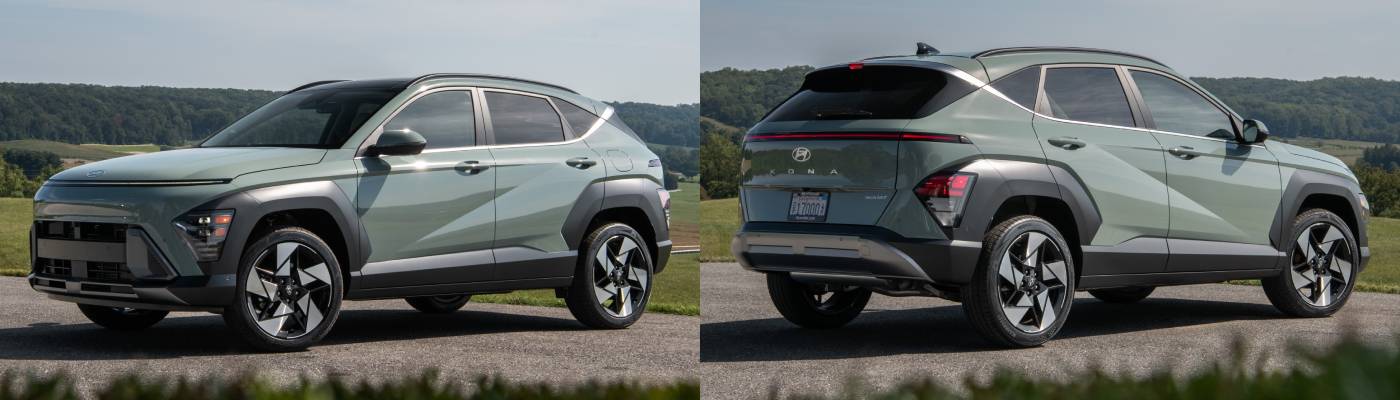
The 2026 Hyundai Kona plays in the increasingly crowded subcompact crossover segment. First introduced for the 2018 model year, the Kona quickly earned a reputation for its unconventional styling, approachable pricing, generous equipment levels and relatively entertaining driving character. A comprehensive redesign for 2024 brought a substantially larger vehicle with enlarged passenger space, greater cargo capacity and an entirely new design. For 2026, the second-generation Kona receives a simplified trim structure and expanded standard safety equipment, including adaptive cruise control across the lineup. The former SEL, SEL Convenience, N Line S and N Line trims have been discontinued, replaced by new SE/SEL Sport and SEL Premium/Limited models. The Kona remains exclusively a four-door, five-passenger wagon, with either front-wheel drive or all-wheel drive. Although Hyundai previously offered an all-electric Kona alongside the gasoline model, that model has been discontinued. There is also no hybrid powertrain. Principal competitors include the Buick Envista, Chevrolet Trailblazer, Chevrolet Trax, Honda HR-V, Kia Seltos, Mazda CX-30, Nissan Kicks, Subaru Crosstrek, Toyota Corolla Cross and Volkswagen Taos.
The 2026 Kona lineup consists of four trims: SE, SEL Sport, SEL Premium and Limited. SE and SEL Sport models are powered by a naturally aspirated 2.0-liter four-cylinder engine producing 147 horsepower at 6,200 rpm and 132 pound-feet of torque at 4,500 rpm. This engine is paired a continuously variable automatic. SEL Premium and Limited models receive a turbocharged 1.6-liter four-cylinder generating 190 horsepower at 6,000 rpm and 195 pound-feet of torque between 1,700 and 4,500 rpm. The turbocharged engine is paired with a conventional eight-speed automatic transmission featuring paddle shifters. Front-wheel drive is standard across the lineup, while Hyundai's HTRAC all-wheel-drive system is optional on every trim.
Pricing for the 2026 Kona begins at $25,500 for the SE, followed by the SEL Sport at $26,825, SEL Premium at $28,425 and Limited at $32,535, before destination charges, taxes and additional options. All-wheel drive adds approximately $1,500. Even the least expensive Kona includes a 12.3-inch infotainment touchscreen, wireless Apple CarPlay and Android Auto, LED headlights, a rearview camera and an extensive assortment of driver-assistance technologies. SEL Sport models add upgraded exterior trim, 18-inch alloy wheels, heated front seats, wireless smartphone charging and automatic climate control. The SEL Premium is particularly appealing because it combines the more powerful turbocharged engine with 19-inch wheels, upgraded H-Tex synthetic-leather upholstery, a power driver's seat and additional convenience features. Limited models bring the most luxurious accommodations, including heated and ventilated front seats, a premium Bose audio system, a larger digital instrument display, a surround-view camera, blind-spot video monitoring, a sunroof, a hands-free power liftgate and Remote Smart Parking Assist.
ACCELERATION & PERFORMANCE
With 147 horsepower and just 132 pound-feet of tor, the standard 2.0-liter four-cylinder is an economical choice providing enough muscle for ordinary suburban driving, but little else. There is little reserve power when the vehicle is loaded with passengers or climbing a substantial grade. Problems become apparent when accelerating onto a busy expressway or attempting a quick pass at highway speeds. The engine needs to work considerably harder in these situations, and the accompanying increase in engine noise makes the lack of power more obvious. The CVT operates smoothly and can simulate traditional gear changes to make the driving experience feel more natural. Press harder on the accelerator, however, and the transmission tends to hold the engine at elevated rpm while the vehicle gradually gains speed. This produces the familiar droning sensation associated with continuously variable transmissions. The base engine's performance is competitive with the Honda HR-V but falls short of stronger versions of the Kia Seltos, Mazda CX-30 and Volkswagen Taos.
Stepping up to the 1.6-liter turbocharged four-cylinder transforms the Kona into a considerably more satisfying vehicle. Output increases to 190 horsepower and 195 pound-feet of torque, with maximum torque available beginning at just 1,700 rpm. That broad torque delivery provides stronger acceleration without requiring the engine to strain. The difference is especially noticeable when merging onto highways. Equally important is the eight-speed automatic transmission fitted to both turbocharged trims. The transmission delivers smooth launches, and predictable responses in stop-and-go traffic and less abrupt shifting during low-speed maneuvers. The transmission generally selects appropriate gears without unnecessary hunting, although it can be slow to downshift when the driver suddenly requests full acceleration. Selecting Sport mode sharpens throttle response and encourages the transmission to hold lower gears longer. Steering-wheel-mounted paddle shifters provide additional control on winding roads or when preparing to pass.
FUEL ECONOMY
Fuel economy with the 2026 Kona is respectable rather than exceptional, particularly considering the vehicle's modest size. Both gasoline engines operate on regular 87-octane unleaded fuel. The 2.0-liter engine provides the best overall efficiency and is fitted with a 12.4-gallon fuel tank. In SE trim with front-wheel drive, EPA estimates are 29 mpg city, 34 mpg highway and 31 mpg combined. Adding AWD changes those figures to 27 city, 29 highway and 28 combined. The SEL Sport uses the same engine but carries slightly different ratings of 28 city, 35 highway and 31 combined with front-wheel drive, or 26 city, 29 highway and 27 combined with AWD. Multiplying EPA highway economy by fuel capacity produces a theoretical highway range of approximately 422 miles for an SE FWD and 434 miles for an SEL Sport FWD. Both AWD versions have a calculated highway range of roughly 360 miles.
The 1.6-liter turbocharged engine carries a slightly larger 13.2-gallon fuel tank and delivers surprisingly competitive fuel economy given its additional horsepower. Both SEL Premium and Limited models receive EPA ratings of 26 mpg city, 31 highway and 28 combined when equipped with front-wheel drive. AWD versions return 25 city, 28 highway and 26 combined. The EPA ratings translate into approximately 409 miles of theoretical highway range for front-wheel-drive turbocharged Konas and 370 miles for AWD versions. Interestingly, the turbocharged engine's combined fuel economy is only three mpg below that of the most economical 2.0-liter models with front-wheel drive, narrowing the operating-cost penalty for selecting the stronger powertrain. The higher output also means the turbo engine does not need to work as hard during routine acceleration or highway passing. However, drivers who frequently exploit the additional performance will quickly consume the potential fuel-economy savings.
Real-world results suggest that EPA estimates are reasonably achievable, although driving conditions make a substantial difference. Buyers of a front-wheel-drive 2.0-liter model can reasonably target the upper 20s to low 30s in mixed driving, while AWD models are more likely to settle in the mid-to-upper 20s.
ALL-WHEEL DRIVE & DRIVE MODES
Thoughtfully, the 2026 Kona offers Hyundai's HTRAC all-wheel-drive system on every trim, giving buyers additional traction without requiring a more expensive engine or equipment package. HTRAC is an electronically controlled, on-demand system that primarily operates as front-wheel drive under favorable conditions but can direct power to the rear wheels when additional traction is needed. This makes it particularly useful on wet pavement, snow-covered streets, loose gravel and slippery inclines. AWD models also have a locking function intended to increase traction at lower speeds, although it is not a mechanical locking differential or a substitute for a traditional four-wheel-drive system with low-range gearing. Selectable drive modes adjust throttle response, transmission behavior and traction management, with Normal and Sport settings serving ordinary driving needs and additional low-traction assistance available on AWD vehicles. Ground clearance also improves with AWD, ranging from approximately 8.1 to 8.3 inches depending on trim, compared with 6.7 to 6.9 inches on front-wheel-drive versions.
RIDE QUALITY
The second-generation Kona places greater emphasis on passenger comfort than its predecessor, which was known for a relatively stiff suspension and somewhat restless behavior over rough pavement. The redesigned platform, longer wheelbase and revised suspension tuning give the newer vehicle a more substantial feel, especially during highway travel. Small pavement imperfections are generally absorbed without much disturbance, and the Kona feels stable while cruising at a steady speed. Sharp potholes,
Ride quality varies depending on wheel size and drivetrain configuration. The SE rides on 17-inch wheels with 215/60-series tires, providing the greatest amount of sidewall cushioning. The SEL Sport upgrades to 18-inch wheels with 215/55-series tires, introducing a slightly firmer response without dramatically compromising comfort. SEL Premium and Limited models use 19-inch wheels with lower-profile 235/45-series tires. These larger wheels contribute to the Kona's sporty appearance, but the shorter tire sidewalls provide less cushioning over potholes and abrupt pavement transitions. Consequently, the 19-inch-equipped models can feel noticeably harsher on poorly maintained city streets. Drivers who prioritize a comfortable ride over appearance may prefer the SE or SEL Sport, although choosing either means accepting the less powerful engine.
A more consequential difference exists between front-wheel-drive and all-wheel-drive models. Front-wheel-drive Konas use a relatively simple torsion-beam rear suspension, while AWD versions receive an independent multi-link rear suspension. The multi-link arrangement allows the rear wheels to react more independently to pavement irregularities, improving ride control when one wheel encounters a bump or depression. This can make AWD versions feel more composed over uneven roads, particularly when traveling with passengers.
For everyday driving, the Kona delivers an acceptable balance between comfort and stability, but it is not the most polished vehicle in its segment. A Volkswagen Taos can feel more settled on certain road surfaces, while the Subaru Crosstrek is particularly good at absorbing the repeated bumps and irregularities encountered on neglected pavement. The Kona's greatest strength is that it maintains a reassuring highway demeanor despite its modest size. However, buyers expecting the plush, isolated ride of a larger Tucson or Santa Fe may be disappointed. The Kona is comfortable enough for extended travel, but its suspension tuning still reminds occupants that it belongs to the more affordable end of the SUV market.
HANDLING & ROADHOLDING
The Kona's compact exterior dimensions make it an easy vehicle to maneuver in urban environments, and its relatively short wheelbase helps it negotiate tight corners and crowded parking areas without difficulty. Steering effort is light at lower speeds, reducing fatigue during parking maneuvers and stop-and-go traffic. As speeds increase, the steering gains some weight, creating a reasonably secure feeling on the highway. However, feedback through the steering wheel is limited. Sport mode increases steering effort, although this primarily adds artificial resistance rather than meaningful feedback. The result is steering that favors convenience over driver engagement.
Cornering behavior is generally predictable, with enough grip to inspire confidence during ordinary driving. The Kona responds willingly to steering inputs and feels reasonably agile during quick directional changes. However, the larger second-generation vehicle is not quite as playful as its smaller predecessor. Body lean is noticeable when entering a corner aggressively, and quick steering transitions can reveal some softness in the suspension's control of the vehicle's weight. The independent rear suspension fitted to AWD models improves composure over uneven pavement, but it does not transform the Kona into a performance-oriented crossover. Buyers looking for sharper handling and greater steering precision may find the Mazda CX-30 more entertaining, particularly when equipped with its stronger available engine.
Braking performance is another area where the Kona performs competently without establishing a new benchmark. Four-wheel disc brakes are standard, and the pedal generally provides reasonably consistent resistance and predictable stopping response. For normal commuting and highway use, the Kona's braking system provides the control most buyers will expect. 
INTERIOR NOISE
The Kona's interior noise levels are generally competitive with other subcompact crossovers, although refinement depends considerably on engine choice, road conditions and wheel size. At moderate speeds on smooth pavement, the cabin is reasonably quiet, allowing occupants to converse without raising their voices. Wind noise around the windshield and side mirrors is generally well controlled, and the vehicle does not produce excessive mechanical vibration while cruising. However, as speeds increase, tire and road noise become more apparent, particularly on coarse asphalt and concrete expressways.
Engine selection also affects perceived refinement. The standard 2.0-liter four-cylinder is reasonably subdued when cruising, but hard acceleration causes the engine to become considerably more vocal. Because the CVT can hold engine speed near the upper portion of the rev range, the resulting sound is a sustained mechanical drone rather than the changing engine note associated with a conventional automatic transmission. The turbocharged 1.6-liter engine produces a somewhat deeper sound and generally does not require as much effort during ordinary acceleration. Its eight-speed automatic also allows engine speeds to settle naturally between gear changes. This makes the turbocharged powertrain feel more refined during highway passing and uphill driving, even though it is not necessarily quieter in every situation. Compared with direct competitors, the Kona sits near the middle of the segment for overall noise suppression. The Mazda CX-30 can provide a more substantial and upscale impression, while the Volkswagen Taos is also a credible alternative for drivers who prioritize highway comfort.
INTERIOR DESIGN & MATERIALS
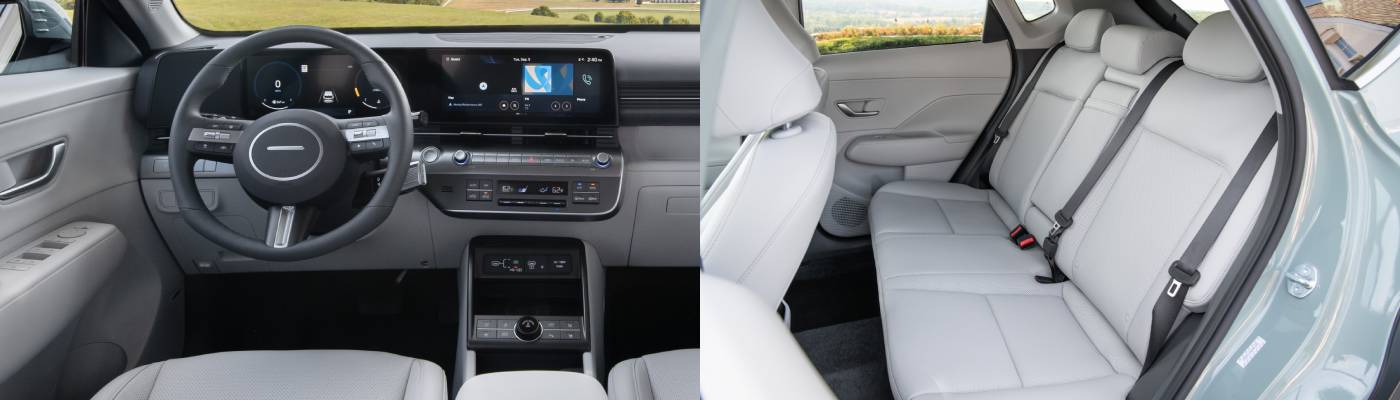
The Kona's interior is one of its strongest selling points, combining contemporary design with a surprising amount of passenger space. Hyundai has adopted a horizontal dashboard layout that emphasizes width and creates a more open feeling than the vehicle's exterior dimensions suggest. A broad panel houses the digital instrumentation and central infotainment display, giving the cabin an appearance reminiscent of more expensive Hyundai models. The available dual 12.3-inch screen configuration is particularly impressive, providing clear graphics and an integrated appearance without overwhelming the dashboard. Slim horizontal air vents, carefully positioned controls and available ambient lighting reinforce the contemporary design.
Material quality is generally good for the price, although the Kona does not entirely disguise its economy-car foundations. Entry-level SE and SEL Sport models feature cloth upholstery and an abundance of molded plastic surfaces. Some of these materials are hard to the touch, particularly along the lower dashboard, center console and door panels. However, the surfaces are generally well assembled, and their textures and finishes help prevent the cabin from looking inexpensive. SEL Premium and Limited models introduce H-Tex synthetic-leather upholstery, additional soft-touch surfaces and decorative trim that creates a more upscale atmosphere. The H-Tex material is attractive and relatively easy to maintain, although it should not be confused with genuine leather. On the Limited, the combination of patterned upholstery, ambient lighting and upgraded trim makes the interior feel closer to that of a compact luxury crossover than the modestly priced SE.
The dashboard design also benefits from Hyundai's decision to relocate the gear selector in turbocharged models to the steering column. This frees valuable space in the center console, allowing a larger storage area and a less cluttered appearance. The open console incorporates clever cupholders that can be repositioned to create additional space for larger personal belongings. Its design is particularly practical for carrying smartphones, wallets and other items that drivers want within easy reach. Hyundai has also avoided the temptation to replace every conventional control with a touchscreen, helping the cabin retain a familiar and approachable character. The result is a modern interior that feels technologically advanced without demanding a lengthy learning process.
INTERIOR FUNCTIONALTY
The Kona's control layout is refreshingly straightforward compared with many newer vehicles. Despite its large infotainment display, Hyundai retains physical controls for important functions, including audio volume, temperature adjustment and frequently used climate settings. This reduces the need to navigate touchscreen menus for routine operations. The central display is positioned high enough to remain within the driver's natural field of vision, and its large graphics are generally easy to understand. Steering-wheel controls provide access to audio, telephone, cruise-control and driver-information functions.
The separation of climate controls from the main touchscreen is especially welcome. Adjusting cabin temperature, fan speed or window defrosting does not require entering several menus, and the dedicated controls are easier to operate while wearing gloves. Automatic climate control is included on the SEL Sport and higher trims, while the SE uses a simpler manual system. Upper trims also provide rear air vents, improving passenger comfort during hot or cold weather.
Visibility is generally good thanks to the Kona's upright seating position, relatively large windows and manageable exterior dimensions. The driver sits high enough to maintain a clear view of surrounding traffic without feeling excessively elevated above the road. The available surround-view camera further simplifies parking, while front and rear parking sensors on the Limited help compensate for areas obscured by the bodywork. The rear window is somewhat smaller than the generous windshield, but the standard rearview camera makes reversing considerably easier. The Kona's 34.8-foot turning diameter also contributes to its maneuverability, allowing it to negotiate parking garages and tight urban streets with relatively little effort.
TECHNOLOGY & SAFETY
Technology remains one of the Kona's most convincing advantages. Every 2026 model features a 12.3-inch central touchscreen with wireless Apple CarPlay and Android Auto integration, allowing drivers to use familiar smartphone navigation, messaging and entertainment applications without connecting a cable. Bluetooth connectivity, SiriusXM satellite radio and Hyundai's Bluelink+ connected services are also included. The system responds reasonably quickly to commands, and its menu organization is generally logical. Higher trims add wireless smartphone charging and additional convenience features, while the Limited upgrades to a 12.3-inch digital instrument cluster that complements the central touchscreen. Most lower trims use a smaller 4.2-inch digital information display within the instrument panel. The larger Limited display provides more flexibility when presenting vehicle information and camera-based driver-assistance features.The Limited also features an eight-speaker Bose premium audio system, offering a worthwhile improvement for buyers who frequently listen to music or podcasts. Hyundai's Digital Key functionality is another available convenience, allowing a compatible smartphone to perform certain functions normally handled by the vehicle's key fob. Remote starting, connected vehicle management and over-the-air software updates add further functionality.
Safety technology is equally impressive, particularly because Hyundai includes many important systems as standard equipment. Every Kona receives Forward Collision-Avoidance Assist with pedestrian and cyclist detection, along with functionality designed to help mitigate certain collisions involving oncoming traffic at intersections. Blind-Spot Collision Warning, Rear Cross-Traffic Collision-Avoidance Assist, Lane Keeping Assist, Lane Following Assist, Driver Attention Warning, Safe Exit Warning and automatic high-beam headlights are also standard. For 2026, Smart Cruise Control with stop-and-go capability becomes standard throughout the lineup. This system automatically adjusts the vehicle's speed to maintain a selected following distance, reducing driver workload during highway travel and congestion. Hyundai's lane-centering assistance can provide gentle steering inputs to help keep the Kona positioned within its lane, although these systems require continued driver attention and do not provide autonomous driving capability.
PASSENGER SEATING & COMFORT
The Kona's increased exterior dimensions have translated into substantial improvements in passenger accommodations. The vehicle offers two rows of seating for five occupants, with individual front bucket seats and a three-passenger rear bench. There is no third-row option. Front-seat occupants enjoy 41.7 inches of legroom, 39.9 inches of headroom in models without a sunroof and 56.8 inches of shoulder room. These measurements are generous for a subcompact crossover, and the relatively upright seating position helps create the impression of a larger vehicle. The front seats offer sufficient adjustment for a wide variety of drivers, while the high roofline provides good head clearance when entering and exiting. The seating position also reduces the need to bend deeply when getting into the vehicle, making access relatively easy for older passengers or anyone who finds lower sedans uncomfortable.
Front-seat comfort varies somewhat by trim level. The SE and SEL Sport use cloth upholstery, while SEL Premium and Limited models substitute H-Tex synthetic leather. The SE and SEL Sport feature manually adjusted driver's seats, while higher trims receive an eight-way power driver's seat with lumbar adjustment. Heated front seats are included on the SEL Sport and higher models, and the Limited adds ventilation for warm-weather comfort. The Limited also receives a heated steering wheel. Seat cushioning is moderately firm, providing reasonable support during extended driving, although some occupants may prefer a softer seat. The available lumbar adjustment is useful for reducing fatigue, and the relatively wide adjustment range makes it easier to establish a comfortable driving position. However, buyers seeking the most supportive seats in the segment may prefer to compare the Kona directly with the Mazda CX-30 and other competitors before making a decision.
Rear-seat accommodations are particularly impressive given the Kona's exterior footprint. The second row provides 38.2 inches of legroom, 38.3 inches of headroom and 55.2 inches of shoulder room. These measurements allow two average-size adults to travel comfortably without the cramped feeling often associated with subcompact crossovers. Hyundai's slim front-seatback design helps maximize usable knee room, while the rear bench includes a two-position reclining backrest that allows passengers to adjust their seating posture. This feature is especially welcome on longer drives, where the ability to recline slightly can improve comfort considerably. Three passengers can occupy the rear bench, but shoulder room becomes limited with three adults sitting side by side. Two adults or a pair of children will be much more comfortable.
Entry and exit from the rear seats are relatively convenient because the Kona's doors open widely and the roofline remains sufficiently high to avoid excessive head ducking. The elevated seating position also makes installing child safety seats easier than in many traditional compact cars.
CARGO CAPACITY & INTERIOR STORAGE
Cargo space is another major improvement introduced with the second-generation Kona. With the rear seats upright, the 2026 model provides 25.5 cubic feet of cargo capacity behind the second row. Folding the 60/40-split rear seatbacks expands the available space to 63.7 cubic feet. Those measurements represent a substantial improvement over the original Kona and place the newer model among the more accommodating vehicles in the subcompact crossover segment. The relatively square cargo opening and upright rear hatch help maximize usable space, making it easier to accommodate grocery bags, suitcases, sports equipment and other everyday belongings. The load floor can also be repositioned to provide additional vertical space or a more convenient loading surface.
The rear seatbacks fold individually, allowing drivers to transport longer items while retaining seating for a rear passenger. With both sections folded, the cargo floor is reasonably flat, although it is not a perfectly uninterrupted surface. The resulting space can accommodate bicycles with appropriate preparation, larger pieces of luggage and relatively bulky household purchases. Cargo-area features include underfloor storage compartments and locations for securing smaller belongings. The Limited's hands-free smart power liftgate is especially convenient when carrying groceries or luggage, although its automatic opening function can occasionally activate when the key holder remains near the back of the vehicle. That behavior can be disabled through the vehicle's settings. Overall, the Kona's cargo capacity gives it a practical advantage over some sportier subcompact alternatives, though the Chevrolet Trax and Volkswagen Taos are also worth considering for their useful cargo configurations.
Storage throughout the passenger compartment is thoughtfully arranged. The front center console contains a relatively large open storage area, cupholders that can be repositioned to accommodate different items and smaller compartments for phones and personal belongings. The dashboard incorporates additional storage space, while door pockets can accommodate water bottles and other everyday items. The open console design provides more versatility than a conventional enclosed center armrest, although it also leaves some belongings exposed and may collect dust more easily. Rear passengers have access to door pockets and smaller storage compartments for phones and other personal items. These touches help the Kona function as a practical family vehicle despite its compact dimensions.
BOTTOM LINE
The 2026 Hyundai Kona succeeds by delivering many of the qualities buyers expect from a larger compact crossover while maintaining the manageable dimensions and affordability of a subcompact crossover. Its distinctive exterior styling will not appeal to everyone, but the design gives Kona a recognizable personality in a segment populated by vehicles that often look remarkably similar. More importantly, the generous passenger space, practical cargo compartment, intuitive controls and extensive standard technology make it exceptionally easy to live with. The turbocharged engine delivers strong acceleration for the class, and the availability of AWD across all trims provides useful flexibility for buyers facing challenging weather conditions. Hyundai's generous warranty coverage and impressive selection of standard driver-assistance systems further strengthen the vehicle's value. The principal shortcomings involve the underpowered base engine, inconsistent ride quality over rough pavement, limited steering feedback and noticeable road noise at highway speeds. The absence of a hybrid powertrain also leaves an important gap in the lineup, particularly as competitors increasingly offer more fuel-efficient alternatives. Nevertheless, Kona remains one of the more compelling choices for shoppers who prioritize interior space, technology and everyday usability over maximum performance or driving excitement.
For the best combination of performance, comfort, features and price, the SEL Premium stands out as the most appealing version of the 2026 Kona. Starting at $28,425 before destination charges, it provides the substantial performance improvement of the 190-horsepower turbocharged engine and eight-speed automatic without requiring buyers to pay for every luxury feature included on the Limited. Its upgraded upholstery, power driver's seat, heated front seats, wireless charging and additional convenience equipment make it feel considerably more upscale than the entry-level models. Choosing AWD improves all-weather traction and adds the independent rear suspension, although the 19-inch wheels may produce a firmer ride than some buyers prefer.