2026 Volkswagen Golf GTI
Fifty years in, the original hot hatch still knows how to turn up the heat.
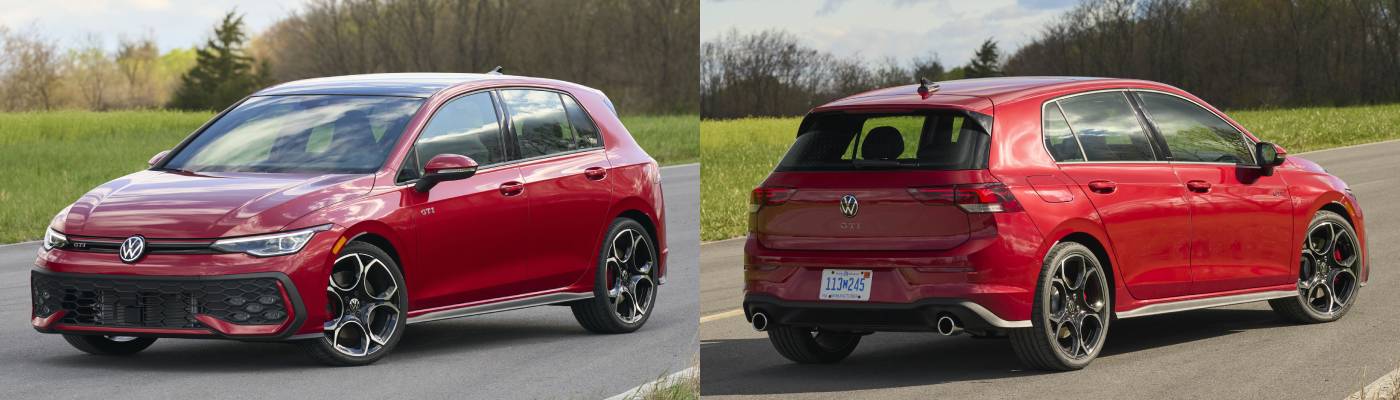
The 2026 Volkswagen Golf GTI continues a performance-car tradition that stretches back half a century, combining the everyday usefulness of a compact hatchback with the acceleration, handling and personality of a genuine sports car. Introduced in Europe in 1976 and arriving in the United States for the 1983 model year, the GTI helped establish the modern hot-hatchback category. Now in its eighth generation, the GTI received a substantial midcycle refresh for 2025, bringing revised exterior styling, improved infotainment technology and updated interior controls. Those changes carry over essentially unchanged for 2026. The GTI is available exclusively as a four-door hatchback with seating for five passengers, occupying a relatively small but enthusiastic corner of the compact performance-car market. Its primary competitors include the Honda Civic Si, Hyundai Elantra N, Subaru WRX and Toyota GR Corolla. Volkswagen also offers the more powerful Volkswagen Golf R for buyers seeking additional performance and all-wheel drive. While several competitors emphasize outright speed or aggressive styling, the GTI continues to distinguish itself through a carefully balanced combination of performance, comfort, practicality and understated design.
The 2026 Golf GTI is offered in three trim levels: S, SE and Autobahn. All three share a turbocharged 2.0-liter four-cylinder engine producing 241 horsepower and 273 pound-feet of torque. Power is delivered exclusively to the front wheels through a seven-speed DSG dual-clutch automatic transmission, which includes steering-wheel-mounted paddle shifters and a manual-shifting mode. Volkswagen discontinued the traditional six-speed manual transmission in the U.S. market following the 2024 model year, making the automatic the only choice. Every GTI receives a sophisticated electronically controlled limited-slip front differential, performance-oriented suspension tuning and selectable driving modes. The Autobahn adds adaptive dampers for greater control over ride firmness and handling response.
Pricing for the 2026 Golf GTI begins at $34,590 for the S, increases to $39,080 for the SE and reaches $42,480 for the Autobahn, excluding the $1,275 destination charge. The S is comes standard with a 12.9-inch touchscreen infotainment system, a configurable digital instrument cluster, heated front seats, a heated steering wheel, LED exterior lighting, 18-inch alloy wheels, keyless access and Volkswagen's IQ.DRIVE suite of driver-assistance technologies. The SE adds additional convenience and entertainment features, including an upgraded audio system and more upscale interior appointments, while the Autobahn emphasizes luxury and performance with adaptive chassis control, 19-inch wheels, leather seating surfaces, ventilated front seats, a head-up display and additional comfort equipment. Standard safety technologies include automatic emergency braking with pedestrian and cyclist detection, blind-spot monitoring, rear cross-traffic alert, adaptive cruise control, lane-keeping assistance and front and rear parking sensors. Available GTI Clubsport ArtVelours upholstery brings a distinctive European performance-inspired appearance to the cabin.
ACCELERATION & PERFORMANCE
The Golf GTI has always demonstrated that a performance car doesn't need enormous horsepower to deliver an entertaining driving experience. The 2026 model follows that philosophy with its turbocharged 2.0-liter four-cylinder engine, a familiar Volkswagen powerplant that combines strong low-speed torque with an energetic personality. Its 241 horsepower may seem modest alongside the 300-plus-horsepower outputs of some competitors, but the engine's 273 pound-feet of torque is available from relatively low engine speeds. That broad torque delivery makes the GTI feel stronger than its horsepower rating might suggest, particularly in everyday driving situations where immediate response is more important than maximum output.
Acceleration from a standing start is brisk, with Volkswagen quoting a 0-to-60-mph time of approximately 6.0 seconds. The GTI doesn't deliver the explosive acceleration of the all-wheel-drive Golf R, but it provides enough performance to make merging, passing and accelerating out of corners thoroughly entertaining. The front-wheel-drive layout also contributes to a relatively light and agile character compared with some heavier all-wheel-drive competitors.
One of the engine's most appealing qualities is its flexibility. Rather than requiring high engine speeds to produce meaningful acceleration, the turbocharged four-cylinder delivers a substantial surge of torque in the middle of its operating range. Passing slower traffic on a two-lane highway rarely requires much planning, and the GTI responds eagerly when the accelerator is pressed. At highway speeds, the engine maintains enough reserve power for confident overtaking without sounding strained. The engine becomes more vocal under hard acceleration, producing a deep, somewhat mechanical growl.
The seven-speed DSG dual-clutch automatic transmission is another important part of the GTI's performance personality. Unlike a conventional torque-converter automatic, the DSG uses separate clutches for alternating gear sets, allowing exceptionally quick shifts with minimal interruption in power delivery. In normal driving, the transmission generally operates smoothly but falls short of the low-speed smoothness of a traditional automatic. Switching to Sport mode makes its behavior noticeably more aggressive, holding lower gears longer, responding more quickly to accelerator inputs and executing rapid downshifts when approaching corners. Steering-wheel-mounted paddle shifters give the driver greater control over gear selection, and the transmission responds quickly enough to make manual shifting enjoyable on winding roads.
FUEL ECONOMY
The 2026 Volkswagen Golf GTI delivers respectable fuel economy for a compact performance car, particularly considering its acceleration capabilities and generous torque output. With its turbocharged 2.0-liter engine and seven-speed DSG automatic transmission, the GTI carries EPA estimates of 24 mpg in the city, 32 mpg on the highway and 27 mpg combined. Another plus is the fact that the GTI uses regular unleaded gasoline. Its fuel tank holds 13.2 gallons, providing an EPA-based theoretical highway driving range of approximately 422 miles and a city range of about 317 miles.
Real-world fuel economy depends heavily on driving style. The GTI's abundant torque makes it possible to accelerate briskly without revving the engine excessively, and the DSG transmission is effective at maintaining efficient engine speeds during relaxed cruising. Drivers who spend much of their time on suburban roads and highways should generally see fuel economy in the upper 20-mpg range, with 30 mpg or better attainable during favorable highway driving. Conversely, frequent full-throttle acceleration, heavy traffic and repeated short trips can pull consumption into the low 20s.
RIDE QUALITY
One of the Golf GTI's defining characteristics has always been its ability to combine sports-car handling with everyday comfort. The 2026 model continues that tradition, although its suspension tuning leans more toward performance than outright softness. Compared with an ordinary compact hatchback, the GTI has firmer springs, more tightly controlled dampers and a lower, more athletic stance. The result is a ride that communicates road conditions clearly without becoming excessively harsh under most circumstances. Smooth pavement reveals the GTI's refined side, while broken pavement reminds occupants that this is a performance-oriented vehicle.
The standard suspension uses MacPherson struts up front and a multilink independent arrangement in the rear. This configuration provides a substantial advantage over simpler rear suspension designs, particularly when encountering bumps in the middle of corners. Rather than allowing the rear wheels to react together, the independent suspension permits each wheel to respond to changing road surfaces with relatively little disturbance to the rest of the vehicle. The GTI feels firmly planted over highway expansion joints and moderate pavement imperfections, with controlled vertical movements and little of the float associated with comfort-oriented compact cars.
Ride quality varies noticeably between trim levels. The S and SE ride on 18-inch alloy wheels fitted with all-season tires, providing a reasonable amount of sidewall cushioning. These models generally deliver the most agreeable balance of everyday comfort and sporting response, particularly on rough urban streets. Sharp-edged potholes and broken pavement still transmit a noticeable impact into the cabin, but the suspension usually settles quickly afterward. The SE's additional luxury equipment does not fundamentally change its suspension characteristics, making its ride similar to that of the S.
The Autobahn takes a different approach with standard 19-inch wheels, lower-profile summer performance tires and Volkswagen's Dynamic Chassis Control adaptive damping system. The larger wheels and shorter tire sidewalls can make sharp impacts more pronounced, but the adaptive dampers provide a broader range of suspension behavior. In their softer settings, they allow more compliance over uneven pavement, while firmer settings improve body control during aggressive driving. The system is particularly useful on roads where smooth corners alternate with rough pavement, allowing the driver to adjust the car's behavior without changing vehicles.
Even with adaptive damping, the GTI should not be mistaken for a luxury-oriented compact car. Its suspension remains busy over deteriorated pavement, and repeated bumps can produce noticeable vertical movement. MotorTrend has criticized the firmness of the eighth-generation GTI during extended testing, indicating that some drivers may find its ride less forgiving than expected. That criticism is worth considering for buyers who regularly travel over poorly maintained roads. Nevertheless, the GTI generally avoids the relentless stiffness associated with more extreme performance cars, making it a reasonable daily driver for enthusiasts willing to accept some ride firmness in exchange for excellent handling. 
HANDLING & ROADHOLDING
Handling is arguably the Golf GTI's greatest strength, and the 2026 model demonstrates why Volkswagen's hot hatch has remained popular with driving enthusiasts for decades. The GTI doesn't rely on excessive horsepower or oversized tires to create excitement. Instead, its appeal comes from the way its steering, suspension, brakes and differential work together to produce a responsive and predictable driving experience. The car feels eager to change direction, with quick reactions that encourage the driver to seek out winding roads rather than simply endure them.
The GTI's electrically assisted steering features a variable-ratio system that provides relatively quick responses without making the car feel nervous at highway speeds. Initial turn-in is sharp, and the front wheels respond accurately to steering inputs. Steering effort increases in Sport mode, giving the driver a stronger sense of resistance, although that added weight does not necessarily translate into more information about available tire grip. Like many modern electrically assisted systems, the GTI's steering is more precise than communicative. Nevertheless, its accuracy and consistency make it easy to position the car confidently through corners.
Body control is excellent for a practical five-passenger hatchback. The GTI exhibits relatively little lean during hard cornering, and the suspension keeps the body settled during rapid changes in direction. Its compact dimensions and relatively short wheelbase contribute to an agile personality, particularly on narrow roads with closely spaced curves. Unlike larger performance sedans, the GTI feels easy to place within its lane, and its modest exterior dimensions make it approachable for drivers who don't routinely explore a vehicle's performance limits.
The electronically controlled VAQ limited-slip front differential plays an important role in the GTI's cornering ability. Powerful front-wheel-drive cars often struggle to apply power while turning because the inside front wheel becomes unloaded and begins spinning. The GTI's differential helps direct torque to the wheel with greater traction, allowing the driver to accelerate earlier and more confidently when exiting a corner. The system also helps counteract understeer, the tendency of a front-wheel-drive vehicle to push toward the outside of a turn. It cannot eliminate the fundamental limitations of front-wheel drive, but it makes the GTI remarkably effective at using its available power.
Braking performance is similarly impressive. All GTI models receive four-wheel disc brakes with ventilated rotors, supported by anti-lock braking and electronic brake assistance. The pedal generally delivers a firm, progressive response that makes it easy to modulate braking force during ordinary driving and more aggressive maneuvers.
Compared with competitors, the GTI occupies an appealing middle ground. The Hyundai Elantra N offers a more aggressive personality and higher performance limits, while the Toyota GR Corolla emphasizes all-wheel-drive traction and rally-inspired character. The Honda Civic Si delivers excellent steering precision and manual-transmission involvement, but its lower horsepower output makes it less forceful in straight-line acceleration. The GTI doesn't necessarily dominate any single performance category, but its combination of speed, composure and accessibility makes it one of the most satisfying all-around vehicles in the class.
INTERIOR NOISE LEVELS
The 2026 Golf GTI offers a reasonably refined cabin for a compact performance car, although its sporting priorities mean it isn't as quiet as a conventional family sedan or luxury hatchback. At idle and during relaxed cruising, the turbocharged four-cylinder remains relatively subdued, with little vibration transmitted through the steering wheel or seating surfaces. The engine becomes more prominent under acceleration, producing a deep, purposeful sound that adds character without becoming excessively harsh. Volkswagen has clearly attempted to preserve enough mechanical personality to satisfy enthusiasts while maintaining the refinement expected of a modern European compact car.
Road noise is more noticeable, particularly on coarse asphalt or concrete highways. The GTI's performance-oriented tires and firm suspension allow a fair amount of tire noise to reach the cabin, and the relatively short distance between the rear wheels and passenger compartment makes the hatchback body style somewhat more susceptible to rear tire noise than a traditional sedan. The Autobahn's 19-inch summer tires can produce additional road noise depending on the pavement surface, while the S and SE's 18-inch all-season tires generally provide a more relaxed acoustic experience. Wind noise is reasonably well controlled at highway speeds, with limited turbulence around the windshield pillars and side mirrors. However, the GTI is not exceptionally quiet at interstate speeds.
INTERIOR DESIGN & MATERIALS
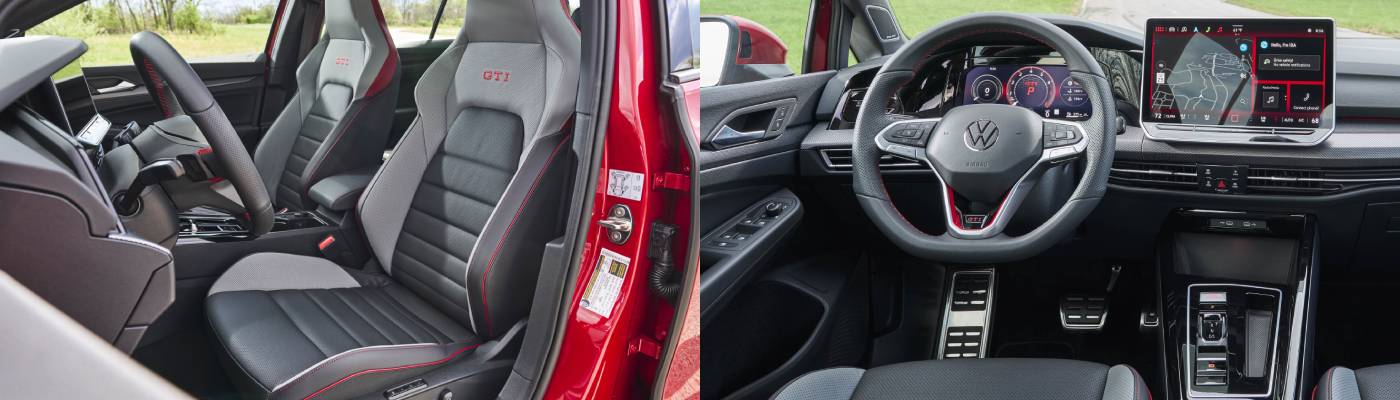
The Golf GTI's interior combines modern Volkswagen design with several traditional styling elements that connect it to earlier generations. The dashboard is dominated by digital displays, horizontal trim elements and a relatively clean arrangement of surfaces. Rather than using an abundance of physical buttons and switches, Volkswagen has adopted a minimalist approach that places much of the vehicle's functionality within the central touchscreen. The result is a cabin that looks contemporary and sophisticated, although some of its design decisions prioritize appearance over convenience.
Materials quality is generally good for the compact performance segment, with soft-touch surfaces across important areas of the dashboard and upper door panels. The GTI also incorporates contrasting textures, metallic-look accents and red stitching to distinguish itself from an ordinary Golf. Gloss-black trim adds visual contrast but can collect fingerprints and dust, while some lower dashboard and console surfaces use harder plastics that feel less expensive than the car's price might suggest.
One of the GTI's most recognizable interior traditions is its plaid upholstery. The S trim continues this heritage with Scalepaper Plaid cloth seating surfaces, giving the cabin a distinctive appearance that immediately identifies the car as a GTI. The plaid pattern is more than a nostalgic styling exercise; it provides a welcome alternative to the increasingly common black leather interiors found in performance vehicles. The cloth also offers good grip during spirited driving and avoids some of the temperature extremes associated with leather upholstery. The SE introduces GTI Clubsport-inspired ArtVelours seating surfaces with a hexagonal pattern and contrasting red accents. These seats provide a more contemporary performance appearance while retaining the supportive shape of the standard sport seats.
Overall, the interior successfully blends sporting character with practical design, although it no longer enjoys the overwhelming materials-quality advantage that earlier GTI generations held over many competitors. The Honda Civic has raised expectations for compact-car interior quality, and the GTI's extensive use of touch-sensitive technology can make its cabin feel less intuitive than its clean appearance suggests.
INTERIOR FUNCTIONALTY
Interior functionality is one area where the current-generation Golf GTI has received considerable criticism. Earlier GTI models were admired for their straightforward controls, clearly labeled buttons and logical dashboard layouts. The eighth-generation model moved away from that philosophy, replacing many traditional switches with touch-sensitive surfaces and touchscreen menus. Volkswagen addressed some of the complaints during the 2025 refresh, but the 2026 GTI still requires more interaction with its central display than many drivers would prefer.
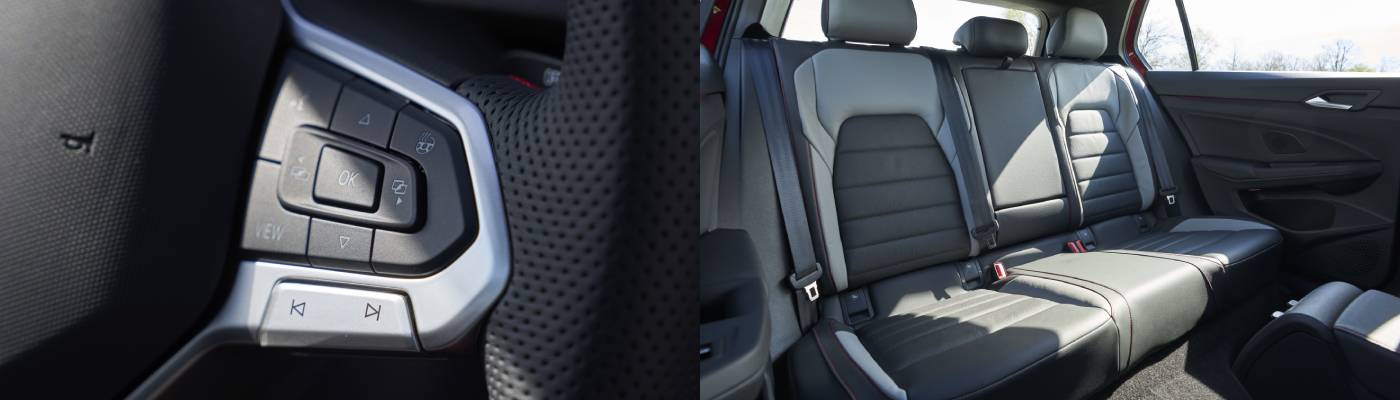
The most welcome improvement is the return of physical pushbutton controls on the steering wheel. Earlier eighth-generation GTI models used touch-sensitive steering-wheel controls that could be activated accidentally while driving. The conventional buttons provide better tactile feedback and make it easier to adjust audio settings, navigate instrument displays and operate driver-assistance functions without looking away from the road. This relatively simple change represents a meaningful improvement in everyday usability.
The large 12.9-inch center touchscreen provides crisp graphics, improved processing speed and a more modern interface than the original eighth-generation system. Frequently used functions are more accessible than before, and the screen's generous dimensions make navigation maps and entertainment information easy to read. That being said, climate adjustments and several secondary functions still depend on touch-sensitive controls or digital menus that a confounding and confusing.
Plues include excellent outward visibility, supportive seating and practical storage makes everyday driving relatively effortless. Still, buyers who place a high priority on simple physical controls may find the Honda Civic Si's more conventional interior layout preferable.
TECHNOLOGY & SAFETY
Technology is a major component of the 2026 Golf GTI's appeal, with an impressive collection of standard features that would have been considered luxury equipment only a few years ago. Every trim includes Volkswagen's Digital Cockpit Pro, featuring a configurable 10.25-inch digital instrument cluster. Drivers can select different display arrangements emphasizing speed, engine information, navigation or other vehicle data. Performance-oriented graphics reinforce the GTI's character, while the ability to prioritize different information makes the system useful for both commuting and spirited driving. The standard 12.9-inch touchscreen serves as the central interface for navigation, entertainment, vehicle settings and climate-related functions. Wireless Apple CarPlay and Android Auto compatibility allow smartphone applications to be displayed without connecting a cable, while Bluetooth connectivity supports hands-free calling and audio streaming. Wireless smartphone charging is standard, with a ventilated charging pad designed to reduce heat buildup during operation. USB-C ports are provided for additional connectivity and charging needs.
Audio equipment varies by trim. The S receives a seven-speaker sound system, while the SE and Autobahn upgrade to a Harman Kardon premium audio system with a subwoofer and dedicated amplifier. The upgraded system offers greater audio depth and improved low-frequency reproduction, making it an appealing feature for drivers who regularly listen to music during longer trips. SiriusXM capability, connected vehicle services and available in-vehicle Wi-Fi further expand the GTI's technology offerings. The Autobahn adds a head-up display that projects selected driving information into the driver's forward field of vision. This is particularly useful in a performance vehicle because it reduces the need to look down at the instrument cluster while monitoring speed. The Autobahn also includes Park Assist Plus, which can assist with steering, speed and gear changes during supported parking maneuvers. These features help distinguish the top trim from the more affordable models, although the GTI's compact dimensions already make it relatively easy to park.
Safety equipment is extensive across the lineup. Volkswagen's IQ.DRIVE system is standard on every 2026 GTI and includes forward collision warning, automatic emergency braking with pedestrian and cyclist monitoring, active blind-spot monitoring, rear cross-traffic alert, adaptive cruise control with stop-and-go capability and lane-keeping assistance. Travel Assist combines adaptive cruise control and lane-centering assistance to reduce driver workload during suitable highway conditions, although it remains a driver-assistance system rather than autonomous driving technology.
PASSENGER SEATING
The 2026 Volkswagen Golf GTI provides seating for five passengers in a conventional two-row configuration. Unlike some compact performance cars that compromise passenger space in pursuit of aggressive styling, the GTI retains the basic dimensions and practical layout of the Golf hatchback. Its relatively tall roofline, upright seating positions and four passenger doors make it more accommodating than its compact exterior dimensions might suggest. Front-seat accommodations are particularly good. The sport seats provide substantial lateral support without being excessively narrow, allowing them to accommodate a reasonably broad range of body types. Their integrated head restraints and prominent bolsters give them a distinctly athletic appearance, but the cushioning is designed for everyday comfort rather than track-only use. The seating position is relatively low, creating a connected feeling with the vehicle, while the wide range of steering-wheel adjustment helps drivers find a comfortable relationship between the wheel, pedals and seat. The S and SE provide manually adjustable front seating with power recline functions, while the Autobahn includes a power-adjustable driver's seat with memory. Heated front seats are standard across the lineup, an especially welcome feature in colder climates. Ventilated front seats are included on the Autobahn and available through the SE Leather Seating Package. The heated steering wheel is also standard, adding another comfort feature that makes the GTI appealing as a year-round daily driver.
The rear seat is more spacious than the GTI's exterior dimensions might suggest. With approximately 35 inches of rear legroom, the Volkswagen can accommodate two adults reasonably comfortably, particularly when the front occupants are not exceptionally tall. Rear headroom is also respectable because the roofline does not slope dramatically toward the hatch. The relatively upright seating position makes efficient use of the available space, and the rear cushions provide adequate support for ordinary trips. Rear-seat access is straightforward thanks to the GTI's four-door configuration. The doors provide reasonably generous openings, and the roofline allows most passengers to enter without excessive bending. The low seating position means occupants must lower themselves farther than they would in a crossover SUV, but entry and exit are generally easier than in a traditional low-slung sports coupe.
Compared with its competitors, the GTI offers a particularly effective combination of supportive front seats and useful rear accommodations. The Honda Civic Si provides a more spacious sedan body, while the Hyundai Elantra N also offers generous passenger room. The Toyota GR Corolla has a tighter rear seating area, and the Subaru WRX offers useful space but lacks the GTI's hatchback flexibility. For buyers who want a performance car that can regularly carry passengers, the GTI remains an attractive choice.
CARGO CAPACITY & INTERIOR STORAGE
Cargo versatility is one of the Golf GTI's most important advantages over traditional compact performance sedans. The 2026 model provides 19.9 cubic feet of cargo space behind the rear seats, considerably more than the trunk capacity of many compact sedans. Folding the rear seatbacks expands the available cargo volume to 34.5 cubic feet, creating a long, relatively flat loading area capable of accommodating larger objects. These figures make the GTI particularly useful for buyers who want sports-car performance without sacrificing the ability to carry luggage, groceries, sporting equipment or other everyday cargo.
The hatchback design provides a large rear opening that makes loading bulky items easier than through a conventional sedan trunk. The rear liftgate extends upward, exposing a broad cargo area with relatively little obstruction. The cargo floor is adjustable, allowing owners to prioritize either a flatter loading surface or additional storage depth. A retractable cargo cover helps conceal valuables when the rear seats are upright, while the relatively square cargo area makes efficient use of the available space. The rear seats feature a 60/40 split-folding configuration, allowing one or two rear seating positions to remain available while carrying longer objects. A center pass-through also makes it possible to transport narrow items such as skis without folding either rear seatback completely. The ability to combine passenger and cargo space gives the GTI an advantage over performance sedans with smaller trunk openings.
Interior storage is adequate rather than exceptional. The front center console provides space for small personal items, while the door pockets can accommodate bottles and other everyday necessities. Cupholders are located between the front seats, and the glove compartment offers additional enclosed storage. The rear center armrest includes cupholders for passengers, although the GTI's compact dimensions limit the amount of storage available throughout the cabin.
BOTTOM LINE
The 2026 Volkswagen Golf GTI remains one of the most well-rounded compact performance cars available in the United States, delivering an appealing combination of acceleration, handling, comfort and everyday practicality. Its turbocharged engine provides strong midrange power, the seven-speed DSG transmission delivers rapid shifts, and the sophisticated front differential helps translate that performance into confident cornering. The GTI is not the fastest vehicle in its competitive set, nor does it offer the raw mechanical involvement of a manual transmission, but its greatest strength is its versatility. Few performance cars feel equally comfortable navigating crowded city streets, covering hundreds of highway miles and attacking a winding back road. The practical hatchback body, comfortable seating, generous standard safety equipment and respectable fuel economy further strengthen its appeal. Weaknesses include the frustrating touchscreen-based controls, a relatively firm ride over rough pavement, and noticeable tire noise. The Hyundai Elantra N and Toyota GR Corolla offer more aggressive performance personalities, while the Honda Civic Si and Subaru WRX provide manual-transmission alternatives. Nevertheless, the GTI's combination of refinement, performance and utility gives it a distinctive position in the market. It remains a vehicle that can satisfy an enthusiast without demanding significant compromises from everyone else who rides in it.