2026 Mazda Mazda3
A premium-minded compact that still remembers driving Is supposed to be fun.
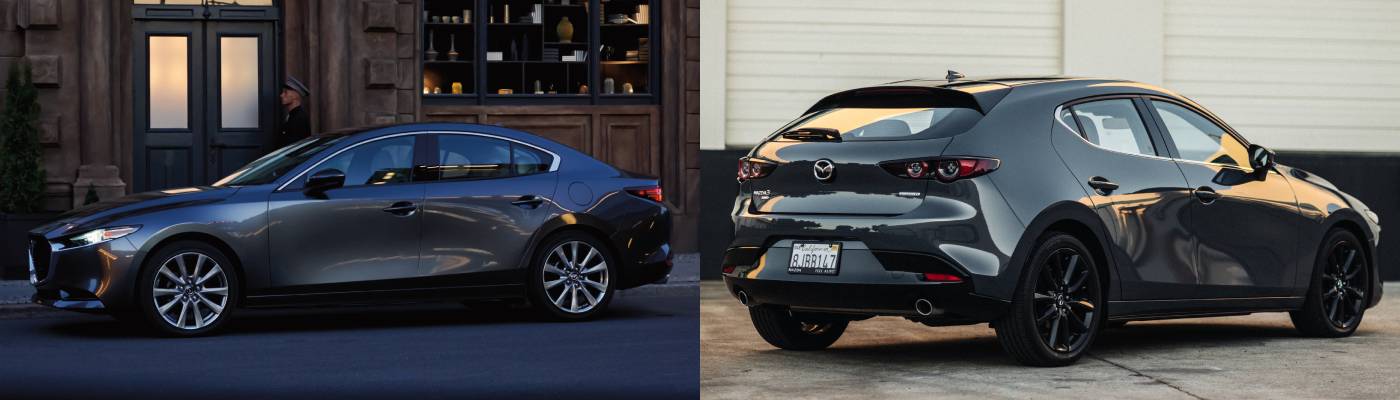
The 2026 Mazda3 enters another model year as one of the increasingly rare compact cars that still places driving character and upscale design near the top of its priorities. The Mazda3 nameplate has been sold in the United States since the 2004 model year, replacing the Protegé, with the current fourth generation arriving in 2019. For 2026, Mazda has not redesigned the car; instead, it makes modest equipment and packaging changes, most notably making its eight-speaker Mazda Harmonic Acoustics audio system standard and adding equipment to the top Turbo Premium Plus. The Mazda3 remains a five-passenger compact offered as either a four-door sedan or five-door hatchback, with the two sharing their basic platform, cabin architecture and powertrains but differing considerably in exterior styling and cargo versatility. Key competitors include the Honda Civic, Hyundai Elantra, Kia K4, Nissan Sentra, Subaru Impreza, Toyota Corolla and Volkswagen Jetta.
The sedan lineup consists of 2.5 S, 2.5 S Select Sport, 2.5 S Preferred, 2.5 S Carbon Edition and 2.5 Turbo Premium Plus trims. The hatchback offers those same versions plus a 2.5 S Premium, which is significant because it is the only Mazda3 still available with a six-speed manual transmission. The standard naturally aspirated 2.5-liter four-cylinder develops 186 horsepower and 186 pound-feet of torque for 2026. Most versions pair it with a conventional six-speed automatic and front-wheel drive; the Carbon Edition combines the naturally aspirated engine with the automatic and standard i-ACTIV AWD. The manual-transmission Premium hatchback is front-drive only. At the top is Mazda's turbocharged 2.5-liter four-cylinder, producing 227 horsepower and 310 pound-feet on regular gasoline or as much as 250 horsepower and 320 pound-feet on 93-octane premium. It comes exclusively with the six-speed automatic and AWD.
Pricing remains competitive at the lower end but becomes considerably more ambitious as equipment and performance are added, perhaps a nod to the Mazda3's positioning as a premium compact. The sedan starts at $24,650 for the 2.5 S, followed by the $25,540 Select Sport, $27,290 Preferred, $29,815 Carbon Edition and $36,940 Turbo Premium Plus. Hatchback prices are $25,650, $26,840, $28,640, $30,965, $31,650 and $38,090, respectively. All models include blind-spot monitoring, rear cross-traffic alert, Mazda Radar Cruise Control with Stop & Go, Apple CarPlay and Android Auto, while Select Sport adds items including leatherette seating and dual-zone climate control. Preferred brings heated front seats, a moonroof and power driver's seat; Carbon Edition combines AWD with distinctive exterior finishes and red leather; and the Premium manual hatchback adds leather and a 12-speaker Bose audio system. Turbo Premium Plus brings the strongest equipment list, including the 10.25-inch display, wireless smartphone integration, paddle shifters, heated steering wheel, Bose audio and 360-degree camera.
ENGINE PERFORMANCE
The pairing of a naturally aspirated engine with a conventional automatic or manual transmission is unusual in a compact-car class increasingly populated by smaller turbocharged engines, hybrids and continuously variable transmissions. Its 186 horsepower and 186 pound-feet of torque are healthy numbers, and the engine's relatively large displacement gives it good response without waiting for turbo boost. Around town, throttle response is predictable and linear, and the Mazda3 feels stronger coming away from a stop than many economy-oriented compacts. There is enough low- and midrange torque that normal acceleration rarely requires working the engine especially hard.
The conventional six-speed automatic deserves some credit for that impression. Six gears may sound old-fashioned in an era of eight-, nine- and 10-speed automatics, but the Mazda transmission generally chooses ratios intelligently and avoids the disconnected, rubber-band sensation associated with many CVTs. Downshifts are positive when additional power is requested, although six widely spaced ratios mean the engine can occasionally fall farther from its power peak than it would with a transmission offering more gears. The Mazda3 will accelerate from 0 to 60 mph in about 7.0 seconds and 7.5 seconds for a naturally aspirated AWD sedan.
The manual hatchback changes the Mazda3's personality even though it does not dramatically improve acceleration. The six-speed gearbox has a precise mechanical action, sensible clutch engagement and well-chosen pedal placement. More important than the stopwatch is the additional involvement. Because the engine develops its strongest performance higher in the rev range, choosing gears yourself makes extracting that performance entertaining in a way few remaining compact cars can match.
The 2.5 Turbo is an entirely different proposition. With premium fuel it delivers 250 horsepower and a substantial 320 pound-feet of torque, while regular gasoline still yields 227 horsepower and 310 pound-feet. That torque transforms passing performance. Instead of needing a downshift and a run toward redline, the turbo Mazda3 produces a strong surge from relatively low engine speeds. Acceleration to 60 mph improves to 5.6 seconds from a turbo AWD sedan, genuinely quick performance for a mainstream compact.
Interestingly, Mazda does not tune the Turbo like a traditional high-strung sport compact. Power delivery is broad and muscular rather than dramatic, and the six-speed automatic emphasizes smoothness more than lightning-fast shifts. That makes the Turbo an exceptionally effective highway car, with effortless merging and passing power, but drivers expecting the aggressive personality of a dedicated hot hatch may find it surprisingly mature. Sadly, there is no manual transmission option with the turbo engine, which remains one of the Mazda3 lineup's more frustrating omissions for enthusiasts.
FUEL ECONOMY
Fuel economy is respectable rather than class-leading, largely because every Mazda3 uses a relatively large 2.5-liter engine and Mazda offers neither a hybrid nor a smaller economy-focused powertrain. For 2026, the naturally aspirated automatic sedan with front-wheel drive is rated at 27 mpg city, 36 highway and 30 combined. The naturally aspirated AWD sedan drops slightly to 26/34/29 mpg. The front-drive automatic hatchback is rated at 26/34/29, while the AWD hatchback is 25/34/28. The manual hatchback is also rated at 25/34/28.
Turbo models pay a larger efficiency penalty. The AWD Turbo sedan is rated at 23 mpg city, 32 highway and 27 combined, while the Turbo hatchback manages 23/31/26. Those numbers are reasonable given the Turbo's performance and standard AWD, but buyers interested primarily in minimizing fuel consumption will find significantly more efficient alternatives among hybrid versions of competitors such as the Civic and Corolla.
The naturally aspirated engine is designed for regular unleaded. The Turbo can also run on regular and produces 227 horsepower and 310 pound-feet when doing so; premium 93-octane fuel is required to extract its full 250 horsepower and 320 pound-feet. Front-drive Mazda3 models carry 13.2 gallons of fuel, while AWD versions use a slightly smaller 12.7-gallon tank. Multiplying EPA highway ratings by usable rated capacity produces theoretical highway ranges of roughly 475 miles for a FWD sedan, 449 miles for a FWD automatic hatchback, about 432 miles for the naturally aspirated AWD sedan and hatchback, roughly 406 miles for the Turbo sedan and 394 miles for the Turbo hatchback. Actual distance between fill-ups will normally be lower because drivers do not completely empty the tank.
Real-world fuel efficiency is quite encouraging considering the larger-displacement engine. Drivers might see as high as 36 mpg is straight highway driving and perhaps 27 mpg in a suburban mix. Mixed driving, short trips and aggressive use of the Turbo's considerable torque will naturally pull results downward. Mazda should be commended for focusing on reducing weight and increasing engine efficiency instead of relying solely on tiny turbocharged engines, sloppy CVT transmissions and gimmicky start-stop technology to artificially boost fuel economy numbers. Mazda has paid attention to the details and the result is a fuel efficient compact that doesn't compromise driveability for efficiency.
ALL-WHEEL DRIVE & DRIVE MODES
Mazda's i-ACTIV AWD system is standard on the naturally aspirated Carbon Edition and Turbo Premium Plus and unavailable on the other 2026 trims. Rather than functioning as an off-road system, i-ACTIV AWD is designed primarily to improve traction and maintain natural handling on wet, snowy or otherwise slippery pavement. Mazda integrates AWD with G-Vectoring Control Plus, adjusting engine torque, braking and front-to-rear torque distribution to make the car respond more naturally during cornering; Mazda describes the system as predictive rather than simply reactive to wheelspin. Automatic-transmission models also offer a Sport drive setting that sharpens accelerator response and encourages the transmission to hold lower gears.
RIDE QUALITY
The Mazda3's ride reflects the same philosophy as the rest of the car: controlled first, cushy second. Mazda uses MacPherson struts in front and a torsion-beam rear suspension, a comparatively simple arrangement that generated some concern when the current generation appeared because the previous Mazda3 used an independent multilink rear suspension. In practice, Mazda's chassis tuning disguises most of the theoretical disadvantage of a torsion-beam suspension remarkably well. Overall, the ride is refined and firm without becoming punishing.
On smooth pavement, the Mazda3 feels surprisingly sorted and settled for a compact car. Vertical body motion is tightly controlled, freeway undulations do not produce repeated bouncing, and the suspension quickly settles the body after a bump. That composure helps give the Mazda3 the substantial feel normally associated with a more expensive vehicle.
Sharp pavement imperfections expose the firmer side of the setup. Models wearing 18-inch wheels and 215/45-series tires transmit more impact through potholes, broken expansion joints and abrupt pavement edges than the base car's 16-inch wheels and taller-sidewall tires. The difference is worth considering in areas with poor roads. The 16-inch setup sacrifices some visual drama but provides the best bump absorption.
The torsion-beam rear axle can occasionally make itself known when one rear wheel encounters a sharp bump in the middle of a corner, but it rarely compromises the car's overall composure. The Mazda3 isn't the softest compact sedan or hatchback, but its ride has a deliberate, well-damped quality that feels sophisticated rather than inexpensive.
HANDLING & ROADHOLDING
Handling remains one of the Mazda3's defining characteristics. The steering is not artificially heavy, yet it builds effort naturally and points the car accurately. Small steering corrections produce predictable responses rather than nervousness, and there is a satisfying relationship between steering input and the rate at which the body changes direction. Body lean is present but restrained. More importantly, the chassis takes a set progressively rather than suddenly rolling onto its outside tires. The G-Vectoring Control Plus on AWD models subtly alters engine torque and can use braking to influence yaw, but its intervention is largely transparent. The result is a car that feels cooperative rather than electronically manipulated.
Braking performance is equally reassuring with stopping distances being respectably short for an everyday compact on all-season tires. Pedal action is progressive and easily modulated in normal driving.
The Turbo's additional power does not turn the Mazda3 into an uncompromising hot hatch. Instead, AWD and abundant torque make it a very fast version of an already capable road car. Drivers looking for maximum steering feedback, track-ready brakes and an aggressive limited-slip differential may prefer a dedicated performance model, but the Mazda strikes an appealing compromise between everyday refinement and genuine enthusiasm.
INTERIOR NOISE LEVELS
Cabin isolation is another area where the Mazda3 tends to feel more expensive than its price suggests. Engine noise is muted in ordinary driving, wind noise is well controlled and the body structure does a good job suppressing the hollow resonance that can afflict inexpensive compact cars. The engine becomes clearly audible when worked hard, particularly the naturally aspirated version because passing maneuvers often require higher rpm. The Turbo usually feels quieter subjectively because its greater low-speed torque means it doesn't need to rev as hard. Tire noise can also increase noticeably on coarse pavement, particularly with the 18-inch wheel-and-tire package.
Compared with mainstream compact rivals, the Mazda3's combination of subdued powertrain noise and substantial cabin construction remains one of its stronger attributes. Some newer competitors have narrowed the refinement gap, but the Mazda still avoids much of the economy-car ambience found at the lower end of the segment. The hatchback's open cargo area allows slightly more rear tire and cargo-area noise into the cabin than the sedan's isolated trunk.
INTERIOR DESIGN & MATERIALS
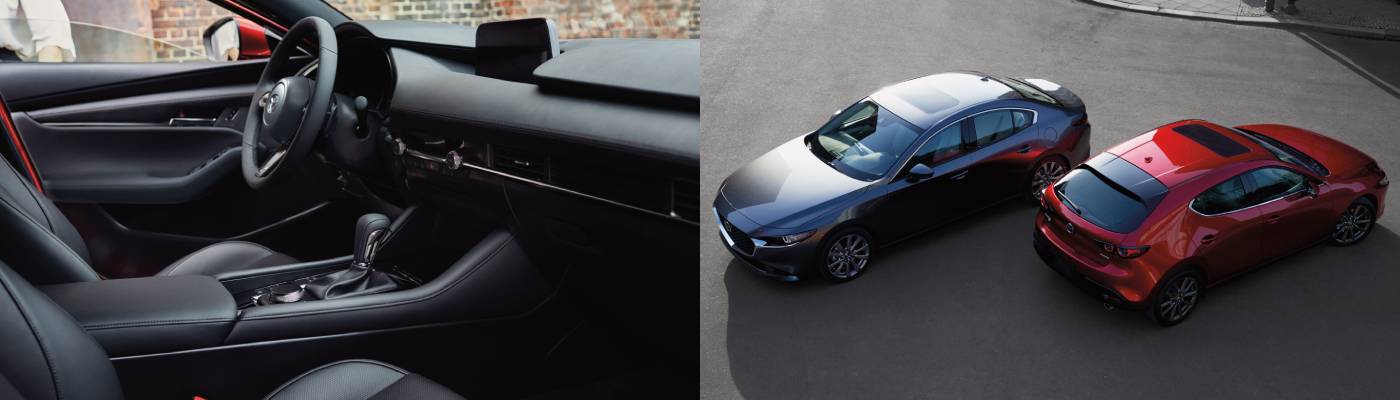
Open the door and the Mazda3 immediately explains why the car is frequently discussed alongside vehicles carrying more prestigious badges. The dashboard is low, horizontal and unusually free of visual clutter. Rather than filling the cabin with enormous screens and glossy-black touch-sensitive panels, Mazda uses a restrained layout with stitched surfaces, metallic accents and conventional physical controls.
Material quality is impressive for the segment. Frequently touched areas are generally padded, switches move with a satisfying solidity, and the controls have consistent weighting. Selecting the Sport trim introduces leatherette upholstery, Preferred adds comfort equipment including heated front seats and a power driver's seat, Carbon Edition supplies striking red leather, and upper hatchback and Turbo models move farther into premium territory with genuine leather and additional equipment.
The driver's environment is particularly successful. The gauges sit directly ahead rather than attempting to look futuristic for its own sake, the steering wheel has a relatively thin rim and straightforward controls, and the center console positions the shifter and infotainment controller naturally within reach. Mazda's emphasis on positioning the driver, wheel and pedals correctly pays dividends on longer trips.
The downside is packaging. The low-slung exterior styling, including the hatchback's thick rear pillars and rising beltline, reduces outward visibility. The cabin can feel darker and more enclosed than a Honda Civic, and rearward visibility in the hatchback is notably compromised. Fortunately, blind-spot monitoring is standard, while the Turbo Premium Plus adds a 360-degree camera that helps compensate.
INTERIOR FUNCTIONALITY & CONTROLS
Mazda's infotainment philosophy differs from much of the industry. The central display is not a touchscreen but is positioned high on the dashboard where it can be viewed with minimal eye movement. A rotary controller and shortcut buttons on the console handle most interactions. Once familiar, the system can be operated largely by feel without reaching forward and poking at a screen.
There is a learning curve. Drivers accustomed to smartphones may initially wonder why they cannot simply touch every menu item. The available 10.25-inch display on Premium Plus models does offer touchscreen operation when using Apple CarPlay or Android Auto, but Mazda continues to emphasize the console controller.
Physical climate controls are another welcome feature. Temperature, fan and defrost functions do not disappear into touchscreen menus, making routine adjustments easy while driving. Steering-wheel switches are similarly conventional and logically grouped.
The Mazda3 therefore may not produce the strongest first impression for someone judging technology by screen acreage, but prolonged use reveals considerable thought behind the layout. It is an interior designed around driving rather than around demonstrating how many functions can be buried in software. It's amazing how much a thoughtfully, some might argue classically, designed interior can both reduce driver fatigue and increase overall functionality.
TECHNOLOGY & SAFETY
Every Mazda3 includes Mazda Connect infotainment with Apple CarPlay and Android Auto integration, Bluetooth connectivity and Mazda Connected Services. For 2026, Mazda Harmonic Acoustics with eight speakers becomes standard, improving the base audio system, while the available Bose system uses 12 speakers. Alexa Built-in is available on higher trims, and Mazda Connected Services includes remote functions through the MyMazda app, with a one-year trial on a new 2026 Mazda3.
The safety equipment list is particularly comprehensive. Standard equipment includes Smart Brake Support automatic emergency braking, blind-spot monitoring, rear cross-traffic alert, lane-departure warning, lane-keep assist, driver-attention alert and Mazda Radar Cruise Control with Stop & Go. Upper trims add more sophisticated functions, and Turbo Premium Plus includes front and rear parking sensors and a 360-degree View Monitor.
PASSENGER SEATING
Every Mazda3 seats five in two rows, although four adults represent a much more comfortable real-world load. Front-seat occupants are prioritized and receive approximately 42.3 inches of legroom and 55.7 inches of shoulder room. The driving position provides an unusually broad adjustment range. The seats themselves combine relatively firm padding with effective support. Long seat cushions support the thighs well, while the seatbacks provide enough lateral support for enthusiastic driving without restrictive bolsters. Preferred and higher trims substantially improve long-distance comfort through heated seats and an eight-way power driver's seat with memory.
Rear accommodations are less impressive. Published specifications list roughly 35 inches of rear legroom, depending on measurement methodology, with approximately 53.5 inches of shoulder room. In reality those numbers are highly optimistic. In reality, space is adequate for average adults but noticeably less generous than the most spacious compact competitors. Headroom is also affected by the sleek roofline, particularly in the hatchback. Adults can fit, but tall passengers may find the rear compartment confined. The relatively small rear windows add to that sensation. Getting into the front seats is easy enough, although the Mazda sits low compared with today's crossovers. Rear access requires a little more ducking under the roofline. There is no third row.
CARGO CAPACITY & INTERIOR STORAGE
The sedan provides 13.2 cubic feet of trunk volume. That's usable space for groceries, luggage and normal daily duty, though several compact sedans offer larger trunks. The rear seatbacks split and fold, allowing longer objects to extend from the trunk into the passenger compartment. The hatchback starts with 20.1 cubic feet behind its rear seat, immediately giving it an advantage for tall or awkwardly shaped cargo. Fold the 60/40 rear seatbacks and maximum capacity increases to approximately 47.1 cubic feet. The hatch opening also makes bicycles, boxes and other bulky objects considerably easier to load than through the sedan's trunk opening.
Inside, Small-item storage is adequate rather than exceptional. There are door pockets, cupholders, a center-console compartment and glovebox, but Mazda has devoted more space to clean design than to scattering bins around the cabin. USB connectivity is provided for device charging and smartphone integration, but there is no household-style 120-volt AC outlet. For most owners, the hatchback's flexible rear cargo compartment will be the more significant practical advantage.
BOTTOM LINE
The 2026 Mazda3 continues to occupy an interesting corner of the compact-car market. At its lower trim levels, it competes directly with conventional economy sedans and hatchbacks while offering a notably richer cabin, a strong 2.5-liter engine and unusually rewarding steering and chassis behavior. It also retains two increasingly uncommon choices: available all-wheel drive and, in the Premium hatchback, a six-speed manual transmission. The Turbo Premium Plus adds another dimension, with as much as 250 horsepower and a tested 0-60 time in the mid-five-second range, yet its personality remains more refined grand tourer than aggressive hot hatch. The Mazda's principal compromises are a relatively tight rear seat, compromised hatchback visibility, less cargo room than the boxiest hatchback competitors and fuel economy that cannot match the increasingly sophisticated hybrid options elsewhere in the class.
For buyers seeking the strongest balance of price and everyday equipment, the 2.5 S Preferred stands out. At $27,290 as a sedan or $28,640 as a hatchback, it retains the more economical naturally aspirated engine and front-wheel drive while adding heated front seats, a power driver's seat with memory, moonroof and 18-inch wheels. Buyers in snowy climates who specifically want AWD may find the Carbon Edition's standard i-ACTIV system, red leather and distinctive appearance worth the roughly $2,500 step upward, while enthusiasts have an unusually compelling reason to consider the Premium hatchback simply because it offers the manual transmission. The Turbo Premium Plus is fast, luxurious and comprehensively equipped, but at nearly $37,000 for the sedan and more than $38,000 for the hatchback before destination, its value equation changes considerably. The Mazda3 is at its most persuasive in the middle of the range, where its combination of design, refinement and driving character comes without pushing the price into entry-luxury territory.