2026 Hyundai Tucson
Hybrid power and efficiency turns a well-rounded compact crossover into a standout.
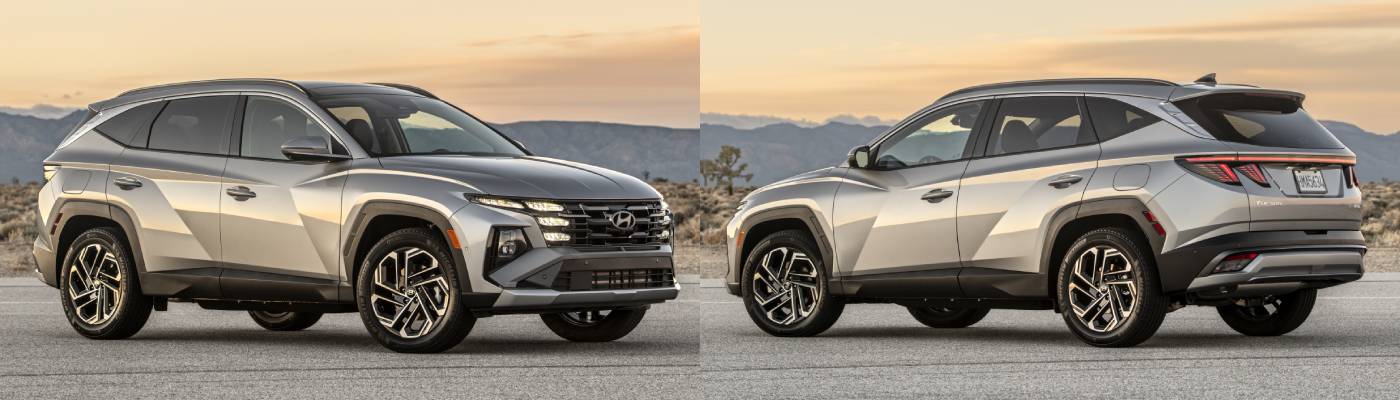
The 2026 Hyundai Tucson is one of the more established players in America's compact-crossover segment. Hyundai first introduced the Tucson to U.S. buyers for the 2005 model year, and the current fourth-generation model arrived for 2022 before receiving a substantial midcycle update for 2025. That refresh brought revised exterior styling, a dramatically reworked dashboard, new displays and controls, and updates to the hybrid powertrains, so changes for 2026 are comparatively modest. The Tucson remains a five-passenger, four-door wagon, offered in conventional gasoline, hybrid and plug-in-hybrid forms. The gasoline lineup consists of SE, SEL, SEL Plus, XRT, SEL Premium and Limited trims; the Hybrid comes in SE, SEL, SEL Convenience and Limited versions; and the Plug-in Hybrid is available as SEL and Limited. Competition is exceptionally strong and includes Chevrolet Equinox, Ford Escape, Honda CR-V, Kia Sportage, Mazda CX-5, Mazda CX-50, Mitsubishi Outlander, Nissan Rogue, Subaru Forester, Toyota RAV4 and Volkswagen Tiguan.
Three distinctly different powertrains make the Tucson unusually broad in scope. Gasoline models use a naturally aspirated 2.5-liter four-cylinder producing 187 horsepower and 178 pound-feet of torque, coupled to an eight-speed automatic transmission. Front-wheel drive is standard and Hyundai's HTRAC all-wheel drive is optional. Hybrid models pair a 178-hp, 195-lb-ft turbocharged 1.6-liter four-cylinder with a 64-hp electric motor and 1.49-kWh lithium-ion battery for combined output of 231 horsepower and 271 pound-feet of torque, driving through a conventional six-speed automatic rather than a continuously variable transmission. For 2026, Hyundai also offers front-drive versions of the lower hybrid trims, while AWD is standard on the upper versions. The Plug-in Hybrid uses the same basic turbocharged engine but adds a stronger 97-hp electric motor and 13.8-kWh battery, raising combined output to 268 horsepower and 271 pound-feet. It uses the six-speed automatic and comes exclusively with HTRAC AWD. Properly equipped, the gasoline Tucson can tow 2,750 pounds with trailer brakes, while Hybrid and Plug-in Hybrid models are rated at 2,000 pounds.
Hyundai lists the 2026 gasoline Tucson from roughly $29,000 before destination, with the Limited approaching $40,000 before AWD and fees; Hybrid pricing starts just above $31,000 and stretches beyond $42,000 for the Limited, while the Plug-in Hybrid begins at $40,675. Even lower trims receive a 12.3-inch touchscreen with wireless Apple CarPlay and Android Auto, while upper versions add equipment such as a 12.3-inch digital instrument cluster, panoramic sunroof, Bose premium audio, leather upholstery, heated and ventilated seats, surround-view cameras, Blind-Spot View Monitor and Remote Smart Parking Assist. Hyundai's SmartSense driver-assistance suite provides features including forward-collision avoidance, lane-keeping and lane-following assistance, blind-spot monitoring and Safe Exit Warning, with more sophisticated highway-driving and parking aids available farther up the range. The XRT remains the visually adventurous member of the gasoline family, adding rugged exterior trim and equipment rather than turning the Tucson into a serious trail machine.
PERFORMANCE & ACCELERATION
The standard 2.5-liter engine is the Tucson's weakest link, although "weak" should be considered relative to what has become a surprisingly powerful compact-SUV segment. Its 187 horsepower is perfectly serviceable for commuting, errands and relaxed highway driving, but 178 pound-feet of torque isn't much for a crossover weighing roughly 3,400 to 3,800 pounds and when you load Tucson up with passengers and cargo it becomes downright slow. Around town the engine doesn't feel slow because throttle response is adequate and the eight-speed automatic keeps the engine in a useful part of its powerband. The shortcomings become clearer when merging onto a fast interstate or attempting a short passing maneuver. There simply isn't much reserve thrust, particularly with passengers and cargo aboard. The transmission generally goes about its business unobtrusively.
The 231-hp Tucson Hybrid is a very different vehicle. Its turbocharged engine and electric motor produce 271 pound-feet of combined torque, and the motor fills in the low-rpm response that the naturally aspirated engine lacks. The 0 to 60 MPH time drops from nearly 9 seconds to 6.9 seconds to 60 mph. With the hybrid powertrain Tucson and feels stronger during normal driving and with a full passenger load. Electric torque gives the Hybrid a much stronger initial response, the turbocharged engine takes over as speeds increase, and the six-speed automatic readily downshifts when additional power is requested. The use of a traditional automatic also makes the Tucson feel more conventional than hybrids that send the engine racing through a continuously variable transmission during hard acceleration.
Despite having considerably more horsepower than the standard Hybrid, the plug-in isn't dramatically faster because the 13.8-kWh battery pushes curb weight above 4,100 pounds. Still, immediate electric assistance makes it pleasantly responsive in traffic, and its ability to perform shorter trips without starting the gasoline engine fundamentally changes the driving experience.
FUEL ECONOMY
The regular Tucson burns regular unleaded gasoline and carries a 14.3-gallon tank. Front-drive models are EPA rated at 25 mpg city, 33 highway and 28 combined; AWD versions return 24/30/26 mpg. Based simply on highway EPA mileage and tank capacity, the theoretical highway cruising range is about 472 miles for FWD and 429 miles for AWD, although actual usable range will be lower because vehicles maintain a fuel reserve. Real-world economy is reasonably close to those figures when the Tucson is driven gently, but the naturally aspirated engine must work fairly hard when accelerating, climbing grades or carrying a full load. That makes mileage more sensitive to driving style than the modest power output might suggest. Drivers spending most of their time in stop-and-go suburban traffic should therefore give the Hybrid serious consideration.
Hybrid economy depends on trim and drivetrain. The most efficient front-drive versions are EPA rated as high as 40 mpg city, 35 highway and 38 combined, while the most efficient AWD version achieves 38/38/38. Heavier, more richly equipped AWD hybrids are rated around 36 city, 37 highway and 36 combined. The Hybrid has a 13.7-gallon fuel tank, and Hyundai quotes total range as high as 520 miles, dropping to about 493 miles on some configurations. Regular unleaded is specified. Real-world results require some qualification. Hybrids typically deliver their biggest advantage in urban and suburban driving where regenerative braking and low-speed electric assistance can repeatedly recover energy. Sustained high-speed highway operation eliminates much of that advantage. Owners driving at lower speeds or doing more city mileage may see considerably better results, so the EPA combined figure is more representative of mixed driving than that single high-speed test.
The Plug-in Hybrid uses regular gasoline, an 11.1-gallon tank and a 13.8-kWh battery. The EPA rates it at 32 miles of electric range, 77 MPGe combined while accounting for electric operation and 35 mpg city/highway/combined after the battery's usable charge is depleted. Hyundai lists total gasoline-plus-electric range at 388 miles. A Level 2 connection can recharge the battery in roughly two hours. The PHEV's real-world fuel economy is almost entirely dependent on charging behavior. Someone with a 15-mile commute and convenient overnight charging could go months without using much gasoline. Someone who rarely plugs it in effectively carries several hundred pounds of battery around while getting roughly 35 mpg. The PHEV makes the most sense when its electric capability is actually used.
ALL-WHEEL-DRIVE & DRIVE MODES
Hyundai's HTRAC AWD is an electronically controlled system that automatically varies torque distribution as traction and driving conditions change. Gasoline Tucsons offer it as an option, while it is standard on the Plug-in Hybrid and available or standard depending on Hybrid trim. It is important to note that Hyundai's AWD system has a traditional mechanical connection between the engine and rear wheels, while some other compact crossovers offer through-the-road all-wheel-drive via an electric motor on the rear axle. Providing a mechanical connection between the engine and rear wheels, while slightly less efficient is more robust and reliable. Gas models provide Normal, Sport and customizable My Drive settings, with Snow available on AWD versions; hybrids add powertrain-specific calibration and adjustable regenerative braking through steering-wheel paddles. AWD gasoline models provide 8.3 inches of ground clearance versus 7.1 inches for FWD. The XRT looks considerably tougher with unique body trim and off-road-inspired styling, and AWD versions gain Terrain Mode functionality, but there are no low-range gears, locking mechanical differentials or major suspension modifications. It is better viewed as a Tucson optimized for dirt roads, snow and outdoor recreation than as a purpose-built off-roader.
RIDE QUALITY
Comfort is one of Tucson's strongest dynamic attributes. Hyundai uses independent MacPherson struts up front and a multi-link rear suspension throughout the lineup, and the tuning emphasizes compliance rather than sporting stiffness. Broken pavement generally produces a muted response rather than a sharp impact, while longer highway undulations are absorbed without excessive secondary motion.
Wheel and tire selection matters. Lower trims with taller tire sidewalls provide the softest impact absorption, while the larger wheels fitted to upper models transmit slightly more road texture. The XRT feels less settled, so buyers attracted by its tougher appearance should test-drive it rather than assuming it rides exactly like an SEL or Limited.
The heavier hybrids feel especially planted. Their additional mass helps take the edge off small impacts, and the battery weight lowers the sensation of body movement. The Plug-in Hybrid is heavier still and remains comfortable, although its additional weight becomes noticeable over larger dips and during abrupt directional changes.
HANDLING & ROADHOLDING
Nobody is likely to confuse a Tucson with a Mazda CX-50 on a winding road, but Hyundai has found a sensible balance between comfort and control. Steering effort is light enough for easy parking yet direct enough that the Tucson doesn't feel disconnected at highway speeds. Body lean is present but progressive. Push into a corner and the Tucson reminds you that comfort was the primary engineering objective, yet it doesn't wallow or require constant correction. The Hybrid is arguably the most satisfying version because the extra power makes corner exits and passing maneuvers easier without undermining ride comfort.
Braking performance is predictable, and the hybrids do a commendable job blending regenerative and friction braking. That transition can be awkward in some electrified vehicles, but the Tucson Hybrid offers strong brakes and smooth blending between its power sources.
INTERIOR NOISE
Cabin isolation is another area where the Tucson punches above its price. Tire and suspension noise are well controlled, and at steady cruising speeds the gasoline engine settles into the background. Tucson's quiet, refined highway demeanor gives it an unexpectedly upscale character. The standard engine becomes considerably more vocal when asked for maximum acceleration, partly because it needs high rpm to produce meaningful power. The Hybrid improves matters during light driving because it can operate briefly on electric power, although the turbocharged engine remains audible when called upon.
Against the Honda CR-V, Toyota RAV4, Subaru Forester and Nissan Rogue, the Tucson belongs among the quieter entries in the segment. The difference isn't dramatic enough to redefine the class, but its combination of low road noise, controlled suspension impacts and subdued drivetrain behavior gives it a mature highway personality.
INTERIOR DESIGN & MATERIALS
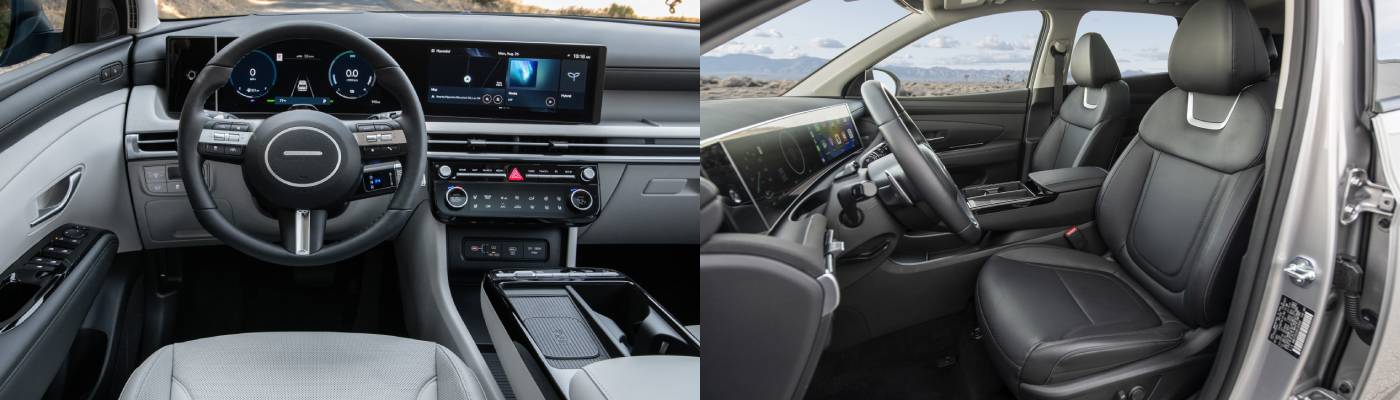
The Tucson's interior got a huge upgrade in the 2025 redesign that corrected several usability shortcomings without sacrificing visual appeal. The broad horizontal dashboard incorporates a standard 12.3-inch infotainment display and, on better-equipped versions, a similarly sized digital instrument panel, creating the appearance of a continuous panoramic display. Materials are appropriately upscale for the segment rather than genuinely luxurious. Soft-touch surfaces appear where occupants interact with the cabin most often, while harder plastics are relegated mostly to lower areas. Higher trims gain leather upholstery and additional decorative trim, and the Limited comes surprisingly close to entry-luxury territory in appearance.
Hyundai also provides useful distinctions among trims. Buyers don't need the Limited simply to obtain an attractive cabin. While the Limited adds enough genuine upgrades like ventilated front seats, leather, additional cameras and technology, you still get high-quality soft-touch surfaces in lower trims.
INTERIOR FUNCTIONALITY
Functionality improved dramatically with the Tucson's 2025 dashboard revision. Hyundai had previously embraced touch-sensitive controls too enthusiastically. The newer cabin restores physical knobs for frequently used audio and climate functions while retaining the large central touchscreen. That matters more in daily use than another inch of screen size. Temperature, fan speed and audio adjustments can be made with less time spent looking away from the road. Wireless Apple CarPlay and Android Auto are available through the 12.3-inch touchscreen, and the system's menu structure is generally straightforward.
Storage is another strength. The center console provides multiple places for phones and small objects, the door pockets are useful, and moving the transmission selector away from the console on some versions frees additional usable space.
TECHNOLOGY & SAFETY
The standard 12.3-inch touchscreen gives even inexpensive Tucsons a modern interface, with wireless Apple CarPlay and Android Auto eliminating the cable clutter once associated with smartphone integration. Higher trims can pair that screen with a 12.3-inch digital instrument cluster, while available equipment includes navigation, Bose premium audio, Hyundai Digital Key and wireless device charging.
Hyundai's camera technology is particularly useful. Blind-Spot View Monitor displays a camera image of the appropriate blind spot in the instrument cluster when the turn signal is activated, while Surround View Monitor provides a stitched overhead image that makes maneuvering in confined spaces much easier. Remote Smart Parking Assist can move suitably equipped Limited models into or out of tight parking spaces while the driver stands outside.
Driver assistance includes forward-collision avoidance, lane-keeping assistance, lane-following assistance, driver-attention monitoring, blind-spot collision warning and Safe Exit Warning, with adaptive cruise control and more sophisticated highway assistance offered depending on trim. Edmunds found the adaptive cruise system smooth and useful but noted that the lane-keeping assistance can occasionally feel intrusive.
PASSENGER SEATING
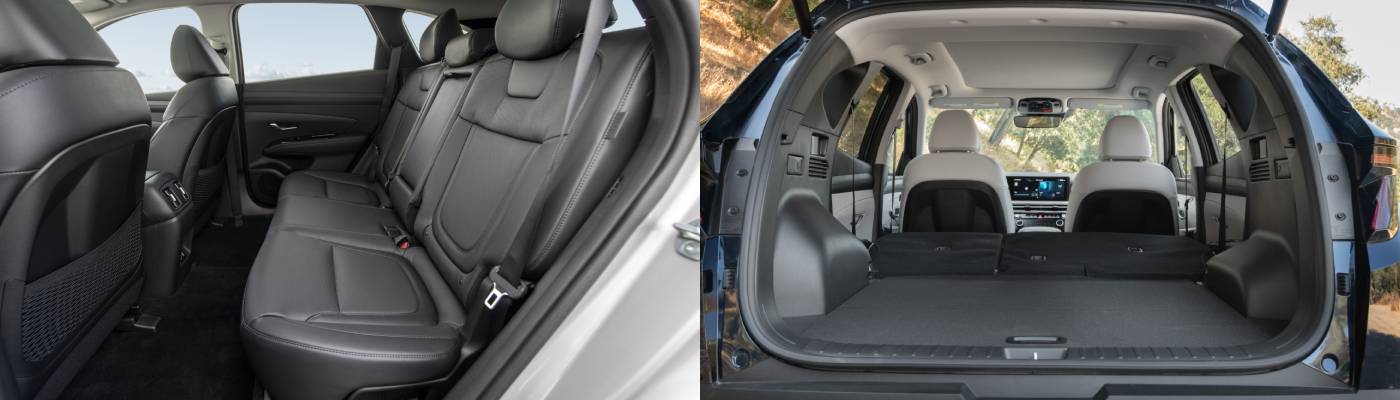
Every Tucson seats five in two rows. There is no third row, which allows Hyundai to devote its 108.5-inch wheelbase almost entirely to passenger and cargo space. Gasoline models provide an impressive 41.4 inches of front legroom and 41.3 inches in the rear. That's an unusually generous rear-seat figure for a compact SUV and allows tall adults to sit comfortably behind tall front occupants. Front headroom reaches 40.1 inches on versions without the space-consuming panoramic roof, while shoulder room measures 57.6 inches front and 56.0 inches rear. The conventional Hybrid retains essentially the same passenger accommodations, including 41.3 inches of rear legroom. The Plug-in Hybrid's battery packaging reduces rear legroom to 39.5 inches, still enough for adults but noticeably less generous than the standard and regular Hybrid versions.
Large door openings and a reasonable step-in height make entry and exit easy. Edmunds praised the Hybrid's generous passenger space and noted that its back seat can accommodate bulky rear-facing child seats without forcing front occupants dramatically forward. Rear seatbacks also recline, an underappreciated advantage on longer trips.
CARGO CAPACITY & STORAGE
Cargo room is one of Tucson's major practical advantages. Gasoline versions provide 41.2 cubic feet behind the second row and as much as 80.3 cubic feet with the rear seat folded using Hyundai's maximum-volume measurement.
The conventional Hybrid gives up remarkably little space. Hyundai lists 38.7 cubic feet by the SAE method, or 41.2 cubic feet maximum, behind the rear seat and 74.5 SAE/80.0 maximum with the seats folded. The battery therefore imposes almost no meaningful everyday cargo penalty.
The Plug-in Hybrid is a different story. The larger battery reduces cargo volume to 31.9 cubic feet behind the rear seat and 66.3 cubic. Rear legroom also decreases, making passenger and cargo packaging the most obvious compromises involved in choosing the PHEV.
Interior storage is plentiful, with a large center-console area, door pockets, cupholders and multiple small-item spaces distributed throughout the cabin. USB charging connections are provided for front and rear passengers on appropriately equipped trims, while upper versions add wireless phone charging. The result is a cabin designed around families carrying phones, tablets, bottles, bags and all of the other clutter that inevitably follows a compact SUV around.
BOTTOM LINE
The 2026 Hyundai Tucson succeeds because it doesn't depend on a single headline feature. It is spacious without being oversized, comfortable without feeling sloppy, technologically sophisticated without frequent trips to the owner's manual, and distinctive without becoming impractical. Passenger room is excellent, cargo capacity is among its strongest attributes, the suspension is unusually compliant, and the refreshed interior solves many of the usability complaints associated with the earlier dashboard. Its primary weakness is the standard 2.5-liter engine. With roughly nine seconds required to reach 60 mph in many tests, it is adequate rather than energetic, and shoppers frequently merging into fast traffic may find themselves wishing they had selected the Hybrid. The PHEV adds genuine short-distance electric capability, but its higher price, greater weight and reduced cargo space mean its advantages depend heavily on regular access to charging.
The regular Tucson Hybrid offers a compelling middle ground. Its 231 horsepower transforms acceleration, its electric assistance improves around-town response, and fuel economy can approach the high 30s without requiring the owner to plug anything in. Just as importantly, it retains virtually all the Tucson's outstanding passenger and cargo space. Against the Honda CR-V Hybrid, Kia Sportage Hybrid, Toyota RAV4 Hybrid and other electrified compact SUVs, its strongest argument isn't necessarily class-leading efficiency but the combination of performance, comfort, equipment, room and value. For buyers prioritizing price, the gasoline SEL and SEL Plus remain sensible choices, but the Tucson Hybrid SEL Convenience arguably represents the lineup's most appealing intersection of power, economy, technology and everyday equipment without climbing all the way to Limited pricing.