2026 Hyundai Santa Cruz
Crossover comfort meets pickup utility in a tidy package that thinks big.
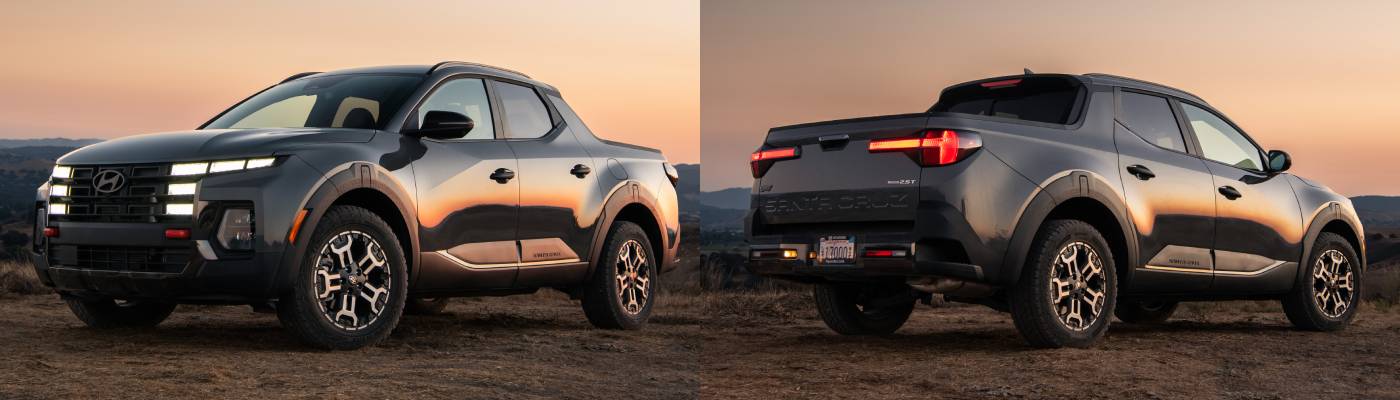
Blending the passenger compartment, road manners and unibody construction of a compact crossover with the open cargo bed of a pickup, the Hyundai Santa Cruz is an extremely unique and niche vehicle. Introduced for the 2022 model year, the Santa Cruz was Hyundai's first pickup-style vehicle offered in the United States, and it remains unusual even several years into its run. A substantial refresh arrived for 2025, bringing revised exterior styling, a redesigned dashboard and updated technology. Every Santa Cruz comes exclusively as a four-door, five-passenger crew-cab pickup with a 52.1-inch bed; there are no extended-cab, long-bed or two-door alternatives. Its most direct competitors are the Ford Maverick and Honda Ridgeline, although the larger Chevrolet Colorado, Ford Ranger, GMC Canyon, Nissan Frontier and Toyota Tacoma inevitably enter the conversation for shoppers willing to consider a conventional body-on-frame midsize truck.
The 2026 lineup consists of SE, SEL, SEL Activity, XRT and Limited trim levels. SE, SEL and SEL Activity models use a naturally aspirated 2.5-liter four-cylinder producing 191 horsepower at 6,100 rpm and 181 pound-feet of torque at 4,000 rpm. It is connected to an eight-speed automatic, with front-wheel drive standard and Hyundai's HTRAC all-wheel drive available. XRT and Limited versions get the much stronger turbocharged 2.5-liter four-cylinder, rated at 281 horsepower at 5,800 rpm and 311 pound-feet from 1,700 through 4,000 rpm. For 2026 that engine is paired with the new conventional eight-speed automatic, and HTRAC AWD is standard. Properly equipped, naturally aspirated Santa Cruz models can tow up to 3,500 pounds, while the turbocharged XRT and Limited raise maximum towing capacity to 5,000 pounds.
Pricing begins at $29,750 for the SE, followed by $31,400 for SEL, $34,450 for SEL Activity, $41,350 for XRT and $43,700 for Limited. Even the SE includes a 12.3-inch touchscreen, wireless Apple CarPlay and Android Auto, LED lighting and a surprisingly useful assortment of bed-storage features. SEL adds conveniences including H-Tex leatherette upholstery, heated front seats, a power driver's seat and dual-zone automatic climate control. SEL Activity is arguably where the Santa Cruz's unusual concept comes fully into focus, adding the integrated tonneau cover, 12.3-inch digital instrument cluster, wireless phone charging, sunroof, bed utility-track system and a 115-volt bed outlet. XRT combines the turbo engine and standard AWD with all-terrain tires, terrain modes, distinctive cladding and exposed front tow hooks, while Limited moves toward luxury with leather upholstery, heated and ventilated front seats, a Bose audio system, heated steering wheel, 20-inch wheels and additional driver-assistance technology.
ENGINE PERFORMANCE
There are really two different personalities hiding beneath the Santa Cruz's hood, and the choice of engine changes the character of the vehicle more dramatically than the trim names might suggest.
The standard 2.5-liter four-cylinder is a sensible choice rather than an entertaining one. Its 191 horsepower sounds respectable for a compact vehicle, but the Santa Cruz weighs roughly 3,800 pounds before passengers or cargo are added, and 181 pound-feet of torque isn't especially generous for something expected to perform pickup duties. Around town, performance is perfectly adequate. Throttle response is predictable and the conventional eight-speed automatic does a reasonable job of keeping the engine in its productive range. Once highway speeds, steep grades, passengers or a trailer enter the picture, however, the engine has to work considerably harder. Full-throttle acceleration also brings more engine noise into the cabin. For buyers primarily interested in commuting, occasional home-improvement runs and light recreational use, though, its performance is entirely workable.
The turbocharged 2.5-liter transforms Santa Cruz. With 281 horsepower and, more importantly, 311 pound-feet of torque available from just 1,700 rpm, it provides the low- and midrange muscle the chassis deserves. The turbo's biggest advantage isn't necessarily launching from a stop. It is the effortless surge available when merging onto an expressway or passing slower traffic. Maximum torque arrives low enough in the rev range that the Santa Cruz responds without requiring the driver to wring out the engine.
The move away from the dual-clutch transmission may prove especially worthwhile in everyday driving. A DCT can shift very quickly, but can shift abruptly during low-speed maneuvering because a dual-clutch unit fundamentally engages clutches rather than relying on a conventional torque converter. Hyundai's switch to a traditional eight-speed automatic for 2026 should favor smoother creeping, parking and trailer maneuvering, even if ultimate shift speed is less aggressive. For a vehicle intended to mix commuting with pickup duty, that is a logical trade.
FUEL ECONOMY
The naturally aspirated Santa Cruz is considerably more economical than its turbocharged stablemate. For 2026, the 2.5-liter SE, SEL and SEL Activity are EPA-rated at 22 mpg city, 30 highway and 25 combined with front-wheel drive. Adding HTRAC AWD changes those figures only slightly, to 21 city, 29 highway and 24 combined. All versions have a 17.7-gallon fuel tank and run on gasoline. Multiplying the EPA highway figure by tank capacity produces a theoretical highway range of approximately 531 miles for a FWD model and 513 miles for an AWD model, although actual usable range will be lower because drivers normally refuel before consuming every gallon.
The turbo is the price paid for turning Santa Cruz into a genuinely quick little truck. XRT and Limited models are AWD only and are rated at 18 mpg city, 25 highway and 20 combined. With the same 17.7-gallon tank, the EPA highway rating translates mathematically to roughly 443 miles of theoretical highway travel.
Real-world economy naturally depends heavily on speed, weather, traffic and how frequently that turbocharger is called upon. In mixed driving, especially with frequent boost, expect consumption to be considerably less impressive. The naturally aspirated engine is the rational choice for buyers prioritizing fuel cost; the turbo is the choice for buyers willing to exchange several mpg for substantially better acceleration and towing performance.
ALL-WHEEL-DRIVE & OFF-ROAD CAPABILITY
Hyundai's HTRAC all-wheel-drive system is optional on SE, SEL and SEL Activity and standard with the turbocharged XRT and Limited. Rather than turning Santa Cruz into a traditional low-range off-road pickup, HTRAC is primarily intended to improve traction and distribute power between the axles as conditions require. The XRT is the adventurous member of the family. For 2026 it gains Terrain Mode Select with Snow, Mud and Sand settings and combines that software with 18-inch wheels wearing all-terrain tires, XRT-specific exterior cladding and exposed front tow hooks. It is important to keep expectations realistic: there is no two-speed transfer case or locking rear differential, so the Santa Cruz XRT isn't a substitute for a purpose-built off-road Tacoma or Colorado. Its strengths are dirt roads, snow, campsites and moderate trails rather than rock crawling. The independent suspension and crossover-derived construction pay dividends during the other 95 percent of driving.
RIDE QUALITY
Ride comfort is one of the Santa Cruz's defining advantages over conventional compact and midsize pickups. Its architecture employs independent MacPherson struts in front and an independent multi-link arrangement at the rear, along with a self-leveling rear suspension across the lineup. That is a fundamentally different recipe from the solid rear axles still found under many traditional trucks.
The result is a ride that behaves much more like a crossover than an old-fashioned pickup. There is less of the empty-bed hopping and shudder that can characterize body-on-frame trucks on broken pavement. The suspension has enough firmness to keep Santa Cruz from feeling floaty, but ordinary expansion joints, pavement seams and moderate potholes are generally absorbed without sending an impact through the passenger compartment.
Wheel choice matters. SE, SEL and SEL Activity use 18-inch wheels, and the XRT also employs 18s but combines them with all-terrain tires. Limited rides on 20-inch wheels. The smaller wheel-and-tire combinations provide more sidewall to absorb sharp impacts, while the Limited's 20-inch setup trades some compliance for appearance and more immediate responses. The XRT's all-terrain tires can introduce a little more texture and tire noise, but its taller sidewalls are preferable to ultra-low-profile rubber when pavement becomes rough.
HANDLING & ROADHOLDING
The same architecture responsible for the Santa Cruz's comfortable ride gives it unusually composed handling for a pickup. The relatively low center of gravity, fully independent suspension and compact dimensions make it easier to place on a winding road than most traditional trucks. Body lean is present, but it develops progressively rather than making the Santa Cruz feel top-heavy.
Steering is electrically assisted and prioritizes accuracy and manageable effort over detailed road feedback. It isn't a sports car steering rack, yet response is quick enough that the Santa Cruz feels considerably more eager to change direction than its pickup profile suggests. Its 39.6-foot curb-to-curb turning diameter is also manageable in parking lots and urban environments.
Like other unibody pickups, however, Santa Cruz gets a little unsettled when there's a heavy payload in the cargo bed. The steering become overly light and braking distances increase. In addition, ride quality suffers a bit as the front tends to bound over bumps while the rear stays more planted.
INTERIOR NOISE LEVELS
The Santa Cruz benefits from its crossover origins in refinement as well. At normal suburban speeds, engine, suspension and wind noise are reasonably well isolated, and the structure doesn't produce the secondary shake sometimes encountered in body-on-frame pickups. The naturally aspirated engine becomes noticeably more vocal when asked for maximum acceleration because it needs more revs to generate useful power. The turbo engine's abundant low-rpm torque means it generally doesn't have to work as hard during normal acceleration.
INTERIOR DESIGN & MATERIALS
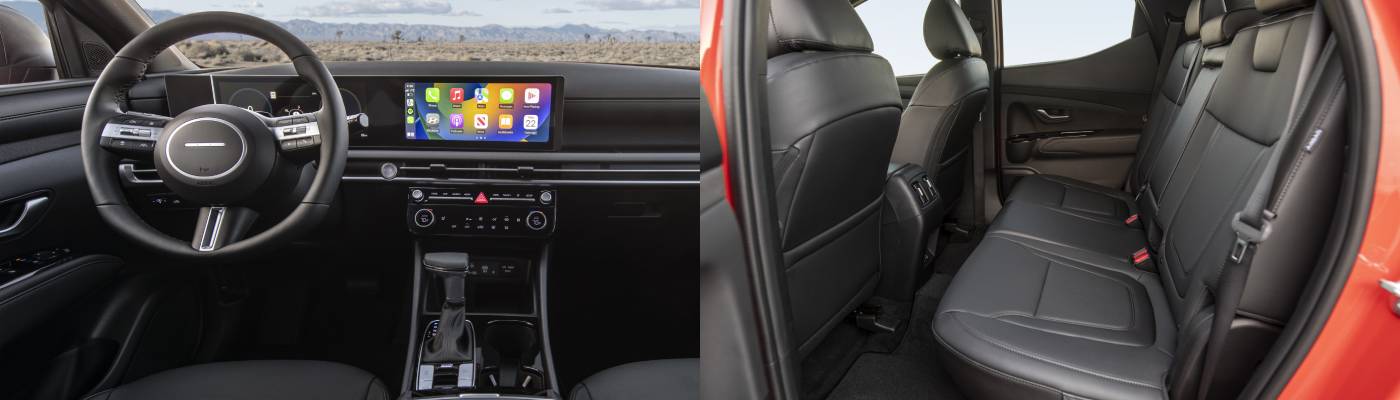
Open the Santa Cruz's doors and its Tucson relationship becomes much more obvious than its pickup bed. The cabin is shaped and finished more like a contemporary Hyundai crossover than a work truck. That is largely complimentary. The dashboard has a wide horizontal orientation, and the latest design integrates the instrument and infotainment areas in a way that makes the cabin appear broader and more modern.
Material quality depends considerably on trim. The SE has stain- and odor-resistant cloth upholstery, SEL and SEL Activity move to H-Tex leatherette, XRT gets black H-Tex with distinctive branding, and Limited receives genuine leather seating surfaces. Some harder plastics remain, especially lower in the cabin where durability matters, but the important touch points are generally well chosen.
SEL is a meaningful upgrade because it adds an eight-way power driver's seat with lumbar adjustment and heated front seats. SEL Activity brings the 12.3-inch digital instrument panel, while XRT adds a leather-wrapped wheel and shifter and its own visual treatment. Limited makes the largest leap toward a premium crossover with leather, heated and ventilated front seats, a power passenger seat, driver-seat memory, heated steering wheel, 64-color ambient lighting and Bose premium audio.
That breadth is part of the Santa Cruz's appeal. A base truck can be relatively straightforward, while a Limited feels less like a commercial vehicle with luxury options added and more like a well-equipped crossover that happens to have a bed.
INTERIOR FUNCTIONALITY
Hyundai's recent interiors generally balance large screens with familiar controls reasonably well, and the Santa Cruz follows that philosophy. Every model receives a large 12.3-inch center touchscreen, which prevents the base SE from feeling technologically stripped. Wireless Apple CarPlay and Android Auto are standard throughout the range.
SE and SEL retain a smaller 4.2-inch gauge display, while SEL Activity, XRT and Limited receive a 12.3-inch digital instrument cluster. XRT and Limited add integrated navigation, Digital Key 2 Touch and additional connected functionality. The broad displays are easy to read, and Hyundai's menu organization is generally logical enough that routine operations don't require excessive digging.
One ergonomic decision deserves mention: Hyundai retained a conventional center-console gear selector. That may sound mundane, but in a vehicle that could frequently require quick shifts between Drive and Reverse while parking, maneuvering a trailer or positioning near a loading area, a familiar physical shifter has practical value.
There are some compromises. The climate-control interface incorporates capacitive-touch controls on most upper trims rather than relying exclusively on traditional knobs and switches. Those controls create a clean dashboard but are less satisfying to operate by feel while driving. Santa Cruz nevertheless avoids the increasingly common mistake of forcing virtually every vehicle function into one touchscreen.
TECHNOLOGY & SAFETY FEATURES
Technology content is unusually generous from the bottom of the lineup. The standard 12.3-inch touchscreen includes wireless smartphone integration, HD Radio, Bluetooth and Hyundai's Bluelink+ connected services. SEL Activity and above add wireless device charging, while XRT and Limited receive navigation, a 12.3-inch digital gauge cluster and Hyundai Digital Key 2 Touch. Limited alone receives the Bose premium audio system.
Safety equipment is equally comprehensive. All trims include Blind-Spot Collision Warning, Lane Keeping Assist, Lane Following Assist, Driver Attention Warning, High Beam Assist and Rear Cross-Traffic Collision-Avoidance Assist. SE, SEL and SEL Activity use Forward Collision-Avoidance Assist with pedestrian detection. XRT and Limited receive a more advanced version incorporating pedestrian, cyclist and junction-turning detection.
The upper trims make another significant step. XRT and Limited include Smart Cruise Control with Stop & Go, navigation-based cruise control with curve control, Highway Driving Assist, Blind-Spot View Monitor and Surround View Monitor. The Blind-Spot View Monitor is especially useful: activating a turn signal places a camera image of the corresponding blind spot into the instrument display. Surround View Monitor is similarly valuable because a pickup often gets maneuvered close to trailers, garage walls, loading docks or other objects.
PASSENGER SEATING
Every Santa Cruz offers two seating rows, four conventional doors and seating for five. There is no regular-cab configuration and no third row. Front-seat accommodations are generous. Hyundai specifies 41.4 inches of front legroom and as much as 40.2 inches of front headroom without the sunroof. The seating position strikes a useful compromise between the upright posture of a truck and the lower, more natural relationship between seat, pedals and steering wheel found in a crossover. Entry is correspondingly easy because passengers don't have to climb as far upward as they would in many body-on-frame pickups.
The rear seat is the more significant compromise. Official numbers peg rear legroom at 36.5 inches, but, honestly, it feels quite cramped. Adults can fit, but taller passengers sitting behind tall front occupants will notice that this isn't a full-size crew cab. The back seat works well for children and is entirely usable for adults on normal trips, but buyers regularly carrying four tall adults should compare it carefully with larger pickups, particularly the roomier Honda Ridgeline.
Hyundai makes clever use of the area beneath the rear seat. The 60/40-split lower cushions tip upward, opening the floor area for additional cargo and providing useful interior space for items owners don't want exposed in the bed. That ability becomes particularly valuable in a pickup with a relatively short cab and bed.
CARGO CAPACITY & STORAGE
The Santa Cruz's cargo story cannot be described adequately with one cubic-foot number. The bed itself holds 27.0 cubic feet and measures 52.1 inches long, 53.9 inches across at its widest point and 42.7 inches between the wheel housings. Bed depth is 19.2 inches. Maximum vehicle load capacity is listed at 1,411 pounds.
A 52.1-inch bed is obviously short compared with a conventional pickup's five- or six-foot box, and buyers regularly hauling construction materials or large motorcycles may find it restrictive. Hyundai compensates by making unusually creative use of the space it does provide.
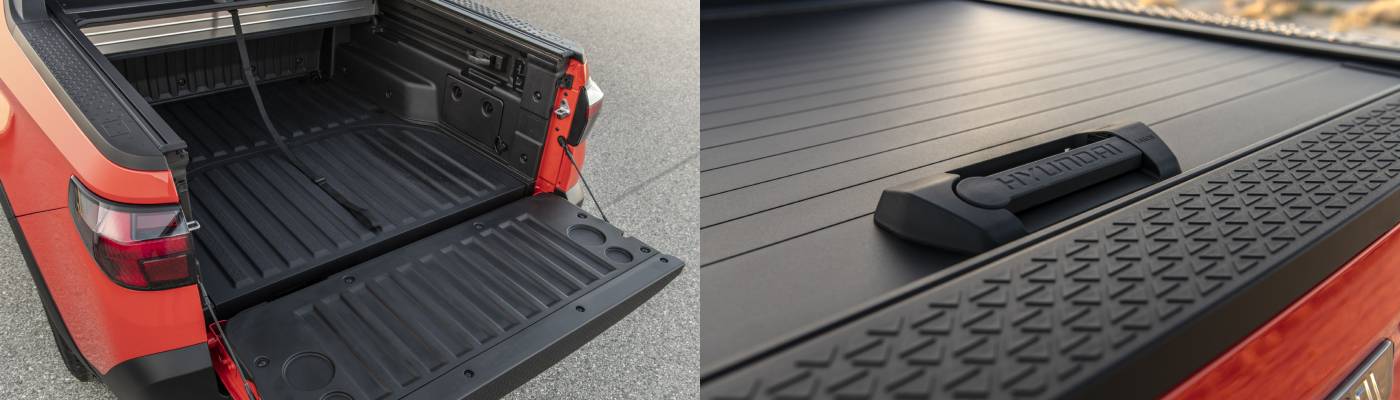
Every Santa Cruz gets a sheet-molded composite bed, heavy-duty D-rings, sidewall storage compartments, a lockable under-bed storage compartment, assisted multifunction tailgate, integrated bumper steps and remote tailgate release. The under-bed compartment is particularly useful because it creates a concealed area for tools, wet equipment, groceries or valuables and has a floor drain.
SEL Activity, XRT and Limited turn the bed into something considerably more sophisticated. They include a factory-installed integrated tonneau cover with T-slot utility tracks, a dual C-channel adjustable rail-and-cleat system, LED bed lighting, a rear sliding window and a 115-volt AC outlet in the bed. The tonneau system makes an important difference because it allows the bed to function more like a weather-protected trunk when closed while retaining the ability to carry tall or dirty cargo when opened.
Inside, there are two front and two rear USB-C ports on appropriately equipped versions such as SEL Activity, and the rear seat cushions fold upward rather than folding flat in the traditional SUV sense. Consequently, there isn't an SUV-style "cargo capacity behind the first and second rows" measurement to report. Instead, owners choose between protected interior storage beneath and around the rear seats and the substantially more versatile external bed.
BOTTOM LINE
The 2026 Hyundai Santa Cruz makes the most sense when judged for what it actually is rather than for how closely it imitates a conventional pickup. It is comfortable, relatively compact, easy to maneuver and genuinely pleasant to drive, yet its 27-cubic-foot bed can handle dirty, tall or awkward cargo that owners would hesitate to put inside a crossover. The available 281-horsepower turbo makes it genuinely quick, and a 5,000-pound maximum towing rating gives turbo models real utility. Its interior is more sophisticated than those of many similarly priced pickups, while available features such as the integrated tonneau cover, lockable under-bed compartment, 115-volt bed outlet, Blind-Spot View Monitor and Surround View Monitor demonstrate that Hyundai has put considerable thought into how owners might actually use the vehicle. Its weaknesses are equally clear. The back seat isn't enormous, the bed is short, the naturally aspirated engine is merely adequate, and the turbo's 20-mpg EPA combined rating takes some shine off Santa Cruz's compact dimensions. Buyers requiring serious off-road hardware, a long bed or maximum towing capability will still be better served by a conventional midsize pickup.
The Ford Maverick remains an especially important alternative because it attacks the same compact-pickup problem with a more traditional truck shape and offers powertrain choices that can emphasize fuel economy. Like the Maverick, the larger Honda Ridgeline shares Santa Cruz's unibody philosophy and combines it with more passenger and cargo space, but it occupies a larger footprint. The Santa Cruz instead stakes out the sporty, crossover-like end of the spectrum. From a value standpoint, the $34,450 SEL Activity is arguably the sweet spot. It retains the more economical 191-horsepower engine and can be ordered with AWD while adding many of the features that make the Santa Cruz special: the integrated tonneau cover, utility rails, 115-volt bed outlet, sunroof, wireless charging and 12.3-inch digital instrument cluster.